Arlington Heights, Fort Worth
Updated · 4,909 residents
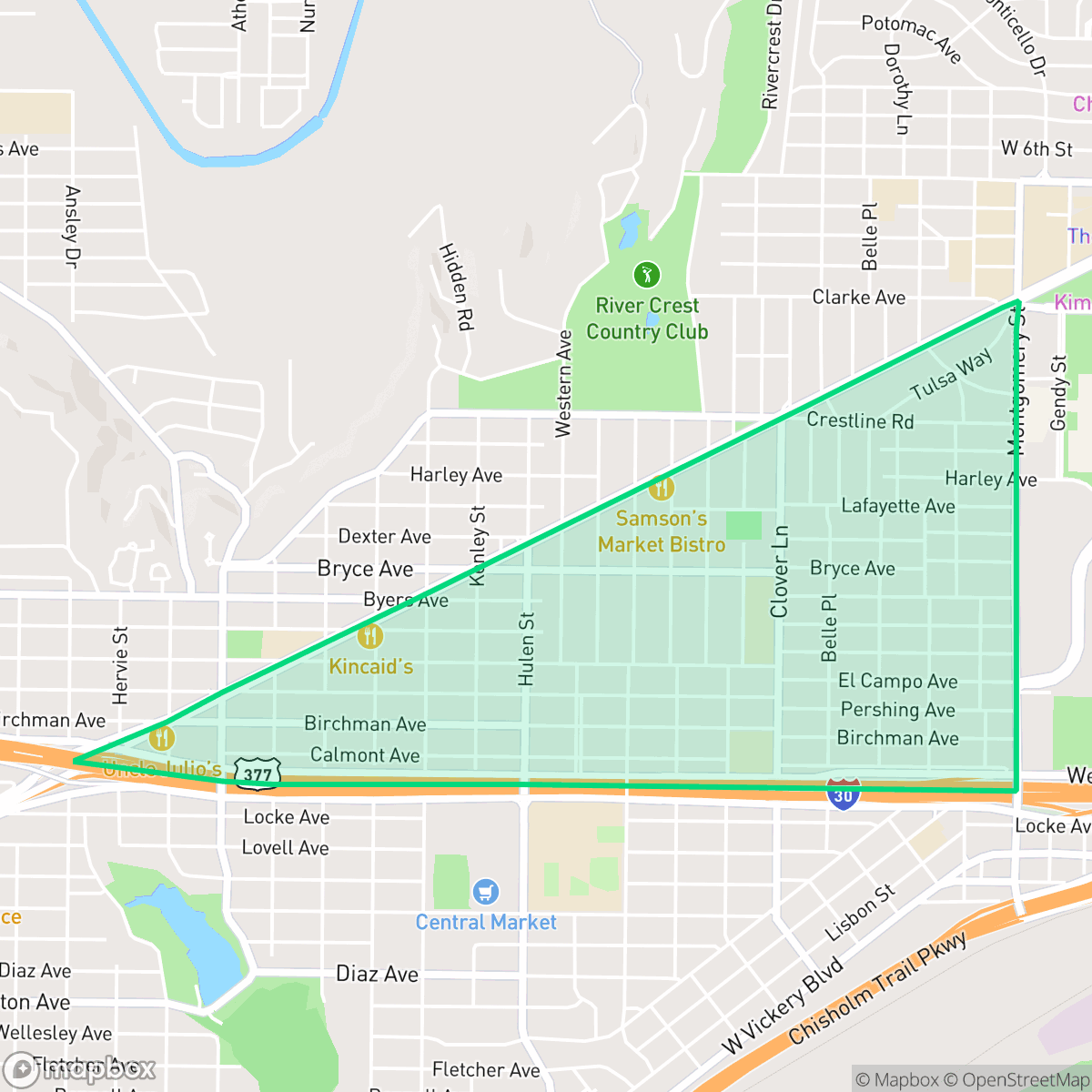
Arlington Heights is a highly walkable neighborhood defined by its historic character and central location along the Camp Bowie Boulevard corridor. While the area offers convenient access to local shops and parks, residents should anticipate notable noise levels from consistent road traffic.
Key Highlights
About Arlington Heights
Initially platted in 1890 by Denver developer H.B. Chamberlin, Fort Worth’s Arlington Heights neighborhood struggled to grow after its centerpiece, the Ye Arlington Inn, burned down in 1894. A lasting remnant of this early era is the 1890 Shingle-style Sanguinet House, built by prominent local architect Marshall R. Sanguinet. The neighborhood’s true boom began during World War I, when the U.S. Army established the Camp Bowie training camp on its open land. The camp's infrastructure spurred rapid residential development in the 1920s and 1930s, filling the neighborhood with Arts and Crafts bungalows and English Cottages. Today, the community is bisected by Camp Bowie Boulevard, a signature thoroughfare paved with historic red brick in 1928 and lined with decades-old local businesses.
The neighborhood functions as a vibrant, high-density residential area that balances historic charm with active commercial corridors. It features a blend of quiet, tree-lined streets and busier zones near major thoroughfares, creating a dynamic environment that supports local galleries, cafes, and specialized retail. Residents benefit from excellent flood safety and high rates of health insurance coverage, which contribute to the overall stability of the local population. The area maintains a unique identity by integrating traditional architecture with modern urban conveniences, making it a focal point for activity within the city. Potential residents should weigh the high walkability and cultural amenities against the acoustic environment, as road traffic noise is a significant factor throughout the area. While the broader school district faces systemic challenges, families may find value in the highly-rated South Hi Mount Elementary. The neighborhood is best suited for those who prioritize proximity to urban conveniences and a strong sense of community over absolute quiet or secluded privacy.
Neighborhood Scores Across 15 Qualities
Residential spacing offers a balanced level of separation between neighbors. According to iHuus data, this degree of privacy is slightly higher than the Fort Worth average.
Pedestrian movement is easy and safe due to wide sidewalks and frequent crossings. According to iHuus data, this level of accessibility is significantly higher than the Fort Worth average.
Large residential properties and frequent upscale amenities contribute to a visual environment that is more polished than the Fort Worth average, according to iHuus data.
Connected green spaces and wide paths offer safe environments for walking pets away from traffic. According to iHuus data, this accessibility is slightly above the Fort Worth average.
Open land and scattered homes characterize the landscape, though some areas feature a dense mix of commercial use and large parkland. This balance of fields and woodland is slightly less developed than the Fort Worth average according to iHuus data.
A high concentration of diverse dining, art galleries, and social hubs provides a level of activity significantly higher than the Fort Worth average. While certain pockets near major highways feature industrial elements, many blocks offer a lively mix of suburban greenery and accessible local destinations.
Frequent noise from nearby highways and railroad tracks characterizes this area. According to iHuus data, acoustic comfort is lower than the Fort Worth average.
Air quality fluctuates between acceptable and unhealthy levels, though conditions remain slightly better than the Fort Worth average. Sensitive groups should monitor local air quality reports according to iHuus data.
Industrial facilities and warehouses are absent from this area, making it notably more residential than the Fort Worth average. According to iHuus data, the neighborhood consists of quiet streets and green spaces, though a nearby rail yard and highway interchange may introduce some noise.
Health insurance access is notably higher here than the Fort Worth average, according to iHuus data. Most residents in this area have established medical coverage.
Political leanings in this area are roughly evenly split between conservative and liberal perspectives. According to iHuus data, this reflects a more moderate ideological landscape than the Fort Worth city average.
A diverse range of age groups resides here, providing a more balanced age distribution than the Fort Worth average. This variety of young adults, families, and seniors creates a demographically varied community according to iHuus data.
Flood risk in this area is notably higher than the Fort Worth average, though a lack of detailed FEMA studies means the specific level of danger remains undetermined. Residents should exercise caution as current assessments do not provide a definitive profile of flood vulnerability for this neighborhood.
Address-Level Insights for Arlington Heights


iHuus Neighborhood Intelligence Insights
Get address-level neighborhood insights for Arlington Heights
- Street-level scores — see how individual blocks compare, not just neighborhood averages
- Micro-zone boundaries — identify quiet pockets, flood boundaries, and walkable clusters before you visit
- 15 dimensions in full — walkability, noise, air quality, school quality, insurance coverage, population age profile, urban/rural index, and more
- Boundary risk alerts — know if your address sits near a block boundary where scores drop, the kind of detail no listing will ever mention
- School insights — individual school ratings and insights, not just district-level data
- Compare before you commit — side-by-side data across neighborhoods, down to block precision
No credit card required
Compare with Any Neighborhood
| Dimension | Arlington Heights | Alamo Heights |
|---|---|---|
| 🚶 Walkabilityavg 7.5 | ||
| 🔊 Acoustic Comfortavg 4.12 | ||
| 🤫 Privacy Indexavg 5.64 | ||
| 🎨 Visual Appealavg 6.38 | ||
| 🐕 Dog Friendlinessavg 6.57 | ||
| 🗺️ Urban-Rural Indexavg 6.92 | ||
| ✨ Neighborhood Vibeavg 4.56 | ||
| 🏥 Health Insurance Coverageavg 5.8 | ||
| 🌿 Air Qualityavg 3.68 | ||
| 🏭 Industrial Proximityavg 8.13 | ||
| 🌊 Flood Safetyavg 3.61 | ||
| 🗳️ Ideological Leanavg 5.62 | ||
| 👥 Population Age Profileavg 4.51 | ||
| 🔥 Fire Safety | ||
| 🏫 School Quality |
Arlington Heights Rankings
School Districts Serving Arlington Heights
School Insights for Arlington Heights
Below average outcomes; significant attendance and academic challenges.
School Insights
See what's really behind every school rating near Arlington Heights
- Individual school ratings — each school's own score with outcome context, not just a district average
- Enrollment & class size data — student-to-teacher ratio and how it compares to the state average
- Full demographics breakdown — ethnicity and gender composition for every school in the enrollment zone
- Every school in the district — all schools within the enrollment boundary ranked by rating, not just the closest one
- Grade levels & benchmarks — elementary through high school, with below/above state-average flags
No credit card required