Alamo Heights, Fort Worth
Updated · 2,319 residents
Alamo Heights is a highly walkable Fort Worth neighborhood that balances suburban residential streets with immediate access to diverse dining corridors. While the area offers exceptional convenience for pedestrians, residents should be prepared for significant ambient noise from nearby highway traffic.
Key Highlights
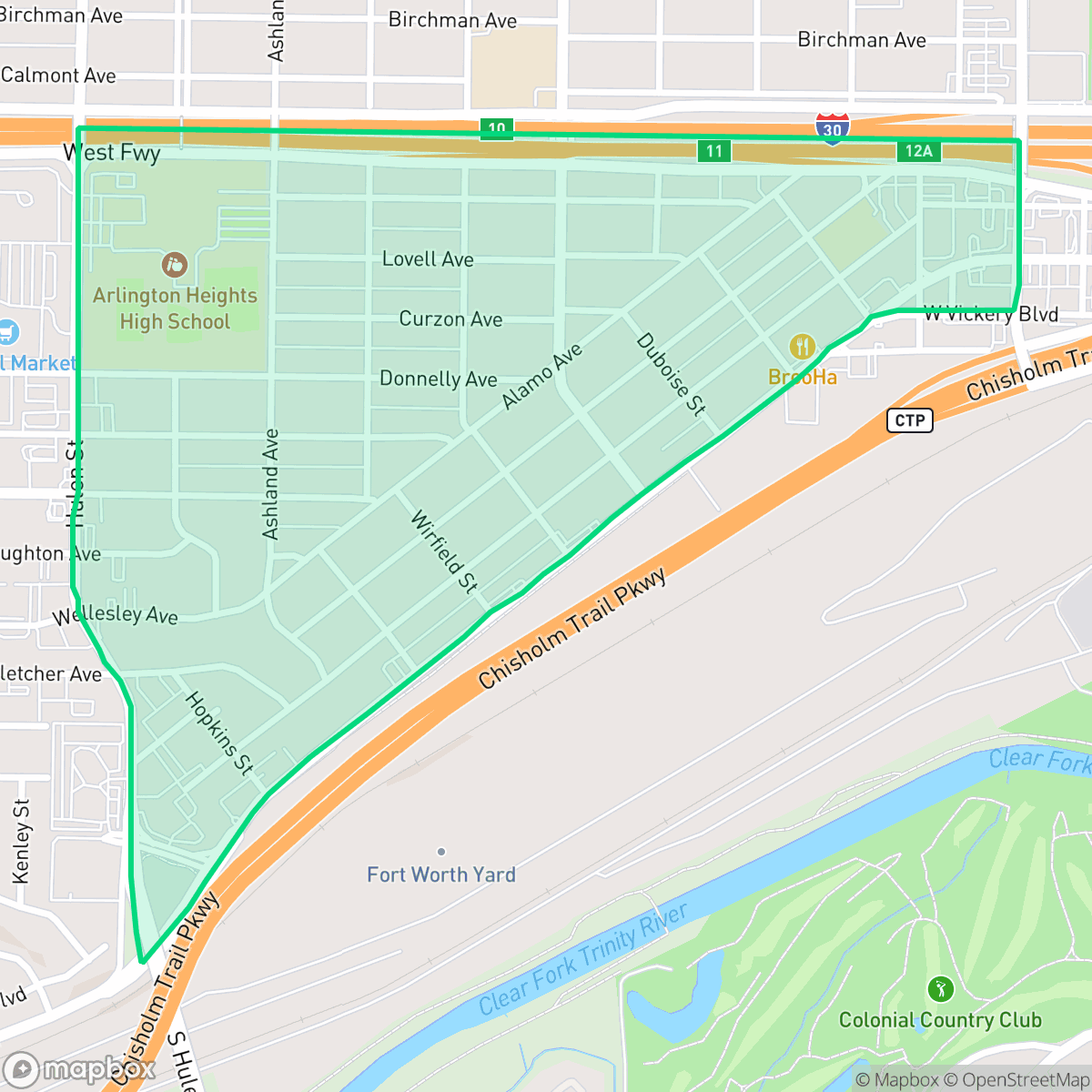
About Alamo Heights
Alamo Heights serves as a compact, pedestrian-friendly residential enclave within Fort Worth, characterized by its proximity to major transit routes and a variety of local dining options. The neighborhood maintains a distinct urban-suburban blend, where quiet residential pockets sit adjacent to commercial stretches featuring popular eateries like Mi Cocina and Thailicious. This layout provides residents with the rare ability to navigate their immediate surroundings entirely on foot, making it a functional choice for those who prioritize accessibility over seclusion.
Living in this area involves specific trade-offs, particularly regarding environmental factors. The high level of road traffic contributes to a notably loud acoustic environment, and the neighborhood faces challenges related to flood safety and air quality that prospective residents should investigate. While the local schools fall under the Fort Worth Independent School District, which is currently navigating significant operational and financial restructuring, the area remains a viable option for those seeking a vibrant, transit-oriented lifestyle in the heart of the city.
Neighborhood Scores Across 15 Qualities
Residential spacing varies across the area, with some neighbors separated by significant buffers and others situated in denser clusters near the center. This level of privacy is slightly lower than the Fort Worth average according to iHuus data.
A grid system with sidewalks on many streets provides pedestrian access to nearby commercial pockets, though overall walkability sits slightly below the Fort Worth average.
Residential views consist primarily of conventional tract housing with uniform rooflines and modest yards. This visual profile is slightly below the Fort Worth average for aesthetic diversity.
Wide sidewalks and a large wooded park on the western edge provide reliable walking routes for pets. According to iHuus data, these features make the area nearly as dog-friendly as the rest of Fort Worth.
Residential blocks and golf courses sit alongside industrial rail yards and major transportation infrastructure. This area features a slightly more developed landscape than the typical Fort Worth setting, according to iHuus data.
Suburban streets and green spaces sit alongside industrial warehouses and major highway corridors. According to iHuus data, the area offers a steadier, more subdued rhythm than the typical Fort Worth urban setting.
Frequent disturbances from nearby railroad tracks and heavy freeway traffic characterize the area. Acoustic comfort in this neighborhood is noticeably lower than the Fort Worth average, according to iHuus data.
Air quality levels in this area fluctuate between acceptable and unhealthy, presenting occasional concerns for sensitive groups. According to iHuus data, the air quality is slightly better than the average found throughout Fort Worth.
Significant rail yards and logistics hubs in certain sectors introduce higher levels of noise and traffic than the Fort Worth average. Residential pockets remain quiet, but the presence of active freight lines and highway interchanges creates a more industrial atmosphere in specific parts of the neighborhood.
Health insurance rates in this area are consistent with the Fort Worth city average. According to iHuus data, coverage levels for residents are moderate.
Residents will find a predominantly liberal community with a modest presence of opposing viewpoints, which leans more liberal than the Fort Worth average according to iHuus data.
A diverse range of age groups, including young professionals, families, and seniors, resides here. This demographic spread is slightly more varied than the average seen across Fort Worth, according to iHuus data.
Significant flood risk exists here because parts of the neighborhood are located within a designated 100-year floodplain. According to iHuus data, this area faces a notably higher risk of inundation compared to the Fort Worth average, which typically necessitates flood insurance.
Address-Level Insights for Alamo Heights


iHuus Neighborhood Intelligence Insights
Get address-level neighborhood insights for Alamo Heights
- Street-level scores — see how individual blocks compare, not just neighborhood averages
- Micro-zone boundaries — identify quiet pockets, flood boundaries, and walkable clusters before you visit
- 15 dimensions in full — walkability, noise, air quality, school quality, insurance coverage, population age profile, urban/rural index, and more
- Boundary risk alerts — know if your address sits near a block boundary where scores drop, the kind of detail no listing will ever mention
- School insights — individual school ratings and insights, not just district-level data
- Compare before you commit — side-by-side data across neighborhoods, down to block precision
No credit card required
Compare with Any Neighborhood
| Dimension | Alamo Heights | Alexandra Meadows |
|---|---|---|
| 🚶 Walkabilityavg 7.5 | ||
| 🔊 Acoustic Comfortavg 4.12 | ||
| 🤫 Privacy Indexavg 5.64 | ||
| 🎨 Visual Appealavg 6.38 | ||
| 🐕 Dog Friendlinessavg 6.57 | ||
| 🗺️ Urban-Rural Indexavg 6.92 | ||
| ✨ Neighborhood Vibeavg 4.56 | ||
| 🏥 Health Insurance Coverageavg 5.8 | ||
| 🌿 Air Qualityavg 3.68 | ||
| 🏭 Industrial Proximityavg 8.13 | ||
| 🌊 Flood Safetyavg 3.61 | ||
| 🗳️ Ideological Leanavg 5.62 | ||
| 👥 Population Age Profileavg 4.51 | ||
| 🔥 Fire Safety | ||
| 🏫 School Quality |
Alamo Heights Rankings
School Districts Serving Alamo Heights
School Insights for Alamo Heights
Below average outcomes; significant attendance and academic challenges.
School Insights
See what's really behind every school rating near Alamo Heights
- Individual school ratings — each school's own score with outcome context, not just a district average
- Enrollment & class size data — student-to-teacher ratio and how it compares to the state average
- Full demographics breakdown — ethnicity and gender composition for every school in the enrollment zone
- Every school in the district — all schools within the enrollment boundary ranked by rating, not just the closest one
- Grade levels & benchmarks — elementary through high school, with below/above state-average flags
No credit card required