Sunset Heights, El Paso
Updated · 2,725 residents
Sunset Heights is a historic, grid-based neighborhood in El Paso known for its high walkability and vibrant social hubs near local cafes and taverns. While the area offers a dense, urban atmosphere, residents experience limited privacy due to closely spaced housing and consistent road traffic noise.
Key Highlights
About Sunset Heights
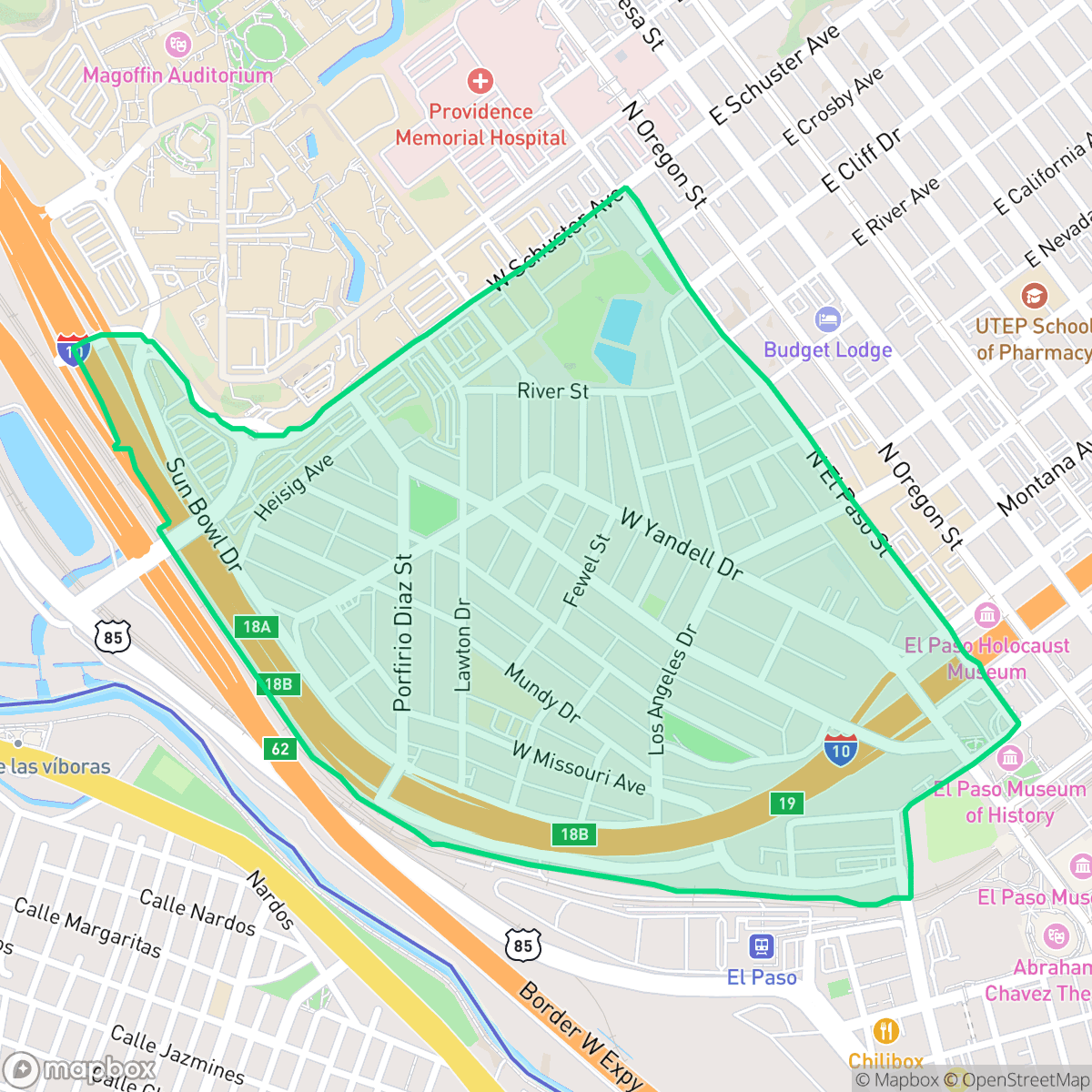
Developed in the 1880s by J. Fisher Satterthwaite and renamed via a 1901 newspaper contest, Sunset Heights is one of El Paso’s oldest and most historic neighborhoods. As one of the nation’s first planned subdivisions, it featured El Paso’s first indoor plumbing and an electric trolley terminating at Mundy Park. The neighborhood showcases diverse architectural styles—including Tudor, Mission, and Classical Revival—with prominent homes designed by Edward Kneezell, pioneering female architect Mabel Welch, and Henry C. Trost, who built his own Prairie-style residence here. Historically a culturally diverse enclave for affluent Anglo, Jewish, and Mexican families, Sunset Heights became a refuge for wealthy Mexicans fleeing the 1910 Mexican Revolution, including Pancho Villa. It is also famous for historic smuggling tunnels, such as those beneath the "Turtle House". The neighborhood was designated a historic district in 1984.
The neighborhood functions as a dense, low-rise urban core characterized by a consistent grid layout that supports high levels of pedestrian activity. Residents benefit from a lively social scene, with popular local spots like the Unbranded Tavern and Kitchen and the Coffee Box serving as central gathering points. The area maintains a strong sense of community identity, supported by its proximity to institutional amenities and a variety of local commercial blocks that keep the atmosphere active throughout the day. According to available data, the environment is primarily residential and institutional, avoiding heavy industrial encroachment while maintaining a high standard of air quality compared to the city average.
Living in this area requires navigating specific trade-offs, particularly regarding acoustic comfort and private space. The close proximity of homes results in limited privacy, and the prevalence of road traffic contributes to a higher noise profile. The neighborhood is also an arid environment with minimal public green space, making it less suitable for pet owners who require frequent access to parks. Prospective residents should also be aware that the local school district is currently managing significant budget and consolidation challenges. Furthermore, the area faces notable flood safety risks, and potential homeowners should factor these environmental and structural considerations into their decision-making process.
Neighborhood Scores Across 15 Qualities
Residential structures are positioned in close quarters with very narrow separations between property lines. According to iHuus data, this lack of buffer space is notably lower than the El Paso average.
Walking is possible on quiet streets, but the lack of continuous sidewalks and fragmentation from major highways makes the area less walkable than much of El Paso. According to iHuus data, some sections of the neighborhood grid are interrupted by industrial rail yards and high-traffic roads.
Uniform tract housing and small, tightly packed lots characterize the area. This landscape lacks significant greenery or luxury amenities and sits below the El Paso average for visual variety.
Limited green space and extensive pavement make finding areas for pet exercise difficult. This neighborhood is notably less dog friendly than the El Paso average due to a lack of public parks and narrow, paved verges.
Residential streets and green spaces are balanced with urban infrastructure. This neighborhood is less densely developed than the El Paso average, featuring a blend of low-rise blocks and industrial areas according to iHuus data.
Active pockets of restaurants, cafes, and shops provide a social hub that is more vibrant than the El Paso average. This energy is interspersed with quieter, suburban streets and industrial zones near major transit corridors.
Frequent acoustic disturbance from nearby freeway and railroad activity is common in this area. This level of noise is significantly higher than the El Paso average, according to iHuus data.
Air quality remains exceptionally high with minimal health concerns for residents. According to iHuus data, the air purity in this area is slightly better than the El Paso city average.
Residential and institutional uses dominate the area, with only occasional light commercial activity visible. According to iHuus data, this lack of heavy industry is largely consistent with the city average.
Health insurance coverage is notably lower than the El Paso average. According to iHuus data, a small portion of the resident population has access to employer or private health plans.
Voting patterns and census indicators reflect a predominantly liberal political leaning that is more pronounced than the El Paso city average.
Residents will find a diverse mix of young adults, families, and older populations. This age distribution aligns with the typical profile found across El Paso.
Address-Level Insights for Sunset Heights


iHuus Neighborhood Intelligence Insights
Get address-level neighborhood insights for Sunset Heights
- Street-level scores — see how individual blocks compare, not just neighborhood averages
- Micro-zone boundaries — identify quiet pockets, flood boundaries, and walkable clusters before you visit
- 15 dimensions in full — walkability, noise, air quality, school quality, insurance coverage, population age profile, urban/rural index, and more
- Boundary risk alerts — know if your address sits near a block boundary where scores drop, the kind of detail no listing will ever mention
- School insights — individual school ratings and insights, not just district-level data
- Compare before you commit — side-by-side data across neighborhoods, down to block precision
No credit card required
Compare with Any Neighborhood
| Dimension | Sunset Heights | A Presidential Neighborhood |
|---|---|---|
| 🚶 Walkabilityavg 6.43 | ||
| 🔊 Acoustic Comfortavg 3.42 | ||
| 🤫 Privacy Indexavg 5.26 | ||
| 🎨 Visual Appealavg 5.76 | ||
| 🐕 Dog Friendlinessavg 4.74 | ||
| 🗺️ Urban-Rural Indexavg 6.67 | ||
| ✨ Neighborhood Vibeavg 4.56 | ||
| 🏥 Health Insurance Coverageavg 4.91 | ||
| 🌿 Air Qualityavg 9.4 | ||
| 🏭 Industrial Proximityavg 7.86 | ||
| 🌊 Flood Safetyavg 3.36 | ||
| 🗳️ Ideological Leanavg 8 | ||
| 👥 Population Age Profileavg 4.76 | ||
| 🔥 Fire Safety | ||
| 🏫 School Quality |
Sunset Heights Rankings
School Districts Serving Sunset Heights
School Insights for Sunset Heights
Below average outcomes; significant attendance and academic challenges.
School Insights
See what's really behind every school rating near Sunset Heights
- Individual school ratings — each school's own score with outcome context, not just a district average
- Enrollment & class size data — student-to-teacher ratio and how it compares to the state average
- Full demographics breakdown — ethnicity and gender composition for every school in the enrollment zone
- Every school in the district — all schools within the enrollment boundary ranked by rating, not just the closest one
- Grade levels & benchmarks — elementary through high school, with below/above state-average flags
No credit card required