Northeast, El Paso
Updated · 101,084 residents
Northeast El Paso is a sprawling residential community defined by its proximity to the Franklin Mountains and a dense, car-dependent suburban layout. Residents benefit from excellent air quality and access to highly-rated schools, though the area remains quiet with limited public green space for outdoor recreation.
Key Highlights
About Northeast
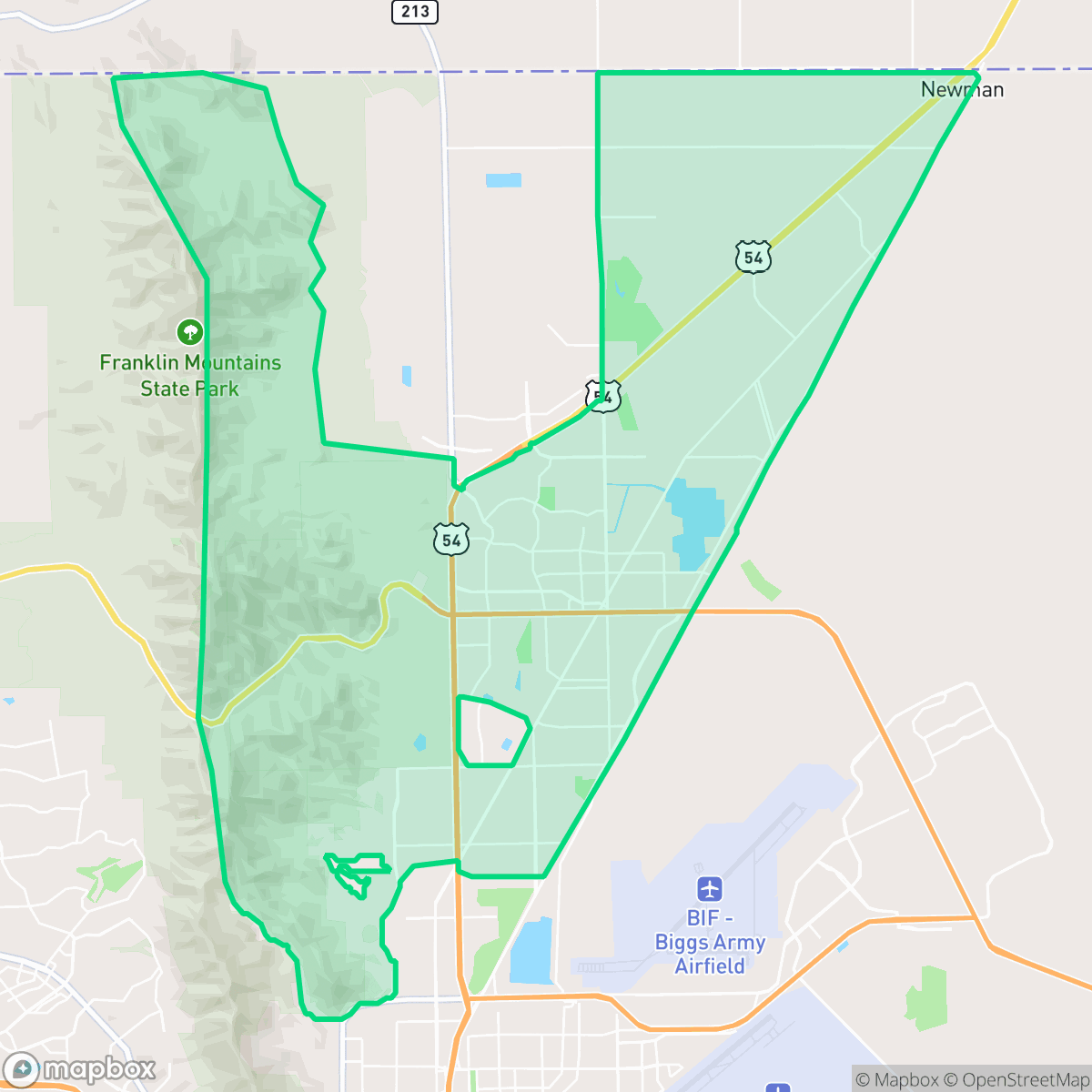
Once an unmapped plain known as "La Noria" ("the well"), Northeast El Paso began transforming when Fort Bliss relocated to the area’s mesa in 1893. In the early 1900s, developer Frank R. Tobin attempted to establish a rival town here; though it failed, it left behind the land for today’s Nations Tobin Park. Suburban development accelerated during a post-WWII housing boom in the 1950s, starting in the Logan Heights area. Due to its proximity to the military base, the neighborhood grew into a highly ethnically diverse community. Distinctive local landmarks include the Castner Range National Monument—a former military artillery range nestled against the Franklin Mountains—and the El Paso Museum of Archaeology. Dyer Street serves as the neighborhood's commercial backbone and cultural "living room".
The neighborhood functions as a classic suburban grid, characterized by a mix of mid-century tract housing and more recent residential developments. While the area lacks a high-density urban core, it serves as a functional residential hub with a steady rhythm of daily life centered around commercial corridors like Dyer Street. According to iHuus data, the area maintains a high air quality score, providing a clean environment for residents despite the arid climate. The landscape is predominantly suburban, featuring closely packed homes with minimal private yard space, reflecting a density typical of the region's post-war expansion. Residents often rely on personal vehicles for transportation, as the sidewalk network is inconsistent and the desert climate offers little shade for pedestrians.
Living in this part of the city involves balancing the convenience of local amenities against the realities of a car-oriented environment. While the neighborhood is generally quiet, proximity to major highway corridors and logistics hubs can introduce moderate traffic noise. Families are well-served by the Ysleta Independent School District, which maintains a strong reputation for academic performance compared to other regional districts. Those considering a move here should prioritize access to private outdoor space, as public dog-friendly parks are scarce and the surrounding terrain is largely composed of desert scrub. It is an ideal location for those seeking a stable, cost-effective residential environment with consistent access to essential services and educational opportunities.
Neighborhood Scores Across 15 Qualities
Residential spacing is roughly average for the city, featuring a mix of suburban layouts with some shared property lines. Depending on the specific block, homes range from closely packed structures to more detached houses with moderate separation.
Low-traffic residential loops and cul-de-sacs allow for safe walking, though many areas lack continuous sidewalks or sufficient shade. This level of walkability is slightly below the El Paso city average due to the presence of high-traffic arterials and some dirt shoulders.
Uniform tract housing and modest yards characterize the area, matching the city average for visual variety. Residents will find a landscape of functional, closely spaced homes with few large-scale luxury amenities.
Walking routes for pets are primarily limited to private backyards and a few scattered public parks, as the arid environment lacks continuous green sidewalk verges. This availability of accessible outdoor space for dogs is roughly in line with the El Paso city average.
The landscape features a blend of suburban residential tracts and vast, open desert terrain. Residents will find a variety of environments ranging from dense single-family housing to sparsely populated industrial and desert areas, which is very similar to the city average.
A peaceful, suburban atmosphere prevails throughout the area, though most dining and essential services require a vehicle to access. The neighborhood features a mix of serene residential pockets and light industrial zones that maintain a steady but low-key rhythm of activity similar to the city average.
Frequent noise from nearby freeway and railroad corridors characterizes this area. According to iHuus data, acoustic comfort levels are roughly consistent with the El Paso city average.
Air quality remains exceptionally clear with minimal pollutants present. This level of air purity is even higher than the average recorded throughout El Paso, according to iHuus data.
Heavy industry and large-scale warehouses are largely absent from the neighborhood, making it comparable to the rest of El Paso in terms of industrial proximity. While some areas near major highway corridors may experience noise from logistics hubs, most of the area remains focused on residential and institutional uses.
Health insurance access in this area is consistent with the El Paso city average. According to iHuus data, a significant portion of the population remains uninsured.
Political views in this area tend toward the liberal side, though the presence of conservative-leaning residents is slightly more pronounced here than in the El Paso city average.
Residents live alongside a balanced mix of young adults, families, and seniors. This demographic spread is largely in line with the average seen across El Paso.
Flood risk in this area is slightly higher than the El Paso average due to undetermined risk levels in local FEMA studies. According to iHuus data, the area lacks a completed detailed flood study, meaning residents should remain aware of potential drainage concerns during heavy rain.
Address-Level Insights for Northeast


iHuus Neighborhood Intelligence Insights
Get address-level neighborhood insights for Northeast
- Street-level scores — see how individual blocks compare, not just neighborhood averages
- Micro-zone boundaries — identify quiet pockets, flood boundaries, and walkable clusters before you visit
- 15 dimensions in full — walkability, noise, air quality, school quality, insurance coverage, population age profile, urban/rural index, and more
- Boundary risk alerts — know if your address sits near a block boundary where scores drop, the kind of detail no listing will ever mention
- School insights — individual school ratings and insights, not just district-level data
- Compare before you commit — side-by-side data across neighborhoods, down to block precision
No credit card required
Compare with Any Neighborhood
| Dimension | Northeast | A Presidential Neighborhood |
|---|---|---|
| 🚶 Walkabilityavg 6.43 | ||
| 🔊 Acoustic Comfortavg 3.42 | ||
| 🤫 Privacy Indexavg 5.26 | ||
| 🎨 Visual Appealavg 5.76 | ||
| 🐕 Dog Friendlinessavg 4.74 | ||
| 🗺️ Urban-Rural Indexavg 6.67 | ||
| ✨ Neighborhood Vibeavg 4.56 | ||
| 🏥 Health Insurance Coverageavg 4.91 | ||
| 🌿 Air Qualityavg 9.4 | ||
| 🏭 Industrial Proximityavg 7.86 | ||
| 🌊 Flood Safetyavg 3.36 | ||
| 🗳️ Ideological Leanavg 8 | ||
| 👥 Population Age Profileavg 4.76 | ||
| 🔥 Fire Safety | ||
| 🏫 School Quality |
Northeast Rankings
School Districts Serving Northeast
School Insights for Northeast
Below average outcomes; significant attendance and academic challenges.
School Insights
See what's really behind every school rating near Northeast
- Individual school ratings — each school's own score with outcome context, not just a district average
- Enrollment & class size data — student-to-teacher ratio and how it compares to the state average
- Full demographics breakdown — ethnicity and gender composition for every school in the enrollment zone
- Every school in the district — all schools within the enrollment boundary ranked by rating, not just the closest one
- Grade levels & benchmarks — elementary through high school, with below/above state-average flags
No credit card required