Mission Hills, El Paso
Updated · 4,120 residents
Mission Hills is a quiet, hillside enclave in El Paso defined by its mid-century architecture and serene atmosphere. While the area offers excellent air quality and high flood safety, residents should expect moderate road noise and a car-dependent lifestyle with limited walkability.
Key Highlights
About Mission Hills
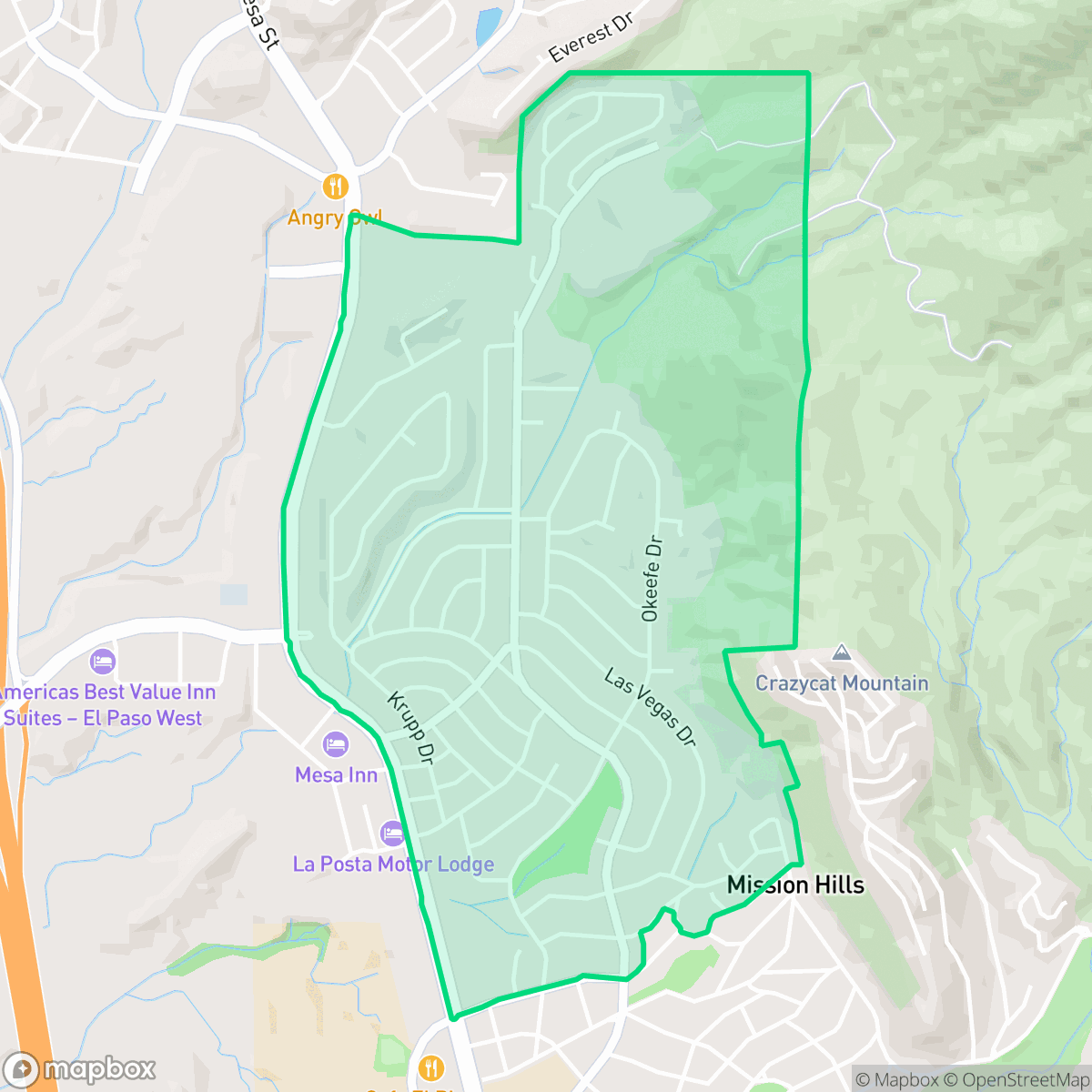
Nestled along the western foothills of the Franklin Mountains, the Mission Hills neighborhood of El Paso, Texas, developed primarily in the mid-20th century as an affluent hillside enclave. Built largely between the 1940s and 1960s, the neighborhood is characterized by its winding, tree-lined streets and a distinctive architectural mix of mid-century modern ranches, Spanish Colonial Revival, and classic Southwestern adobe-inspired designs. Local landmarks include Mission Hills Park, which offers sweeping mountain views, and Mesita Elementary School, a community cornerstone celebrated for its historic Spanish Revival architecture. Bordered by natural features like the Billy Rogers Arroyo and positioned near the Scenic Drive Lookout Trailhead, Mission Hills maintains a tranquil, walkable character while remaining closely connected to the vibrant commercial corridors of nearby Cincinnati and Kerbey avenues.
This residential area provides a low-density, suburban setting that prioritizes tranquility over high-energy urban activity. The neighborhood features a mix of single-family homes and mid-sized apartment complexes, creating a residential environment that feels removed from the busier parts of the city. According to iHuus data, the area benefits from superior air quality and strong flood protection, making it a stable choice for those seeking a secure, quiet living environment.
Prospective residents should note that the neighborhood is primarily car-oriented, as daily errands often require driving to nearby commercial corridors. While sidewalks exist, the presence of busy arterials and limited public green space can impact overall walkability and dog friendliness. The local school district presents a polarized landscape where families must navigate between high-performing magnet programs and campuses facing consolidation, requiring careful research for those with school-aged children.
Neighborhood Scores Across 15 Qualities
Residential density is slightly above the El Paso average, featuring a blend of closely spaced apartment complexes and single-family homes with moderate buffers. According to iHuus data, this mix provides a variety of living arrangements ranging from shared-wall structures to more separated housing units.
Low-traffic residential streets provide a peaceful environment for walking, though the network is interrupted by large parking lots and busy arterial roads. According to iHuus data, the connectivity is slightly below the El Paso average due to many pedestrians being forced onto dirt shoulders near main roads.
Large homes and upscale amenities provide a more polished visual landscape than the El Paso average. According to iHuus data, the area features spacious driveways and well-maintained properties, though some sections consist of standard suburban tract housing.
Limited public park access and narrow street verges are offset by nearby open desert terrain and some landscaped areas, making this area slightly more pet-friendly than the El Paso average.
Open land and scattered homes are balanced by a dense suburban mix of single-family residences and apartment complexes. This balance of desert infill and built environments is consistent with the city average.
Suburban streets and green spaces offer a serene atmosphere with scattered dining options, though the car-dependent layout results in a lower level of activity than the El Paso average. According to iHuus data, residents will find a peaceful environment characterized by low-density housing and limited local walkability.
Frequent noise from nearby transit corridors and railroad activity is a common feature here. According to iHuus data, acoustic levels in this area are slightly higher than the El Paso city average.
Air quality remains consistently high with minimal health concerns, performing even better than the El Paso city average according to iHuus data.
Residential and light commercial uses dominate the area without any presence of warehouses or heavy industrial hazards. This lack of industrial activity is notably lower than the El Paso average, according to iHuus data.
Health insurance enrollment among residents is significantly higher than the El Paso city average, according to iHuus data.
Voting patterns and census indicators show a leaning toward liberal ideologies that is more pronounced than the El Paso city average, according to iHuus data.
A balanced mix of young adults, families, and older residents characterizes the area. This demographic spread is slightly more varied than the typical El Paso population profile, according to iHuus data.
Residual flood risks exist within the area due to its location in a 500-year floodplain, though safety levels remain significantly higher than the El Paso city average according to iHuus data.
Address-Level Insights for Mission Hills


iHuus Neighborhood Intelligence Insights
Get address-level neighborhood insights for Mission Hills
- Street-level scores — see how individual blocks compare, not just neighborhood averages
- Micro-zone boundaries — identify quiet pockets, flood boundaries, and walkable clusters before you visit
- 15 dimensions in full — walkability, noise, air quality, school quality, insurance coverage, population age profile, urban/rural index, and more
- Boundary risk alerts — know if your address sits near a block boundary where scores drop, the kind of detail no listing will ever mention
- School insights — individual school ratings and insights, not just district-level data
- Compare before you commit — side-by-side data across neighborhoods, down to block precision
No credit card required
Compare with Any Neighborhood
| Dimension | Mission Hills | A Presidential Neighborhood |
|---|---|---|
| 🚶 Walkabilityavg 6.43 | ||
| 🔊 Acoustic Comfortavg 3.42 | ||
| 🤫 Privacy Indexavg 5.26 | ||
| 🎨 Visual Appealavg 5.76 | ||
| 🐕 Dog Friendlinessavg 4.74 | ||
| 🗺️ Urban-Rural Indexavg 6.67 | ||
| ✨ Neighborhood Vibeavg 4.56 | ||
| 🏥 Health Insurance Coverageavg 4.91 | ||
| 🌿 Air Qualityavg 9.4 | ||
| 🏭 Industrial Proximityavg 7.86 | ||
| 🌊 Flood Safetyavg 3.36 | ||
| 🗳️ Ideological Leanavg 8 | ||
| 👥 Population Age Profileavg 4.76 | ||
| 🔥 Fire Safety | ||
| 🏫 School Quality |
Mission Hills Rankings
School Districts Serving Mission Hills
School Insights for Mission Hills
Below average outcomes; significant attendance and academic challenges.
School Insights
See what's really behind every school rating near Mission Hills
- Individual school ratings — each school's own score with outcome context, not just a district average
- Enrollment & class size data — student-to-teacher ratio and how it compares to the state average
- Full demographics breakdown — ethnicity and gender composition for every school in the enrollment zone
- Every school in the district — all schools within the enrollment boundary ranked by rating, not just the closest one
- Grade levels & benchmarks — elementary through high school, with below/above state-average flags
No credit card required