Mesa Hills, El Paso
Updated · 10,342 residents
Mesa Hills is a suburban enclave in West El Paso defined by its proximity to the Franklin Mountains and a diverse mix of residential housing styles. While the area offers excellent air quality and access to local landmarks like Galatzan Park, residents should expect a car-dependent lifestyle and elevated noise levels from nearby road traffic.
Key Highlights
About Mesa Hills
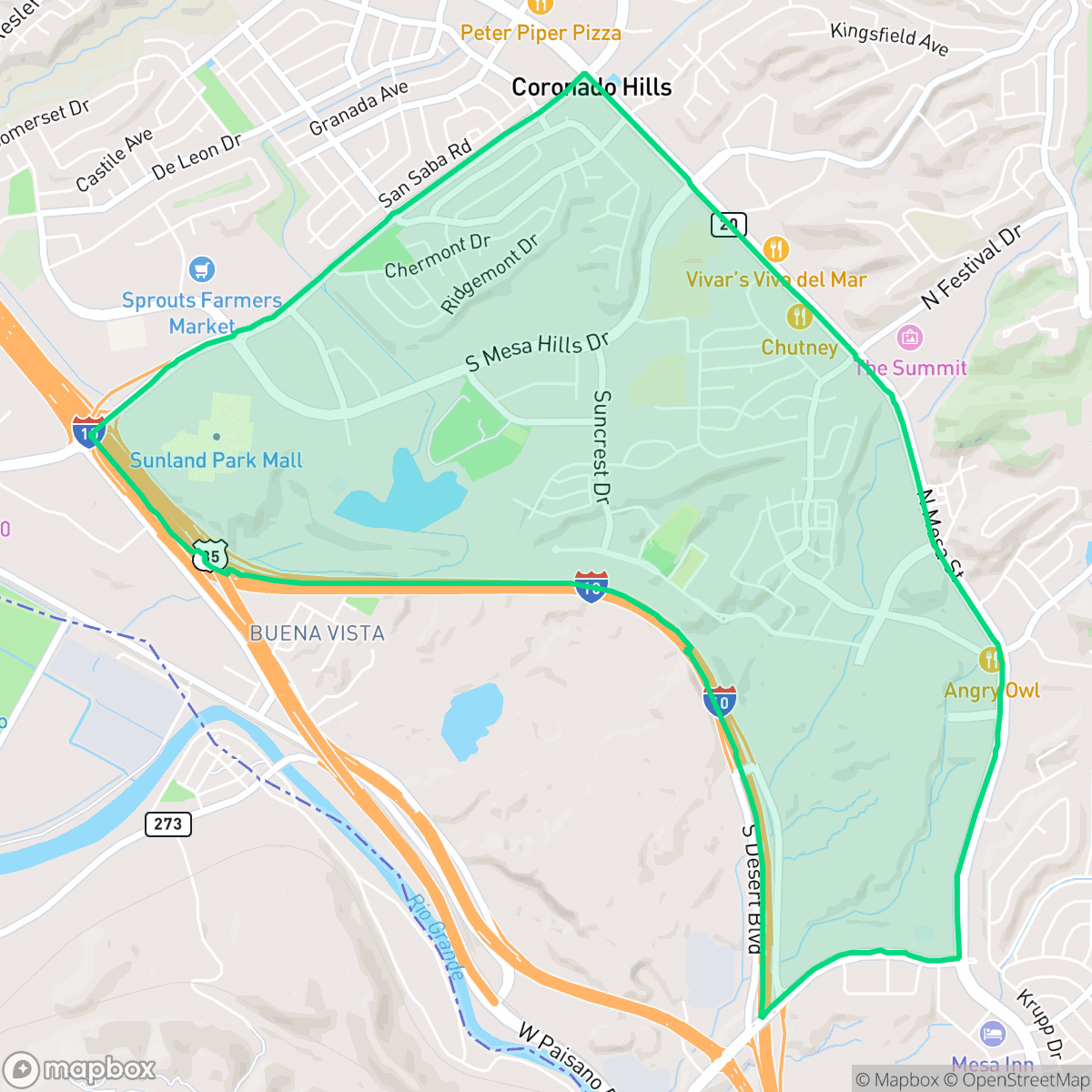
Mesa Hills, located in West El Paso, Texas, developed primarily between the 1970s and 1990s as a suburban residential enclave nestled in the foothills of the Franklin Mountains. Characterized by a mix of mid-century and late 20th-century single-family homes, townhomes, and low-rise apartments, the neighborhood offers direct access to local natural landmarks like the Resler Canyon Trailhead and the Thunder Canyon Conservation Easement. Prominent local fixtures defining the area include the hilltop Saint Francis on the Hill Episcopal Church, Galatzan Park, and the nearby Shoppes at Solana (formerly Sunland Park Mall). The neighborhood's transition from open desert foothills to a bustling suburban community reflects the broader late-20th-century westward expansion of El Paso.
The area functions as a dense suburban hub where residential tracts, apartment complexes, and light commercial strips converge. Residents benefit from high air quality and convenient access to regional shopping at the Shoppes at Solana. The local landscape is marked by a blend of mid-century and late 20th-century architecture, providing a consistent suburban aesthetic that integrates with the surrounding desert foothills. The neighborhood maintains a calm, suburban character with light industrial units and green spaces, though it lacks the high-density walkability found in more urbanized districts.
Prospective residents should consider the trade-offs of living in a car-dependent environment, as the sidewalk network is fragmented and major arterial roads create barriers for pedestrians. Acoustic comfort is a notable factor, with traffic noise levels averaging 63 dB across the area. While the neighborhood provides a range of educational options through the El Paso Independent School District and local charter schools, families should evaluate individual campus performance. The area is best suited for those who prioritize proximity to Westside amenities and mountain access over pedestrian-friendly infrastructure.
Neighborhood Scores Across 15 Qualities
Housing density fluctuates between closely packed multi-family complexes and single-family homes with moderate buffers. According to iHuus data, this provides a higher degree of privacy than the average El Paso neighborhood.
Quiet residential streets offer opportunities for walking, but a lack of continuous sidewalks and presence of wide arterial roads make pedestrian travel more difficult than the El Paso average. According to iHuus data, many pedestrians must navigate dirt shoulders near main roads due to gaps in the sidewalk network.
Uniform tract housing and apartment complexes define the area, featuring small yards and boxy rooflines. This visual landscape is slightly more varied than the El Paso average, according to iHuus data.
Walking routes for pets are restricted by narrow sidewalks and a lack of formal green parks. While vast desert terrain provides open space, the area lacks the specialized amenities found in more pet-centric neighborhoods, according to iHuus data.
Residential pockets feature a blend of single-family homes and apartment complexes interspersed with desert landscape and commercial corridors. This setting is largely comparable to the broader El Paso area in its balance of built environments and open land.
Suburban blocks featuring diverse dining and social hubs offer a slightly more active atmosphere than the El Paso average. While certain areas contain lively pockets of restaurants and parks, the neighborhood remains largely car-dependent with several quiet, industrial, and rural stretches.
Frequent noise from nearby major highways and railroad tracks makes this area louder than the typical El Paso neighborhood. Residents should expect significant acoustic disturbance from heavy traffic and transit corridors, according to iHuus data.
Air quality is exceptionally clear with minimal pollutants. According to iHuus data, the air quality in this area is superior to the El Paso average.
Mixed-use activity is present near major roads, featuring some large warehouses and a wastewater treatment plant. This level of industrial proximity is lower than the El Paso average, as the area remains predominantly residential with only occasional light commercial activity.
Health insurance access is below the El Paso average. Residents may face higher out-of-pocket medical costs due to the lower rates of coverage identified in iHuus data.
Political leanings in Mesa Hills trend more liberal than the El Paso average, according to iHuus data.
Residents live alongside a balanced variety of young adults, families, and seniors. This demographic distribution is largely consistent with the broader El Paso area, according to iHuus data.
Flood risk levels remain undetermined in this area because official federal studies are incomplete; however, the potential for flooding is slightly higher than the El Paso average according to iHuus data.
Address-Level Insights for Mesa Hills


iHuus Neighborhood Intelligence Insights
Get address-level neighborhood insights for Mesa Hills
- Street-level scores — see how individual blocks compare, not just neighborhood averages
- Micro-zone boundaries — identify quiet pockets, flood boundaries, and walkable clusters before you visit
- 15 dimensions in full — walkability, noise, air quality, school quality, insurance coverage, population age profile, urban/rural index, and more
- Boundary risk alerts — know if your address sits near a block boundary where scores drop, the kind of detail no listing will ever mention
- School insights — individual school ratings and insights, not just district-level data
- Compare before you commit — side-by-side data across neighborhoods, down to block precision
No credit card required
Compare with Any Neighborhood
| Dimension | Mesa Hills | A Presidential Neighborhood |
|---|---|---|
| 🚶 Walkabilityavg 6.43 | ||
| 🔊 Acoustic Comfortavg 3.42 | ||
| 🤫 Privacy Indexavg 5.26 | ||
| 🎨 Visual Appealavg 5.76 | ||
| 🐕 Dog Friendlinessavg 4.74 | ||
| 🗺️ Urban-Rural Indexavg 6.67 | ||
| ✨ Neighborhood Vibeavg 4.56 | ||
| 🏥 Health Insurance Coverageavg 4.91 | ||
| 🌿 Air Qualityavg 9.4 | ||
| 🏭 Industrial Proximityavg 7.86 | ||
| 🌊 Flood Safetyavg 3.36 | ||
| 🗳️ Ideological Leanavg 8 | ||
| 👥 Population Age Profileavg 4.76 | ||
| 🔥 Fire Safety | ||
| 🏫 School Quality |
Mesa Hills Rankings
School Districts Serving Mesa Hills
School Insights for Mesa Hills
Below average outcomes; significant attendance and academic challenges.
School Insights
See what's really behind every school rating near Mesa Hills
- Individual school ratings — each school's own score with outcome context, not just a district average
- Enrollment & class size data — student-to-teacher ratio and how it compares to the state average
- Full demographics breakdown — ethnicity and gender composition for every school in the enrollment zone
- Every school in the district — all schools within the enrollment boundary ranked by rating, not just the closest one
- Grade levels & benchmarks — elementary through high school, with below/above state-average flags
No credit card required