Manhattan Heights, El Paso
Updated · 2,446 residents
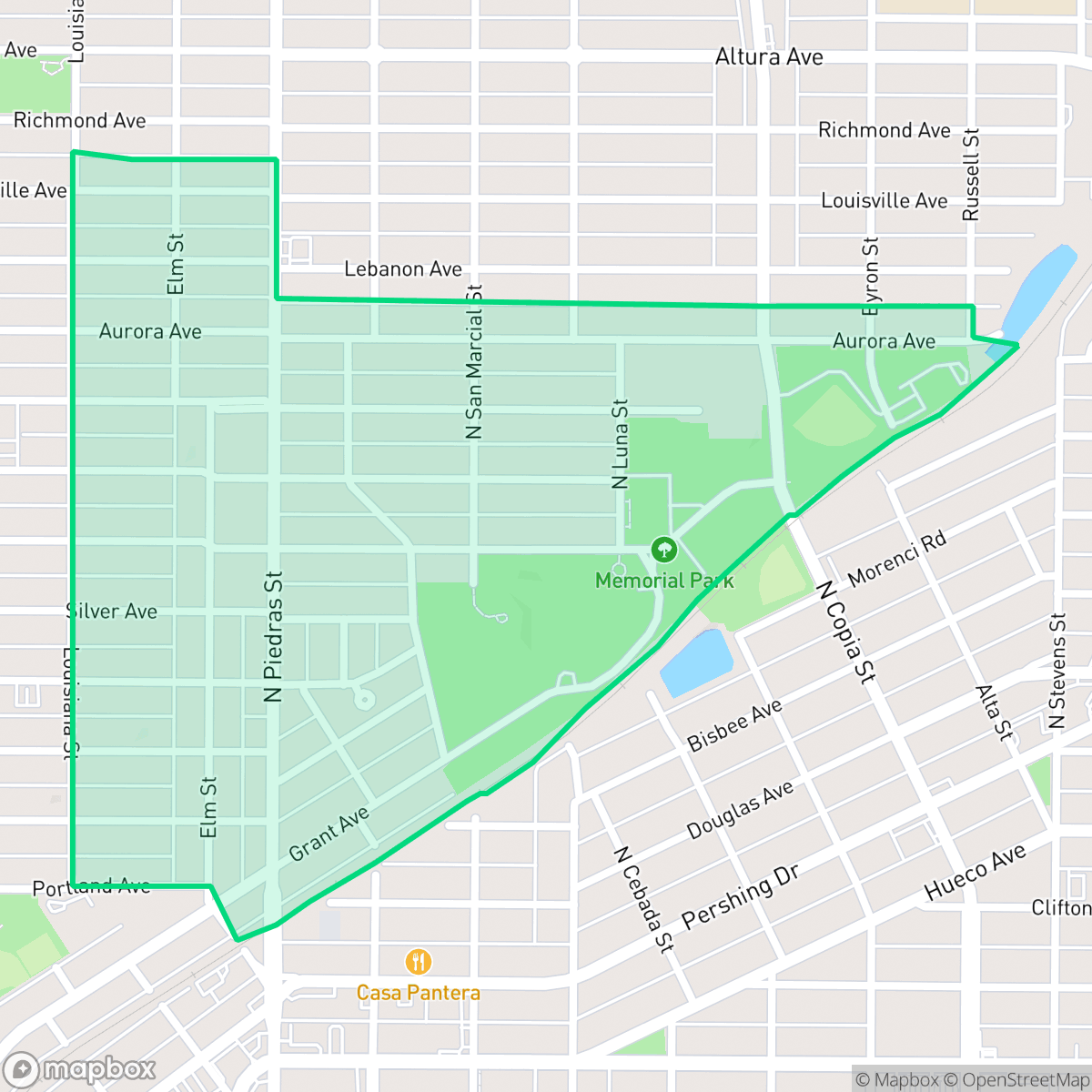
Manhattan Heights is an exceptionally walkable historic district in El Paso, defined by its dense residential grid and proximity to popular local cafes and eateries. Residents benefit from significant green space at Memorial Park, though the area faces challenges regarding flood safety and moderate noise levels from nearby transit corridors.
Key Highlights
About Manhattan Heights
Established on the former site of the Federal Copper Company smelter (1899–1908), El Paso’s Manhattan Heights neighborhood was subdivided in 1912 by Dr. James B. Brady and the Coles brothers. Reflecting its industrial past, the developers named its signature streets Federal, Copper, Silver, Bronze, and Gold. In 1980, Manhattan Heights became El Paso's first neighborhood listed on the National Register of Historic Places. The district features over 500 homes showcasing diverse architectural styles, including Georgian Revival, Tudor, and Craftsman bungalows. Notably, Mabel C. Welch, El Paso’s first female architect, designed her first home here in 1927, popularizing the Spanish Colonial Revival style in the area. The neighborhood is anchored by Memorial Park, designed by renowned landscape architect George Kessler, and the El Paso Municipal Rose Garden.
The neighborhood maintains a vibrant, pedestrian-friendly atmosphere, supported by a consistent grid layout and accessible sidewalks. Local favorites like 2ten Coffee Roasters and Deserto Pizzeria contribute to a lively social scene that distinguishes the area from quieter suburban alternatives. While the architecture provides a classic aesthetic, the community is entirely residential and commercial, remaining free from heavy industrial hazards. According to iHuus data, the area offers a balanced urban lifestyle for those comfortable with a denser, older residential setting. Prospective residents should note that the neighborhood experiences moderate noise levels from road and rail traffic, averaging around 57 decibels. Additionally, the area has a low flood safety rating, which is a critical consideration for homeowners. It is well-suited for those who prioritize walkability and proximity to public amenities over absolute silence or flood-resistant terrain.
Neighborhood Scores Across 15 Qualities
Residential lots feature a moderate level of separation with detached homes and small yards. This spacing provides more buffer between neighbors than is typical for the El Paso average, according to iHuus data.
A consistent grid layout with visible sidewalks and safe crossings makes navigating the area on foot easy. According to iHuus data, walking conditions in this neighborhood are notably better than the El Paso average.
Modest tract housing and uniform rooflines characterize this area. The visual landscape is slightly below the El Paso average, featuring compact lots with small yards and few luxury amenities.
Public green space for dog walking is primarily concentrated around a central park and baseball fields, though many residential streets lack wide verges or significant public grass. This level of accessibility is slightly above the El Paso average according to iHuus data.
Residential blocks feature a mix of single-family homes and low-rise structures within a consistent urban grid. This environment is slightly less open than the El Paso average, primarily consisting of established suburban infrastructure and school complexes.
Suburban streets and green spaces feature a moderate concentration of social hubs and local eateries, making the area more active than the El Paso average. Residents can access various amenities and restaurants within walkable pockets near parks and railway corridors.
A steady hum of local traffic from nearby busy streets defines the acoustic environment. This level of sound is notably higher than the El Paso city average.
Air quality is generally good with rare instances of elevated readings, though levels are slightly lower than the El Paso city average according to iHuus data.
Industrial hazards, large warehouses, and heavy manufacturing facilities are entirely absent from this area. According to iHuus data, this neighborhood offers a cleaner environment than the El Paso average due to its exclusive focus on residential and light commercial uses.
Health insurance coverage among residents is slightly below the El Paso city average. This indicates a higher proportion of uninsured individuals compared to many other areas in the region.
Voting patterns and census indicators reflect a more liberal leaning than the El Paso average, according to iHuus data.
Residents live alongside a relatively even mix of young professionals, families, and seniors. This demographic variety is slightly more balanced than the average across El Paso, according to iHuus data.
Properties in this area are located within a designated floodplain, which implies a higher risk of flooding and more frequent requirements for flood insurance than the El Paso average. According to iHuus data, the area is subject to more significant water-related vulnerabilities compared to most other parts of the city.
Address-Level Insights for Manhattan Heights


iHuus Neighborhood Intelligence Insights
Get address-level neighborhood insights for Manhattan Heights
- Street-level scores — see how individual blocks compare, not just neighborhood averages
- Micro-zone boundaries — identify quiet pockets, flood boundaries, and walkable clusters before you visit
- 15 dimensions in full — walkability, noise, air quality, school quality, insurance coverage, population age profile, urban/rural index, and more
- Boundary risk alerts — know if your address sits near a block boundary where scores drop, the kind of detail no listing will ever mention
- School insights — individual school ratings and insights, not just district-level data
- Compare before you commit — side-by-side data across neighborhoods, down to block precision
No credit card required
Compare with Any Neighborhood
| Dimension | Manhattan Heights | A Presidential Neighborhood |
|---|---|---|
| 🚶 Walkabilityavg 6.43 | ||
| 🔊 Acoustic Comfortavg 3.42 | ||
| 🤫 Privacy Indexavg 5.26 | ||
| 🎨 Visual Appealavg 5.76 | ||
| 🐕 Dog Friendlinessavg 4.74 | ||
| 🗺️ Urban-Rural Indexavg 6.67 | ||
| ✨ Neighborhood Vibeavg 4.56 | ||
| 🏥 Health Insurance Coverageavg 4.91 | ||
| 🌿 Air Qualityavg 9.4 | ||
| 🏭 Industrial Proximityavg 7.86 | ||
| 🌊 Flood Safetyavg 3.36 | ||
| 🗳️ Ideological Leanavg 8 | ||
| 👥 Population Age Profileavg 4.76 | ||
| 🔥 Fire Safety | ||
| 🏫 School Quality |
Manhattan Heights Rankings
School Districts Serving Manhattan Heights
School Insights for Manhattan Heights
Below average outcomes; significant attendance and academic challenges.
School Insights
See what's really behind every school rating near Manhattan Heights
- Individual school ratings — each school's own score with outcome context, not just a district average
- Enrollment & class size data — student-to-teacher ratio and how it compares to the state average
- Full demographics breakdown — ethnicity and gender composition for every school in the enrollment zone
- Every school in the district — all schools within the enrollment boundary ranked by rating, not just the closest one
- Grade levels & benchmarks — elementary through high school, with below/above state-average flags
No credit card required