Magoffin, El Paso
Updated · 2,787 residents
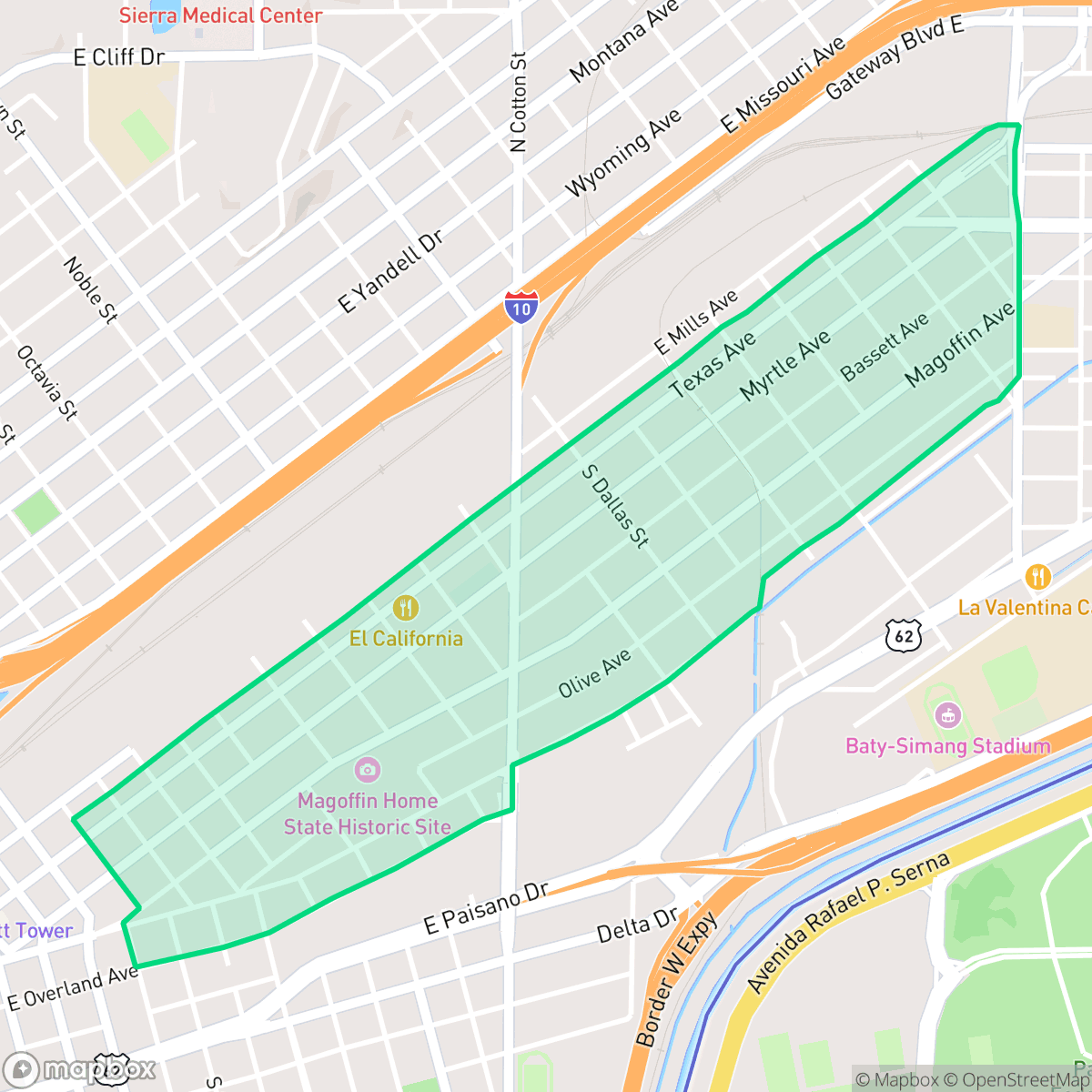
Magoffin is a dense, historic urban neighborhood in El Paso characterized by its proximity to industrial rail yards and a lively collection of local eateries. While the area offers a unique connection to the city's past, residents face challenges with limited privacy, low walkability, and significant noise from nearby logistics activity.
Key Highlights
About Magoffin
The Magoffin neighborhood in El Paso, Texas, trace its roots to "Magoffinsville," an early settlement established by James Wiley Magoffin in 1849. After a flood destroyed the original site in 1868, his son, civic leader Joseph Magoffin, built the landmark Magoffin Home in 1875. This homestead showcases Territorial style architecture, blending local adobe construction with Greek Revival details. Following the arrival of the railroads in the 1880s, Magoffin developed as El Paso's first major residential neighborhood, quickly filling with grand High Victorian homes, churches, and schools. Spanning 65 acres, the Magoffin Historic District was established in 1985 to preserve over 200 historic buildings, including vintage apartment complexes and the iconic Toltec Club, protecting the area from mid-century industrial encroachment.
The neighborhood functions as a dense, low-rise urban grid where industrial infrastructure meets residential blocks. It maintains a distinct energy, supported by local dining staples like Ciro's Bar and Kitchen and District Coffee Co. Despite its historical significance, the area is heavily influenced by its location near major rail lines and warehouses, which contribute to high levels of truck traffic and ambient noise. The environment is defined by its grey infrastructure and high-density residential clusters, creating a landscape that is more industrial than suburban in character.
According to iHuus data, the area is best suited for those who prioritize proximity to urban amenities and a central location over quiet, expansive green spaces. Potential residents should be aware of the limited privacy due to high building density and the lack of dedicated pet-friendly areas. The neighborhood presents a pragmatic choice for those integrated into the local commercial landscape, though it requires navigating challenges related to flood safety and limited pedestrian infrastructure.
Neighborhood Scores Across 15 Qualities
Residential structures are tightly packed with very little separation between rooftops. This level of density is significantly higher than the El Paso average, as indicated by iHuus data.
Residential blocks feature a grid layout with sidewalks and pedestrian crossings, though some areas are less accessible due to heavy truck traffic and nearby rail yards. Overall walkability is slightly below the El Paso city average according to iHuus data.
Dense housing and proximity to industrial zones result in a visual landscape that is notably less aesthetically pleasing than the El Paso average. Residents will find a functional environment characterized by small lots, dirt patches, and limited greenery according to iHuus data.
Sparse greenery and narrow verges make much of the area difficult for pet owners. While a large public park exists to the south, most residential streets feature a high amount of concrete and lacks the accessible green space found elsewhere in El Paso.
Largely comprised of industrial zones and warehouses, this area features a higher concentration of grey infrastructure and large-scale commercial footprints than the El Paso average. Residential grids transition quickly into heavy transportation corridors and extensive industrial yards according to iHuus data.
Active social hubs and diverse dining options provide a higher level of activity than the El Paso average. While some blocks offer walkable amenities, other areas are dominated by industrial warehouses and require a car for easy access.
Frequent noise from nearby railroad tracks and major freeways defines the acoustic environment. This level of disturbance is slightly higher than the El Paso average, according to iHuus data.
Air quality is mostly clean with rare instances of elevated readings, though it remains slightly lower than the El Paso city average according to iHuus data.
Large warehouses, rail yards, and heavy truck traffic are concentrated in the northern and central corridors, resulting in significantly more industrial activity than the El Paso average.
Health insurance access is significantly lower here than the El Paso average. According to iHuus data, a very small portion of the population maintains medical coverage.
Voting patterns and census indicators show a predominantly liberal political leaning, which is more pronounced here than in the average El Paso neighborhood according to iHuus data.
Residents will find a balanced demographic mix of young adults, families, and seniors. This age distribution is slightly more varied than the average found across El Paso.
Significant flood hazards are present in this area, making it much more vulnerable to inundation than most of El Paso. According to iHuus data, residents should expect substantially higher insurance premiums due to this elevated risk level.
Address-Level Insights for Magoffin


iHuus Neighborhood Intelligence Insights
Get address-level neighborhood insights for Magoffin
- Street-level scores — see how individual blocks compare, not just neighborhood averages
- Micro-zone boundaries — identify quiet pockets, flood boundaries, and walkable clusters before you visit
- 15 dimensions in full — walkability, noise, air quality, school quality, insurance coverage, population age profile, urban/rural index, and more
- Boundary risk alerts — know if your address sits near a block boundary where scores drop, the kind of detail no listing will ever mention
- School insights — individual school ratings and insights, not just district-level data
- Compare before you commit — side-by-side data across neighborhoods, down to block precision
No credit card required
Compare with Any Neighborhood
| Dimension | Magoffin | A Presidential Neighborhood |
|---|---|---|
| 🚶 Walkabilityavg 6.43 | ||
| 🔊 Acoustic Comfortavg 3.42 | ||
| 🤫 Privacy Indexavg 5.26 | ||
| 🎨 Visual Appealavg 5.76 | ||
| 🐕 Dog Friendlinessavg 4.74 | ||
| 🗺️ Urban-Rural Indexavg 6.67 | ||
| ✨ Neighborhood Vibeavg 4.56 | ||
| 🏥 Health Insurance Coverageavg 4.91 | ||
| 🌿 Air Qualityavg 9.4 | ||
| 🏭 Industrial Proximityavg 7.86 | ||
| 🌊 Flood Safetyavg 3.36 | ||
| 🗳️ Ideological Leanavg 8 | ||
| 👥 Population Age Profileavg 4.76 | ||
| 🔥 Fire Safety | ||
| 🏫 School Quality |
Magoffin Rankings
School Districts Serving Magoffin
School Insights for Magoffin
Below average outcomes; significant attendance and academic challenges.
School Insights
See what's really behind every school rating near Magoffin
- Individual school ratings — each school's own score with outcome context, not just a district average
- Enrollment & class size data — student-to-teacher ratio and how it compares to the state average
- Full demographics breakdown — ethnicity and gender composition for every school in the enrollment zone
- Every school in the district — all schools within the enrollment boundary ranked by rating, not just the closest one
- Grade levels & benchmarks — elementary through high school, with below/above state-average flags
No credit card required