Lower Valley, El Paso
Updated · 62,583 residents
Lower Valley is a culturally significant area defined by its deep-rooted history, agricultural legacy, and a blend of mid-century residential tracts. The neighborhood offers a dense suburban environment with a mix of industrial logistics hubs and established school districts, though residents should expect a car-dependent lifestyle. It is characterized by tightly packed housing and limited private outdoor space, providing a grounded, working-class atmosphere.
Key Highlights
About Lower Valley
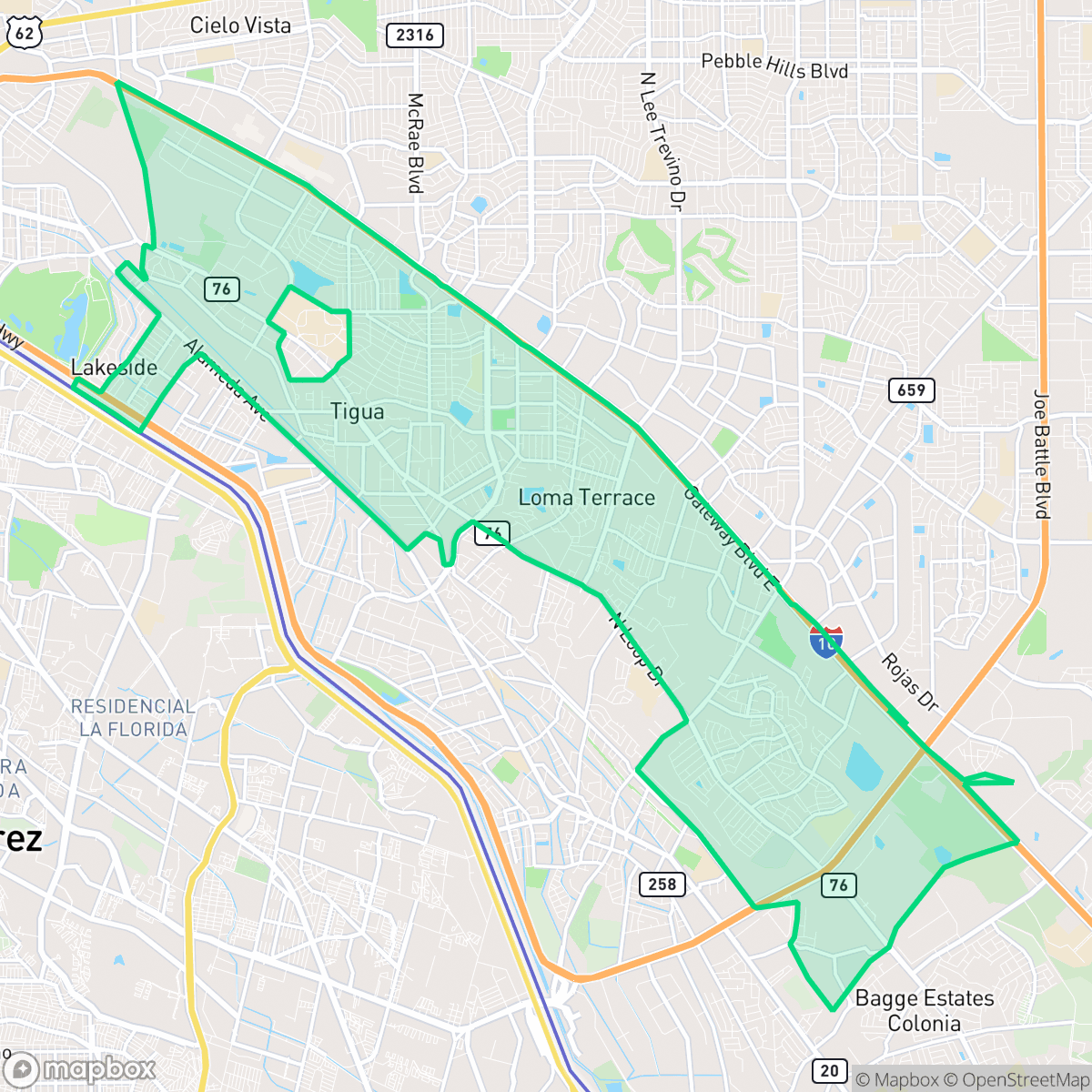
El Paso’s Lower Valley, also known as Mission Valley, is one of the region's oldest and most culturally rich areas. It is home to the Ysleta del Sur Pueblo, a federally recognized Native American tribe whose members built the Ysleta Mission, the oldest continuously operating parish in Texas. Historically defined by its agricultural roots and dairy farms, the neighborhood experienced a post-World War II housing boom that established a diverse, close-knit working-class community. Key local landmarks include the historic Alameda Avenue corridor and Ascarate Park, the city's largest public recreational park centered around a scenic lake. Today, the Lower Valley retains a distinct blend of rural-suburban character, where centuries-old Spanish and Indigenous heritage seamlessly intersects with mid-century residential growth.
This area functions as a dense suburban and industrial corridor where residential blocks sit alongside logistics infrastructure and major transit routes. The landscape is primarily composed of modest, mid-century tract housing on small lots, creating a high-density environment with limited privacy between neighbors. While the neighborhood lacks the luxury amenities found in newer developments, it maintains a strong connection to its heritage through the historic Alameda Avenue corridor and proximity to regional recreational spaces like Ascarate Park.
Residents in this part of El Paso benefit from access to high-performing schools within the Ysleta Independent School District, which serves as a major draw for families. The area is largely car-dependent, as fragmented sidewalk networks and heavy truck traffic from nearby industrial zones can make pedestrian transit challenging. Those considering the Lower Valley should prioritize proximity to major employment hubs and school access, while acknowledging the trade-offs of living in a noise-sensitive, high-density environment with limited public green space.
Neighborhood Scores Across 15 Qualities
Residential structures range from tightly packed houses and mobile home lots to more moderately spaced single-family homes. This level of privacy is slightly lower than the El Paso average due to the presence of closely clustered buildings and limited separation between neighbors.
Pedestrian navigation is challenging due to fragmented sidewalk networks and the frequent need to use dirt shoulders near high-traffic roads; this makes the area less walkable than the El Paso average.
Dense tract housing and mobile home parks dominate the area, offering limited greenery or luxury amenities. The visual landscape is notably less varied than the El Paso city average, characterized by uniform rooflines and small lot sizes.
Walking routes for pets are primarily restricted to paved surfaces and narrow dirt shoulders due to the arid landscape. While some large sports complexes and central parks offer open space, most residential streetscapes lack wide, grassy verges, making the area slightly below the city average for dog-friendly walking.
A blend of residential clusters and large-scale industrial warehouses defines this area. The landscape is largely similar to the El Paso city average, featuring a mix of suburban housing and significant commercial grey space.
Industrial landscapes and freight corridors dominate the area, creating a subdued atmosphere with limited commercial activity. While some dining options exist near major highways, most daily errands will require a vehicle due to the lack of walkable business clusters.
Frequent noise from nearby railroad tracks and major freeways defines the acoustic environment. According to iHuus data, this level of disturbance is higher than the El Paso city average.
Air quality remains largely healthy with infrequent instances of poor air. This level of cleanliness is slightly below the El Paso city average, according to iHuus data.
Residential and light commercial uses dominate the landscape, offering fewer industrial hazards than the El Paso average. While some logistics hubs and warehouse activity exist nearby, the area lacks significant heavy industrial plants or large-scale manufacturing facilities.
Health insurance accessibility is notably lower than the El Paso average. Residents may face greater challenges accessing medical services due to the low rate of coverage in the area, according to iHuus data.
Voting patterns and census indicators reflect a strong liberal leaning that is more pronounced than the El Paso city average, according to iHuus data.
A balanced mix of young adults, families, and older residents characterizes this area. According to iHuus data, the age distribution is slightly more varied than the typical El Paso demographic.
Flood risk in this area is significantly higher than the El Paso average, as parts of the neighborhood sit within designated floodplains. Residents should be aware that flood insurance is typically required for properties here according to iHuus data.
Address-Level Insights for Lower Valley


iHuus Neighborhood Intelligence Insights
Get address-level neighborhood insights for Lower Valley
- Street-level scores — see how individual blocks compare, not just neighborhood averages
- Micro-zone boundaries — identify quiet pockets, flood boundaries, and walkable clusters before you visit
- 15 dimensions in full — walkability, noise, air quality, school quality, insurance coverage, population age profile, urban/rural index, and more
- Boundary risk alerts — know if your address sits near a block boundary where scores drop, the kind of detail no listing will ever mention
- School insights — individual school ratings and insights, not just district-level data
- Compare before you commit — side-by-side data across neighborhoods, down to block precision
No credit card required
Compare with Any Neighborhood
| Dimension | Lower Valley | A Presidential Neighborhood |
|---|---|---|
| 🚶 Walkabilityavg 6.43 | ||
| 🔊 Acoustic Comfortavg 3.42 | ||
| 🤫 Privacy Indexavg 5.26 | ||
| 🎨 Visual Appealavg 5.76 | ||
| 🐕 Dog Friendlinessavg 4.74 | ||
| 🗺️ Urban-Rural Indexavg 6.67 | ||
| ✨ Neighborhood Vibeavg 4.56 | ||
| 🏥 Health Insurance Coverageavg 4.91 | ||
| 🌿 Air Qualityavg 9.4 | ||
| 🏭 Industrial Proximityavg 7.86 | ||
| 🌊 Flood Safetyavg 3.36 | ||
| 🗳️ Ideological Leanavg 8 | ||
| 👥 Population Age Profileavg 4.76 | ||
| 🔥 Fire Safety | ||
| 🏫 School Quality |
Lower Valley Rankings
School Districts Serving Lower Valley
School Insights for Lower Valley
Below average outcomes; significant attendance and academic challenges.
School Insights
See what's really behind every school rating near Lower Valley
- Individual school ratings — each school's own score with outcome context, not just a district average
- Enrollment & class size data — student-to-teacher ratio and how it compares to the state average
- Full demographics breakdown — ethnicity and gender composition for every school in the enrollment zone
- Every school in the district — all schools within the enrollment boundary ranked by rating, not just the closest one
- Grade levels & benchmarks — elementary through high school, with below/above state-average flags
No credit card required