Golden Hills, El Paso
Updated · 2,817 residents
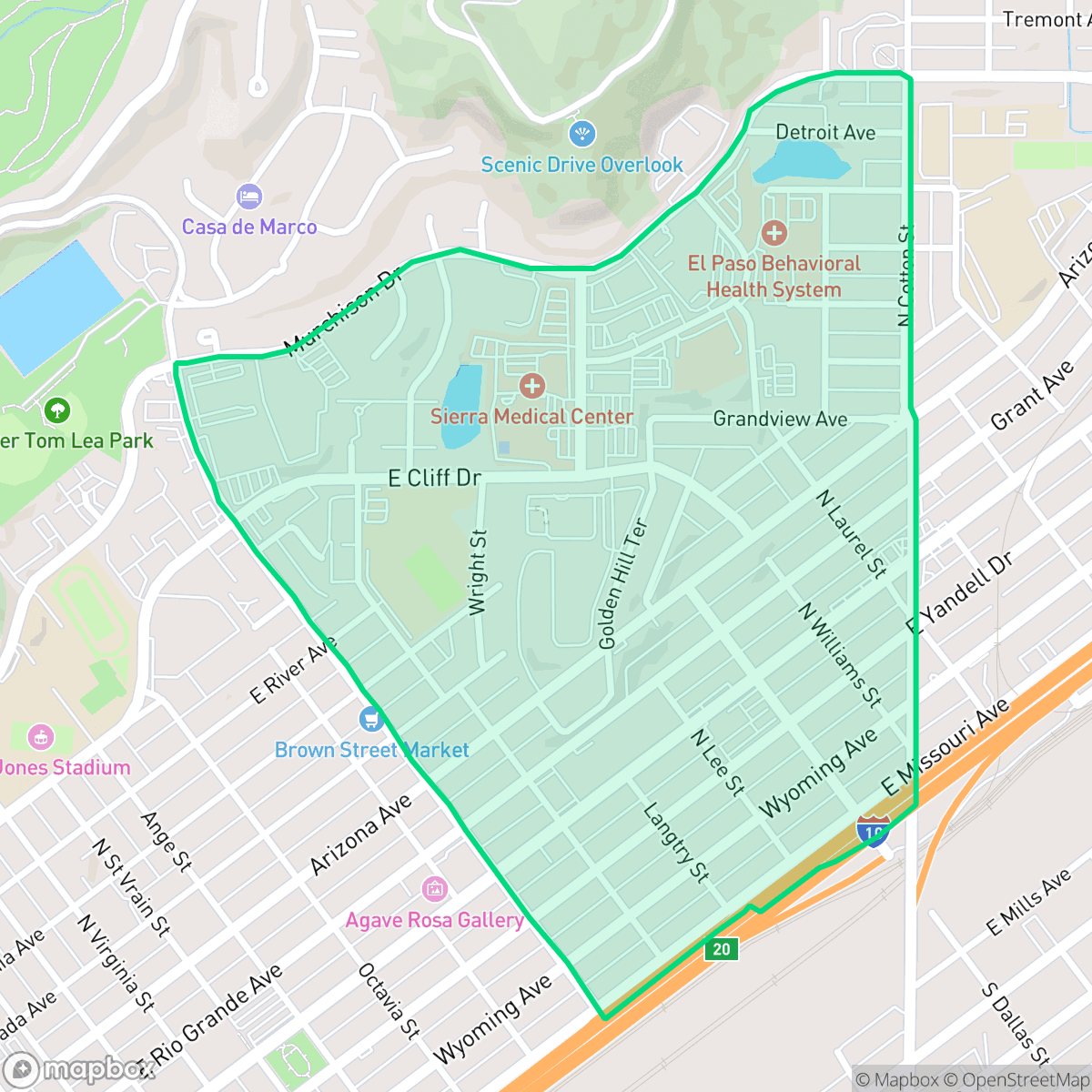
Golden Hills is a historic Central El Paso neighborhood defined by its early 20th-century architecture and dense, grid-based layout. While the area offers a quiet, suburban atmosphere, residents experience a high-density environment with close proximity to major industrial logistics centers and highway infrastructure.
Key Highlights
About Golden Hills
Golden Hill is a historic neighborhood in Central El Paso, Texas, notable for its early 20th-century residential architecture. A central landmark of the area is the Albert B. Fall Mansion at 1725 Arizona Avenue. Built in 1906, this Classical Revival estate was the home of the prominent Southwest politician and former U.S. Secretary of the Interior, Albert Bacon Fall. Due to its cultural and architectural significance, the mansion has been recognized on Preservation Texas’s Most Endangered Historic Places list. The neighborhood also historically featured the Krakauer Residence on Golden Hill Terrace, a 1915 home designed by renowned regional architect Henry C. Trost. Today, Golden Hill remains a distinct residential pocket defined by its storied past and ongoing preservation efforts.
The neighborhood functions as a quiet, industrial-adjacent residential pocket in Central El Paso. Its layout is characterized by a dense grid of streets where homes are situated in close proximity to one another. Despite its suburban feel, the area is heavily influenced by its location near major logistical hubs, including a large rail yard and expansive warehouse facilities. Local dining options, such as the Salt and Honey Bakery Cafe and various established taco spots, provide community-focused amenities within the neighborhood boundaries.
Regarding livability, the area presents distinct trade-offs for prospective residents. According to iHuus data, the environment is notably dense, which limits private outdoor space and contributes to a lower privacy index. While the grid system supports basic walkability, the lack of shade and buffers from nearby traffic can impact the pedestrian experience. Acoustic comfort is moderate, with noise levels primarily driven by road traffic and nearby industrial operations. Families may find the proximity to highly-rated campuses like Lamar Elementary and Wiggs Middle School advantageous, though they must navigate the broader challenges and consolidation pressures currently facing the El Paso Independent School District.
Neighborhood Scores Across 15 Qualities
Residential spacing varies across the area, with some sections featuring closely positioned houses and others offering more buffer between neighbors. This level of density is slightly higher than the El Paso average, according to iHuus data.
Quiet residential streets and a grid layout allow for manageable walking, although some areas lack sidewalks or sufficient shade. This level of pedestrian accessibility is slightly lower than the El Paso average according to iHuus data.
Simple rooflines and compact lots characterize this area, which offers less visual variety than the El Paso average. According to iHuus data, the residential landscape consists mainly of high-density housing with minimal private amenities or large yards.
Minimal green verges and narrow sidewalks make long walks difficult. Aside from a single central park, the arid landscape offers fewer opportunities for dog walking than the El Paso average.
Open land and scattered residential structures provide a semi-rural feel that is consistent with the city average. According to iHuus data, the area features a mix of low-rise urban layouts and industrial integration.
Residential streets and industrial pockets create a tranquil atmosphere that is slightly less active than the El Paso average. According to iHuus data, the area offers a low-energy environment characterized by scattered dining options and vast open spaces.
Steady sounds from nearby busy streets are present. This level of acoustic activity is higher than the typical experience found across El Paso, according to iHuus data.
Air quality remains mostly clean with only rare instances of elevated readings, though it stays slightly below the El Paso city average according to iHuus data.
Limited industrial presence characterizes most of the area, though large warehouses and rail yards are visible along the southern and eastern edges. This level of industrial proximity is slightly higher than the El Paso average, according to iHuus data.
Health insurance coverage among residents is slightly lower than the El Paso average. According to iHuus data, a significant portion of the population lacks employer-sponsored or private coverage.
Voting patterns and census indicators show a predominantly liberal political leaning that is more pronounced than the El Paso average, according to iHuus data.
A balanced mix of young adults, families, and older residents characterizes the area. According to iHuus data, this demographic spread is slightly more varied than the typical El Paso population profile.
Flood risk in this area is significantly higher than the El Paso average. Residents should anticipate much higher insurance premiums and potential challenges with property protection according to iHuus data.
Address-Level Insights for Golden Hills


iHuus Neighborhood Intelligence Insights
Get address-level neighborhood insights for Golden Hills
- Street-level scores — see how individual blocks compare, not just neighborhood averages
- Micro-zone boundaries — identify quiet pockets, flood boundaries, and walkable clusters before you visit
- 15 dimensions in full — walkability, noise, air quality, school quality, insurance coverage, population age profile, urban/rural index, and more
- Boundary risk alerts — know if your address sits near a block boundary where scores drop, the kind of detail no listing will ever mention
- School insights — individual school ratings and insights, not just district-level data
- Compare before you commit — side-by-side data across neighborhoods, down to block precision
No credit card required
Compare with Any Neighborhood
| Dimension | Golden Hills | A Presidential Neighborhood |
|---|---|---|
| 🚶 Walkabilityavg 6.43 | ||
| 🔊 Acoustic Comfortavg 3.42 | ||
| 🤫 Privacy Indexavg 5.26 | ||
| 🎨 Visual Appealavg 5.76 | ||
| 🐕 Dog Friendlinessavg 4.74 | ||
| 🗺️ Urban-Rural Indexavg 6.67 | ||
| ✨ Neighborhood Vibeavg 4.56 | ||
| 🏥 Health Insurance Coverageavg 4.91 | ||
| 🌿 Air Qualityavg 9.4 | ||
| 🏭 Industrial Proximityavg 7.86 | ||
| 🌊 Flood Safetyavg 3.36 | ||
| 🗳️ Ideological Leanavg 8 | ||
| 👥 Population Age Profileavg 4.76 | ||
| 🔥 Fire Safety | ||
| 🏫 School Quality |
Golden Hills Rankings
School Districts Serving Golden Hills
School Insights for Golden Hills
Below average outcomes; significant attendance and academic challenges.
School Insights
See what's really behind every school rating near Golden Hills
- Individual school ratings — each school's own score with outcome context, not just a district average
- Enrollment & class size data — student-to-teacher ratio and how it compares to the state average
- Full demographics breakdown — ethnicity and gender composition for every school in the enrollment zone
- Every school in the district — all schools within the enrollment boundary ranked by rating, not just the closest one
- Grade levels & benchmarks — elementary through high school, with below/above state-average flags
No credit card required