El Paso High, El Paso
Updated · 2,941 residents
El Paso High is a visually striking neighborhood defined by its historic architecture and elevated mountain views. Residents benefit from high walkability and excellent air quality, though the area maintains a quiet, low-key atmosphere with limited commercial activity.
Key Highlights
About El Paso High
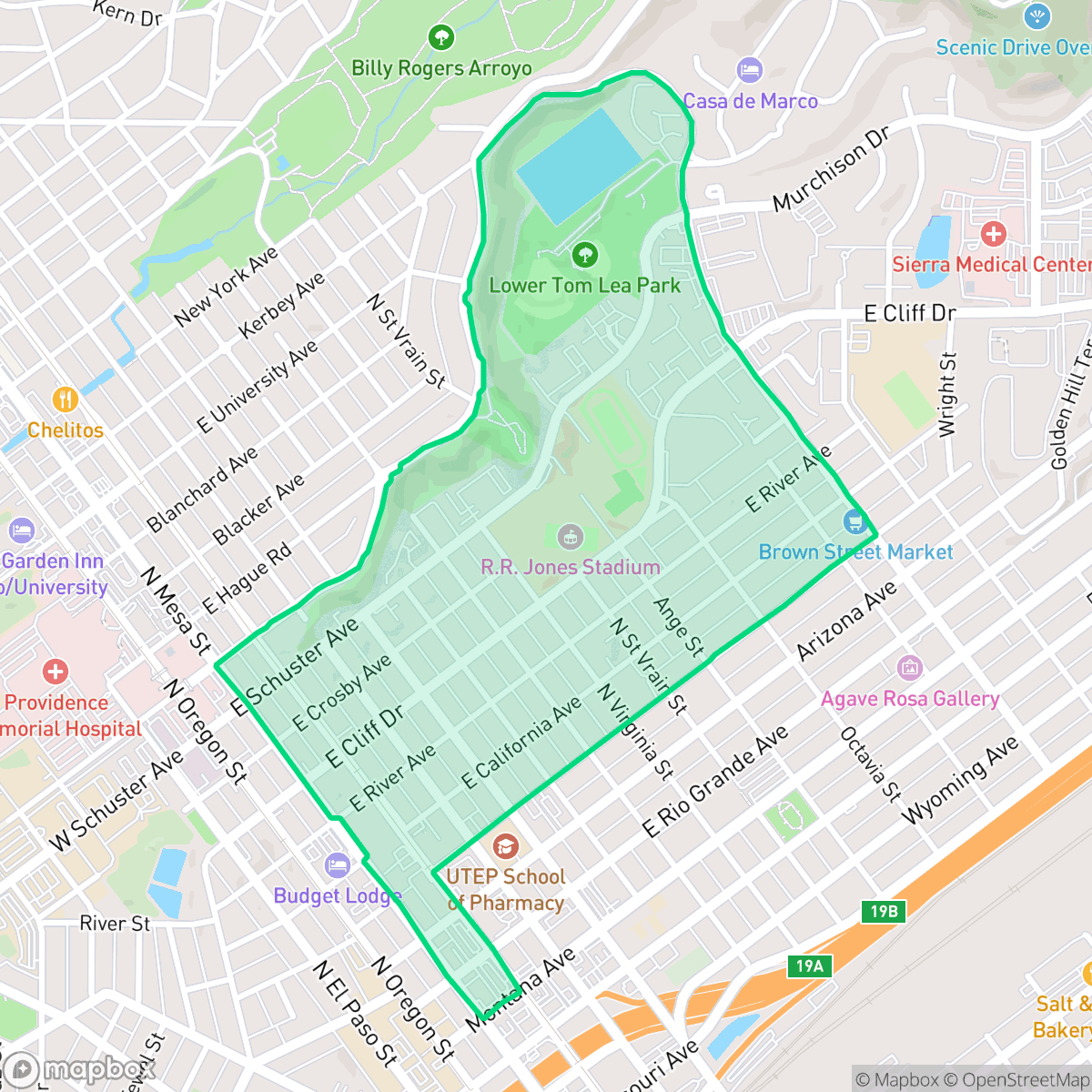
Named after the iconic, century-old El Paso High School, the historic El Paso High neighborhood in west-central El Paso is one of the city's most architecturally distinctive areas. The neighborhood's identity is anchored by the school itself—a monumental 1916 Greco-Roman structure designed by Trost & Trost, affectionately nicknamed "The Lady on the Hill." Developed primarily in the early 20th century, the surrounding residential area boasts a remarkably intact collection of historic housing, with over half of its homes built before 1939. Streets are lined with diverse architectural styles, including Mediterranean Revival, Pueblo-inspired, and Classical Revival residences. A key local landmark is Tom Lea Park, which sits on the mountainside and offers panoramic views of downtown El Paso and Ciudad Juárez, Mexico, reflecting the neighborhood's scenic and deeply rooted cross-border character.
The neighborhood functions as a peaceful residential enclave, characterized by its high visual appeal and well-preserved historic housing stock. It offers a distinct sense of place through its hilly terrain and proximity to iconic local landmarks, providing residents with an environment that prioritizes quiet streets and green spaces over high-density commercial development. According to iHuus data, the area maintains a strong sense of community stability, supported by high levels of health insurance coverage and a well-regarded local high school that serves as a central pillar of the district.
Prospective residents should consider that the neighborhood is relatively quiet, with a lower level of commercial liveliness compared to other parts of the city. While the area is highly walkable and dog-friendly, it is primarily a car-oriented residential zone. Additionally, the region faces significant challenges regarding flood safety, which is a critical factor for homeowners to consider. It is best suited for those who value architectural character, clean air, and a slower pace of life, provided they are comfortable navigating the specific infrastructure and environmental considerations of the west-central El Paso landscape.
Neighborhood Scores Across 15 Qualities
Residential structures are closely spaced with shared property lines, resulting in less privacy than the typical El Paso neighborhood. According to iHuus data, neighbors often live in close proximity with minimal buffer between homes.
Pedestrians benefit from a dense street grid and consistent sidewalks that are significantly more accessible than the El Paso average. While some routes lack shade and border high-traffic roads, many areas feature sidewalks on both sides of the street and safe crossings.
Uniform tract housing and small lots define the local scenery. This area offers a visual profile that is very similar to the city average.
Minimal public greenery and narrow sidewalk verges make finding walking paths difficult. This area offers fewer opportunities for dog owners compared to the El Paso average, as the landscape is characterized by an arid environment with extensive pavement.
Streets and green spaces exist in roughly equal measure, creating a suburban feel that is slightly less dense than the El Paso average. The area features a mix of low-rise residential grids and commercial blocks with significant asphalt coverage.
Diverse dining and social hubs offer more activity than the city average, though much of the area remains car-dependent with pockets of quiet suburban space. According to iHuus data, the neighborhood features a blend of energetic commercial pockets and low-density greenery.
Steady traffic noise from nearby busy streets is a notable feature here. This level of acoustic activity is higher than the average seen throughout El Paso.
Air quality in this area remains mostly clean with infrequent periods of elevated readings. According to iHuus data, the air quality is slightly lower than the El Paso city average.
Residential streets and institutional zones dominate the area, offering a cleaner environment than the El Paso average. While some rail infrastructure and warehouse buildings exist in the southern portion, heavy industrial activity is notably absent from most of the neighborhood.
Health insurance accessibility is notably lower than the El Paso average, which may present challenges for residents seeking medical coverage. According to iHuus data, a small portion of the local population is covered by health insurance plans.
Voting patterns and census indicators reflect a strong liberal leaning that is more pronounced than the El Paso city average, according to iHuus data.
Residents experience a diverse demographic spread of young adults, families, and older individuals. This age distribution is slightly more varied than the average seen across El Paso.
Flood vulnerability in this area is significantly higher than the El Paso average. Residents should account for substantial water runoff risks during heavy rain events according to iHuus data.
Address-Level Insights for El Paso High


iHuus Neighborhood Intelligence Insights
Get address-level neighborhood insights for El Paso High
- Street-level scores — see how individual blocks compare, not just neighborhood averages
- Micro-zone boundaries — identify quiet pockets, flood boundaries, and walkable clusters before you visit
- 15 dimensions in full — walkability, noise, air quality, school quality, insurance coverage, population age profile, urban/rural index, and more
- Boundary risk alerts — know if your address sits near a block boundary where scores drop, the kind of detail no listing will ever mention
- School insights — individual school ratings and insights, not just district-level data
- Compare before you commit — side-by-side data across neighborhoods, down to block precision
No credit card required
Compare with Any Neighborhood
| Dimension | El Paso High | A Presidential Neighborhood |
|---|---|---|
| 🚶 Walkabilityavg 6.43 | ||
| 🔊 Acoustic Comfortavg 3.42 | ||
| 🤫 Privacy Indexavg 5.26 | ||
| 🎨 Visual Appealavg 5.76 | ||
| 🐕 Dog Friendlinessavg 4.74 | ||
| 🗺️ Urban-Rural Indexavg 6.67 | ||
| ✨ Neighborhood Vibeavg 4.56 | ||
| 🏥 Health Insurance Coverageavg 4.91 | ||
| 🌿 Air Qualityavg 9.4 | ||
| 🏭 Industrial Proximityavg 7.86 | ||
| 🌊 Flood Safetyavg 3.36 | ||
| 🗳️ Ideological Leanavg 8 | ||
| 👥 Population Age Profileavg 4.76 | ||
| 🔥 Fire Safety | ||
| 🏫 School Quality |
El Paso High Rankings
School Districts Serving El Paso High
School Insights for El Paso High
Below average outcomes; significant attendance and academic challenges.
School Insights
See what's really behind every school rating near El Paso High
- Individual school ratings — each school's own score with outcome context, not just a district average
- Enrollment & class size data — student-to-teacher ratio and how it compares to the state average
- Full demographics breakdown — ethnicity and gender composition for every school in the enrollment zone
- Every school in the district — all schools within the enrollment boundary ranked by rating, not just the closest one
- Grade levels & benchmarks — elementary through high school, with below/above state-average flags
No credit card required