East Side, El Paso
Updated · 155,057 residents
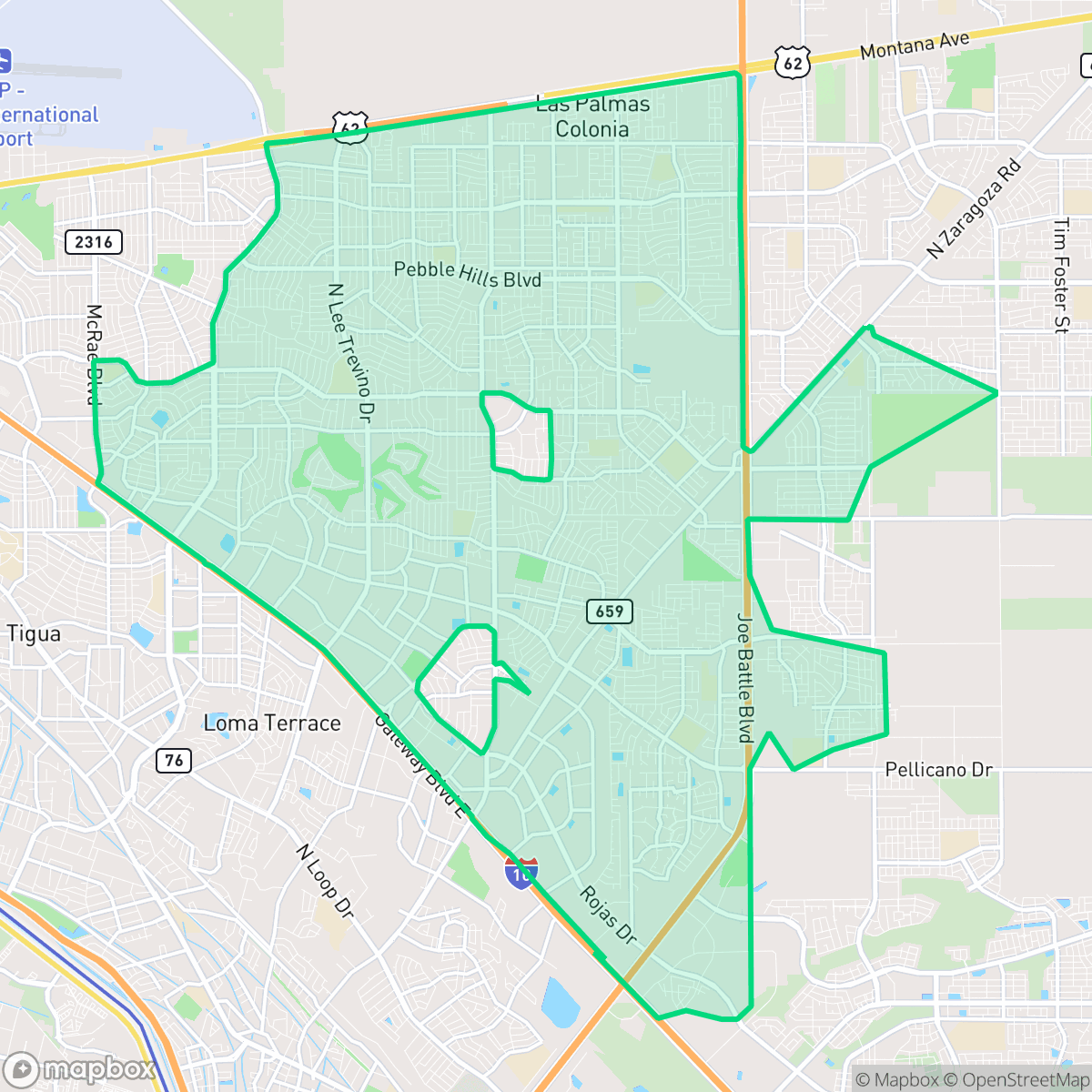
The East Side of El Paso is a well-established residential area defined by its grid-based street network and high walkability. While the neighborhood features a dense suburban layout with closely spaced homes, it offers excellent access to top-rated schools and essential local services.
Key Highlights
About East Side
El Paso’s East Side experienced a massive mid-century boom as the city expanded eastward in the 1960s. The area became defined by master-planned suburban communities like Eastwood, which was developed to accommodate a growing population with tree-lined streets and spacious lots. The neighborhood is widely recognized for its mid-century modern architectural heritage, featuring low-slung ranch homes and cottages built along key corridors like McRae Boulevard, Deby Lewis Drive, and Montwood Drive. A central anchor of the community is Eastwood High School, established in 1961 and nicknamed "Trooperland". Other prominent local landmarks include the sprawling Eastwood/Album Park, which has served as a major recreational and social hub for generations of local families.
The area serves as a primary residential hub for El Paso, characterized by its consistent mid-century suburban grid and reliable infrastructure. According to iHuus data, the neighborhood provides a high level of walkability for a suburban setting, featuring continuous sidewalks that connect residential blocks to schools and commercial corridors. Residents benefit from proximity to a wide array of highly-rated educational institutions within the Ysleta Independent School District, which contributes to the area's stable and family-oriented reputation. The landscape is primarily composed of single-family tract housing with modest lots, creating a dense, community-focused environment where neighbors are typically separated by shared fencing and narrow side yards. Living here involves a balance between accessibility and urban density. While the neighborhood is largely residential, some sections border logistics and commercial zones, which can introduce increased traffic and noise levels. The arid climate and lack of expansive public green verges make the area less ideal for pet owners who rely on public parks, though private backyards remain common. The neighborhood is best suited for families and professionals seeking a stable, well-connected community with strong school pipelines and straightforward access to major city thoroughfares.
Neighborhood Scores Across 15 Qualities
Residential spacing is typical for suburban layouts, providing a moderate amount of buffer between neighbors. According to iHuus data, the density here is roughly in line with the rest of El Paso.
Continuous sidewalks and clear crosswalks are available on most residential streets and main arterials, making the area more walkable than the El Paso average. While the sidewalk network is comprehensive, high-traffic roads and a lack of shade from desert vegetation can create barriers for pedestrians.
Residential landscapes range from dense, uniform tract housing to more affluent pockets featuring large homes and private pools. Overall, the visual variety in the area sits slightly above the El Paso city average.
Public walking options are largely restricted to specific school fields and central parks, as most residential streets feature narrow, dirt-heavy sidewalks and greenery is mostly confined to private backyards. This availability of accessible pet space is consistent with the city average.
Suburban development and large-scale industrial warehouses define the landscape, matching the city average for semi-rural characteristics. Residents will find a mix of single-family housing tracts interspersed with significant commercial and logistics infrastructure.
A balanced mix of residential life and essential services creates a steady daily rhythm that is slightly more active than the city average. While many areas offer diverse dining and social hubs, some suburban blocks remain car-dependent due to the spread of industrial and warehouse units.
Frequent noise from nearby railroad tracks and major freeway traffic characterizes this area. According to iHuus data, acoustic comfort is slightly below the El Paso city average.
Air quality remains consistently high with minimal health concerns for residents. This level of air purity is nearly identical to the El Paso city average, according to iHuus data.
Residential and light commercial uses dominate this area, with very few heavy industrial hazards or large-scale warehouses visible. This lack of industrial proximity is slightly better than the El Paso city average, offering a cleaner environment for residents.
Health insurance coverage among residents is higher than the El Paso city average. According to iHuus data, a significant portion of the population lacks coverage, which may impact local healthcare accessibility.
Political leanings in this area are slightly more liberal than the El Paso average, characterized by a liberal majority with a modest opposing presence according to iHuus data.
Residents live alongside a balanced mix of young adults, families, and older individuals. This age distribution is roughly aligned with the average seen across El Paso.
Flood risk in this area is notably higher than the El Paso average due to its location within a designated floodplain. Residents should prepare for the potential necessity of flood insurance according to iHuus data.
Address-Level Insights for East Side


iHuus Neighborhood Intelligence Insights
Get address-level neighborhood insights for East Side
- Street-level scores — see how individual blocks compare, not just neighborhood averages
- Micro-zone boundaries — identify quiet pockets, flood boundaries, and walkable clusters before you visit
- 15 dimensions in full — walkability, noise, air quality, school quality, insurance coverage, population age profile, urban/rural index, and more
- Boundary risk alerts — know if your address sits near a block boundary where scores drop, the kind of detail no listing will ever mention
- School insights — individual school ratings and insights, not just district-level data
- Compare before you commit — side-by-side data across neighborhoods, down to block precision
No credit card required
Compare with Any Neighborhood
| Dimension | East Side | A Presidential Neighborhood |
|---|---|---|
| 🚶 Walkabilityavg 6.43 | ||
| 🔊 Acoustic Comfortavg 3.42 | ||
| 🤫 Privacy Indexavg 5.26 | ||
| 🎨 Visual Appealavg 5.76 | ||
| 🐕 Dog Friendlinessavg 4.74 | ||
| 🗺️ Urban-Rural Indexavg 6.67 | ||
| ✨ Neighborhood Vibeavg 4.56 | ||
| 🏥 Health Insurance Coverageavg 4.91 | ||
| 🌿 Air Qualityavg 9.4 | ||
| 🏭 Industrial Proximityavg 7.86 | ||
| 🌊 Flood Safetyavg 3.36 | ||
| 🗳️ Ideological Leanavg 8 | ||
| 👥 Population Age Profileavg 4.76 | ||
| 🔥 Fire Safety | ||
| 🏫 School Quality |
East Side Rankings
School Districts Serving East Side
School Insights for East Side
Below average outcomes; significant attendance and academic challenges.
School Insights
See what's really behind every school rating near East Side
- Individual school ratings — each school's own score with outcome context, not just a district average
- Enrollment & class size data — student-to-teacher ratio and how it compares to the state average
- Full demographics breakdown — ethnicity and gender composition for every school in the enrollment zone
- Every school in the district — all schools within the enrollment boundary ranked by rating, not just the closest one
- Grade levels & benchmarks — elementary through high school, with below/above state-average flags
No credit card required