Coronado, El Paso
Updated · 7,747 residents
Coronado is a hillside community in West El Paso known for its winding streets and panoramic views of the border region. The area offers high walkability for a suburban setting, complemented by excellent air quality and a low risk of flooding.
Key Highlights
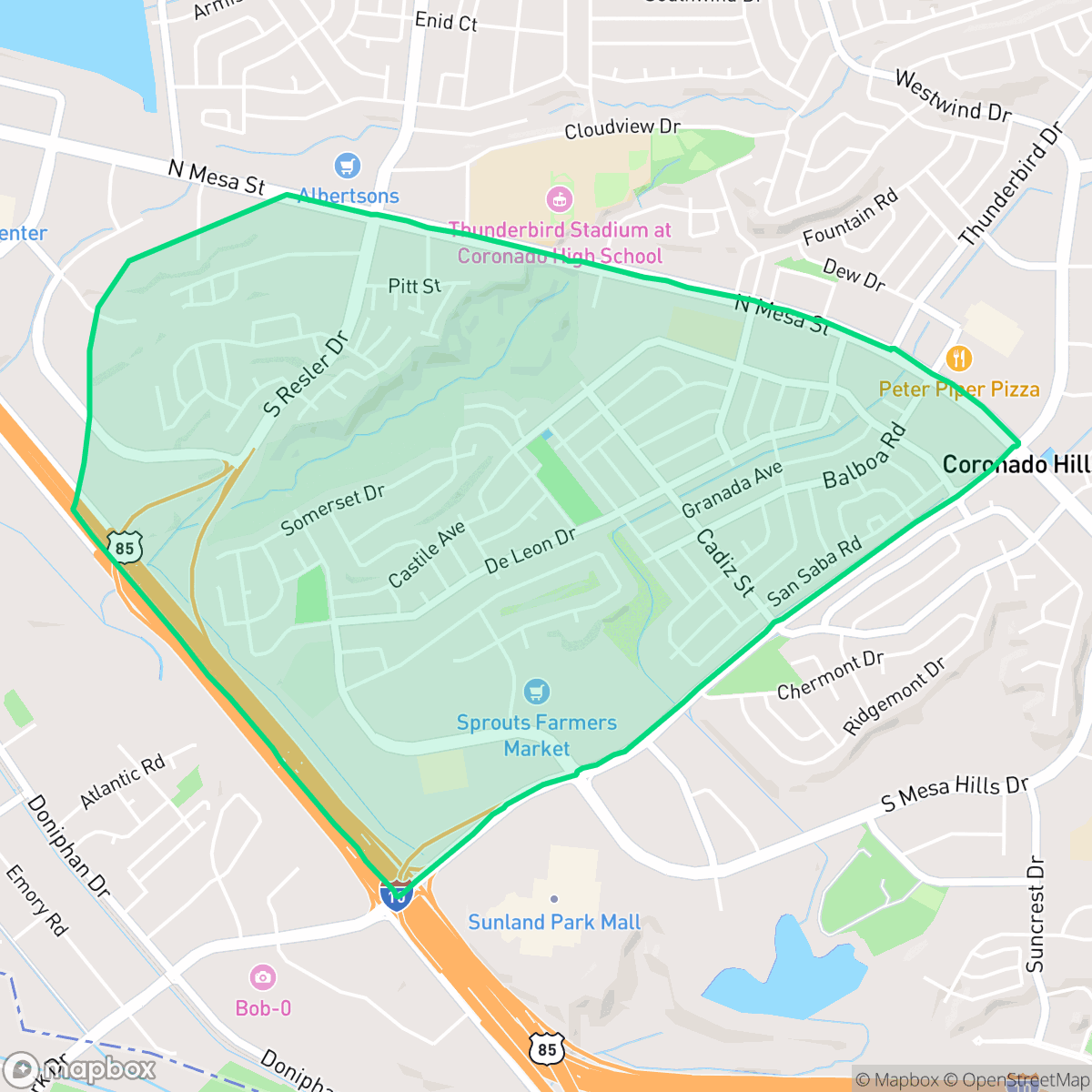
About Coronado
Located in West El Paso against the Franklin Mountains, the Coronado Hills neighborhood began as state land until H.E. Cantrell acquired the tract in 1914 to develop a mountainside golf course and residential enclave. Construction of the first homes and the golf course commenced in 1959, culminating in the opening of the Coronado Country Club in June 1961. The neighborhood is defined by its winding roads, such as Broadmoor Drive and Thunderbird Drive, which offer panoramic views of Texas, New Mexico, and Mexico. Architecturally, the area features a mix of mid-century and contemporary homes with signature Southwestern elements like red-tiled roofs and adobe accents. Today, Coronado High School on North Mesa Street serves as a central community hub, while local favorites like Bella Cora Bakery anchor the neighborhood's relaxed, refined character.
The neighborhood functions as a mature suburban enclave where residential streets meet light commercial hubs. Residents benefit from consistent sidewalk access, which facilitates movement between local dining spots and community green spaces like Ht Ponsford Park and Paul Harvey Park. The area maintains a balanced aesthetic with private outdoor amenities and a clean environment, supported by high air quality scores according to iHuus data.
While the area provides a stable living environment, prospective residents should note the moderate noise levels from road traffic. The local school district, EPISD, presents a mixed landscape of specialized programs and broader consolidation challenges, making it a nuanced choice for families. Overall, the neighborhood suits those seeking a quiet, established community with direct access to the Franklin Mountains and regional transit corridors.
Neighborhood Scores Across 15 Qualities
Residential spacing varies between suburban-style homes and denser apartment blocks, providing slightly more privacy than the El Paso average. While many houses maintain a buffer from neighbors, certain areas on the east side feature larger apartment complexes with closer proximity.
Residential streets and cul-de-sacs offer continuous sidewalks and safe crossings, making the area slightly more walkable than the El Paso average. While pedestrian access is reliable within the neighborhood, connectivity to nearby commercial zones is occasionally interrupted by large lots.
Standard tract housing defines the local landscape, though some areas feature more affluent properties with private pools and larger driveways. According to iHuus data, the overall visual landscape is slightly more polished than the El Paso average.
Limited public greenery and narrow sidewalks make long walks difficult, though nearby desert buffers and parks provide some relief. This level of dog friendliness is slightly above the El Paso average according to iHuus data.
Open land and scattered developments are common here, making the area feel slightly more open than the El Paso average. According to iHuus data, the landscape features a mix of low-density residential spaces and light industrial zones within a desert setting.
Vibrant pockets of dining and social hubs exist alongside quieter, more car-dependent suburban blocks. This level of activity and amenity access is higher than the El Paso city average, according to iHuus data.
Frequent disturbances from nearby railroad tracks and heavy freeway traffic are common here. According to iHuus data, acoustic comfort in Coronado is lower than the El Paso city average.
Air quality in Coronado is exceptionally high with minimal health concerns. According to iHuus data, the air remains cleaner than the typical levels found across El Paso.
Residential life remains largely undisturbed by heavy industry, as the area consists primarily of homes and light commercial zones. According to iHuus data, the level of industrial proximity is slightly lower than the El Paso average.
Access to health insurance is notably lower than the El Paso average, according to iHuus data. Residents may face higher out-of-pocket medical expenses due to the lack of coverage in the area.
Political leanings in this area skew liberal, following a trend that is slightly more progressive than the El Paso city average.
A balanced mix of young adults, families, and seniors defines the local demographic. This age distribution is slightly more varied than the typical El Paso profile, according to iHuus data.
Flood risk in this area is higher than the El Paso average, though a lack of detailed FEMA studies means the precise level of danger remains undetermined. Residents should remain aware of potential drainage issues during heavy rainfall.
Address-Level Insights for Coronado


iHuus Neighborhood Intelligence Insights
Get address-level neighborhood insights for Coronado
- Street-level scores — see how individual blocks compare, not just neighborhood averages
- Micro-zone boundaries — identify quiet pockets, flood boundaries, and walkable clusters before you visit
- 15 dimensions in full — walkability, noise, air quality, school quality, insurance coverage, population age profile, urban/rural index, and more
- Boundary risk alerts — know if your address sits near a block boundary where scores drop, the kind of detail no listing will ever mention
- School insights — individual school ratings and insights, not just district-level data
- Compare before you commit — side-by-side data across neighborhoods, down to block precision
No credit card required
Compare with Any Neighborhood
| Dimension | Coronado | A Presidential Neighborhood |
|---|---|---|
| 🚶 Walkabilityavg 6.43 | ||
| 🔊 Acoustic Comfortavg 3.42 | ||
| 🤫 Privacy Indexavg 5.26 | ||
| 🎨 Visual Appealavg 5.76 | ||
| 🐕 Dog Friendlinessavg 4.74 | ||
| 🗺️ Urban-Rural Indexavg 6.67 | ||
| ✨ Neighborhood Vibeavg 4.56 | ||
| 🏥 Health Insurance Coverageavg 4.91 | ||
| 🌿 Air Qualityavg 9.4 | ||
| 🏭 Industrial Proximityavg 7.86 | ||
| 🌊 Flood Safetyavg 3.36 | ||
| 🗳️ Ideological Leanavg 8 | ||
| 👥 Population Age Profileavg 4.76 | ||
| 🔥 Fire Safety | ||
| 🏫 School Quality |
Coronado Rankings
School Districts Serving Coronado
School Insights for Coronado
Below average outcomes; significant attendance and academic challenges.
School Insights
See what's really behind every school rating near Coronado
- Individual school ratings — each school's own score with outcome context, not just a district average
- Enrollment & class size data — student-to-teacher ratio and how it compares to the state average
- Full demographics breakdown — ethnicity and gender composition for every school in the enrollment zone
- Every school in the district — all schools within the enrollment boundary ranked by rating, not just the closest one
- Grade levels & benchmarks — elementary through high school, with below/above state-average flags
No credit card required