Chamizal, El Paso
Updated · 1,415 residents
Chamizal is a dense, highly walkable urban neighborhood defined by its grid layout and proximity to industrial hubs. While residents benefit from excellent air quality and access to the expansive Chamizal National Memorial, the area faces significant noise from road traffic and limited residential privacy due to its closely packed housing.
Key Highlights
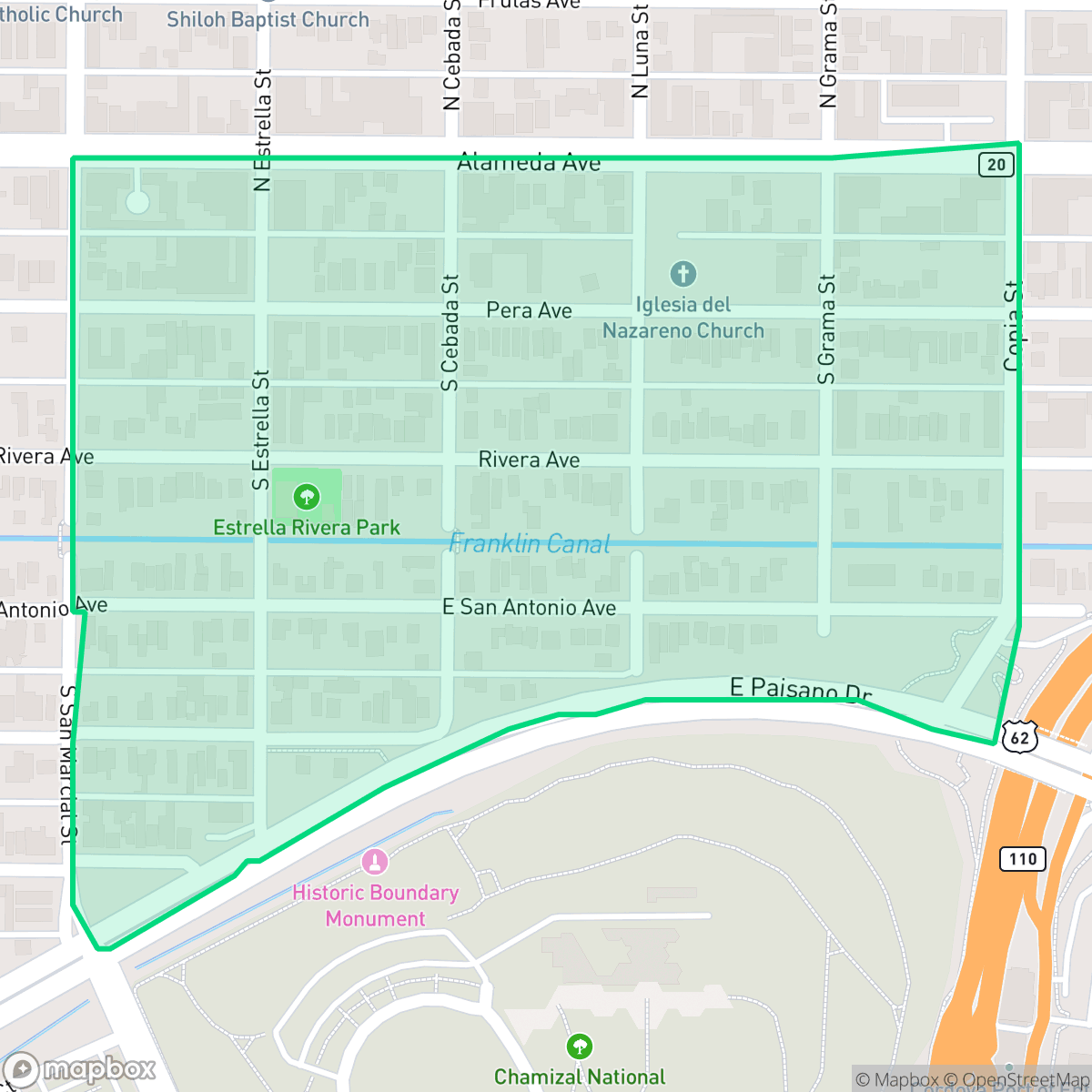
About Chamizal
El Paso’s Chamizal neighborhood originated from a century-long border dispute sparked when an 1864 Rio Grande flood shifted the river southward, creating a contested "no man's land" named for the native chamizo shrub. The dispute was resolved by the 1963 Chamizal Treaty, which channelized the river in concrete, returned land to Mexico, and displaced over 5,000 residents. In response, displaced families fought for concessions, including the construction of Bowie High School and the toll-free Bridge of the Americas. Today, the neighborhood is anchored by the 54.9-acre Chamizal National Memorial, established in 1974 as a cultural center and park. This historically working-class, Spanish-speaking immigrant enclave is also defined by grassroots activism, notably through La Mujer Obrera, an organization founded in 1981 by Chicana garment workers to advocate for community rights.
The neighborhood is characterized by a dense, low-rise urban grid that transitions into industrial zones featuring warehouses and rail lines. This layout supports high walkability, allowing residents to navigate the area on foot, though the physical environment is marked by tightly packed residential lots and proximity to heavy infrastructure. The presence of the Chamizal National Memorial provides a significant green space that serves as a focal point for the community, offering a distinct contrast to the surrounding industrial landscape.
Potential residents should consider the trade-offs of living in this sector, including high noise levels from road traffic and a lack of private outdoor space. The area is served by the El Paso Independent School District, which is currently undergoing structural changes and school consolidations that may impact local educational options. This neighborhood is best suited for those who prioritize community connectivity and proximity to cultural landmarks over quiet, secluded living environments.
Neighborhood Scores Across 15 Qualities
Residential structures in this area are tightly packed with minimal separation between rooftops. According to iHuus data, this level of density offers less seclusion than the typical El Paso neighborhood.
Pedestrian access is facilitated by a grid layout with sidewalks and safe crossings available on most residential blocks. This level of walkability is slightly above the El Paso average, according to iHuus data.
Dense housing with small lots and proximity to industrial zones creates a landscape that is less visually diverse than the El Paso average. According to iHuus data, visible debris and the presence of rail corridors contribute to a more utilitarian aesthetic.
Access to a large public park in the southern portion of the area provides notable benefits for pet owners, though residential streets lack significant green verges. This level of accessibility is higher than the El Paso average, according to iHuus data.
Low-rise urban grids transition into industrial zones and large public green spaces, making the area less dense than the El Paso average. This mix of street networks and open land creates a landscape of equal parts developed infrastructure and greenery.
A mix of industrial zones and active dining hubs creates a lively atmosphere that is slightly more active than the El Paso average. While specific pockets offer diverse restaurant options, many amenities require a vehicle to access.
Frequent disturbances from nearby railroad tracks and heavy freeway traffic characterize this area. This level of acoustic disruption is notably higher than the average found throughout El Paso, according to iHuus data.
Atmospheric conditions remain consistently clean with very little pollution present. According to iHuus data, air quality in this area is even better than the El Paso average.
Large warehouses and rail infrastructure are concentrated in the northern sector, resulting in significantly less industrial density than the El Paso average. Residential areas coexist with light commercial units, though heavy freight traffic is notable near certain industrial zones according to iHuus data.
Access to health insurance is significantly lower than the El Paso average, which may impact access to predictable medical costs for residents. According to iHuus data, the vast majority of the population in this area lacks coverage.
Voting patterns and census indicators show a strong liberal leaning that is more pronounced than the El Paso city average.
Residents live alongside a balanced mix of young adults, families, and seniors. This age distribution is slightly more varied than the El Paso average, according to iHuus data.
Flood vulnerability in this area is significantly higher than the El Paso average. Residents should prepare for much higher insurance premiums and potential property hazards due to the proximity of high-hazard flood zones.
Address-Level Insights for Chamizal


iHuus Neighborhood Intelligence Insights
Get address-level neighborhood insights for Chamizal
- Street-level scores — see how individual blocks compare, not just neighborhood averages
- Micro-zone boundaries — identify quiet pockets, flood boundaries, and walkable clusters before you visit
- 15 dimensions in full — walkability, noise, air quality, school quality, insurance coverage, population age profile, urban/rural index, and more
- Boundary risk alerts — know if your address sits near a block boundary where scores drop, the kind of detail no listing will ever mention
- School insights — individual school ratings and insights, not just district-level data
- Compare before you commit — side-by-side data across neighborhoods, down to block precision
No credit card required
Compare with Any Neighborhood
| Dimension | Chamizal | A Presidential Neighborhood |
|---|---|---|
| 🚶 Walkabilityavg 6.43 | ||
| 🔊 Acoustic Comfortavg 3.42 | ||
| 🤫 Privacy Indexavg 5.26 | ||
| 🎨 Visual Appealavg 5.76 | ||
| 🐕 Dog Friendlinessavg 4.74 | ||
| 🗺️ Urban-Rural Indexavg 6.67 | ||
| ✨ Neighborhood Vibeavg 4.56 | ||
| 🏥 Health Insurance Coverageavg 4.91 | ||
| 🌿 Air Qualityavg 9.4 | ||
| 🏭 Industrial Proximityavg 7.86 | ||
| 🌊 Flood Safetyavg 3.36 | ||
| 🗳️ Ideological Leanavg 8 | ||
| 👥 Population Age Profileavg 4.76 | ||
| 🔥 Fire Safety | ||
| 🏫 School Quality |
Chamizal Rankings
School Districts Serving Chamizal
School Insights for Chamizal
Below average outcomes; significant attendance and academic challenges.
School Insights
See what's really behind every school rating near Chamizal
- Individual school ratings — each school's own score with outcome context, not just a district average
- Enrollment & class size data — student-to-teacher ratio and how it compares to the state average
- Full demographics breakdown — ethnicity and gender composition for every school in the enrollment zone
- Every school in the district — all schools within the enrollment boundary ranked by rating, not just the closest one
- Grade levels & benchmarks — elementary through high school, with below/above state-average flags
No credit card required