West Oak Historic District, Denton
Updated · 1,253 residents
West Oak Historic District is a quiet, tree-lined residential enclave in Denton characterized by its diverse collection of early 20th-century architectural styles. The area offers high walkability and excellent dog-friendliness, providing a peaceful suburban atmosphere just steps from the city's central activity.
Key Highlights
About West Oak Historic District
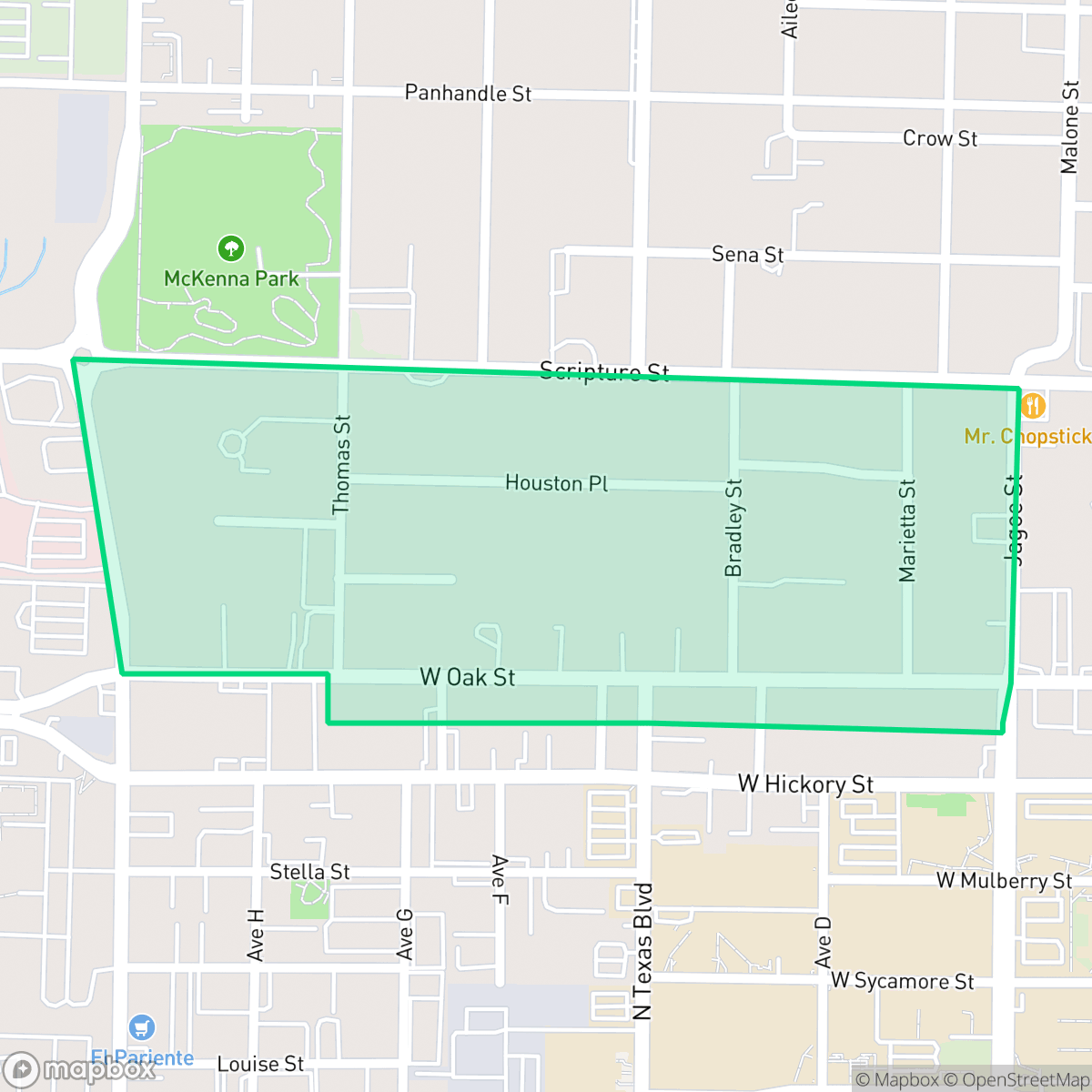
Adopted by the city in 2008, the West Oak Area Historic District in Denton, Texas, comprises 89 historic buildings located along Oak, Jagoe, Marietta, Bradley, and Thomas streets, as well as Houston Place. Developed as a residential haven just west of the downtown courthouse square, this neighborhood features an eclectic architectural blend of early 20th-century Revival styles, Craftsman bungalows, cottages, Minimal Traditional homes, and mid-century Ranch houses. The district serves as a key component of Denton's west-side historic residential fabric. Its tree-lined streets and consistent setbacks preserve a distinct early-to-mid-20th-century streetscape, reflecting the residential expansion that occurred as locals moved away from the noise of the central railroad lines.
The neighborhood maintains a distinct identity through its well-preserved streetscapes and consistent residential setbacks. Unlike the busier areas closer to the downtown square, this district offers a more tranquil environment with a strong sense of community. Residents benefit from a highly walkable layout and proximity to local landmarks, making it a convenient choice for those who value pedestrian access to daily amenities while maintaining a quiet home life. The area is largely insulated from industrial noise, contributing to a comfortable acoustic environment that stands out compared to other parts of Denton.
Prospective residents should note that while the neighborhood provides a high quality of life, it is best suited for those who appreciate a slower pace and a historic aesthetic. It is particularly well-regarded by dog owners and those who prefer a stable, suburban environment. Families are supported by the Denton Independent School District, which provides a range of educational opportunities. While air quality and privacy levels are consistent with typical urban-suburban transitions, the overall livability is bolstered by excellent flood safety and a strong, cohesive community character.
Neighborhood Scores Across 15 Qualities
Residential spacing varies between private fenced backyards and more densely packed multi-family housing. According to iHuus data, the level of separation between neighbors is slightly lower than the Denton average.
Pedestrian infrastructure is exceptionally strong here, featuring wide sidewalks and a consistent grid layout that makes navigating the area on foot easier than in most parts of Denton. According to iHuus data, well-marked crossings and low-traffic residential streets provide a highly accessible environment for walkers.
Uniform architecture and modest yards characterize this area, which offers slightly less visual variety than the Denton average. Residential views consist primarily of standard-roofed housing and well-maintained institutional structures.
Abundant campus lawns, wide green verges, and a central sports field provide excellent walking areas for pets. According to iHuus data, the availability of connected green spaces and safe paths makes this area slightly more dog friendly than the Denton average.
Open land and scattered homes amid woodland or fields provide a more relaxed, less dense environment than the Denton average. According to iHuus data, the area features a mix of mature tree canopies and mid-size residential complexes rather than dense urban development.
Local dining and social hubs are much more concentrated here than in the rest of Denton. This area balances quiet, green residential streets with easy access to diverse, walkable dining options.
Acoustic levels remain notably lower than the Denton average, consisting primarily of infrequent distant trains and sporadic passing vehicles. According to iHuus data, the area maintains a high level of acoustic comfort for residents.
Air quality levels fluctuate between acceptable and unhealthy, presenting occasional concerns for sensitive groups. This pattern is largely consistent with the broader Denton area according to iHuus data.
No heavy industrial sites or warehouses are present within the district. This area remains entirely residential and light commercial, offering a higher degree of separation from industrial hazards than the Denton average.
Health insurance enrollment among residents is slightly below the Denton city average, according to iHuus data.
Voting patterns and census indicators show a much more liberal leaning than the Denton average, according to iHuus data.
Young adults form the primary demographic in this area, representing a younger population than the Denton average. Residents will find a modest presence of families and older adults alongside this larger group of young adults, according to iHuus data.
Property within this district is situated inside a designated floodplain, which presents a much higher risk of flooding than the Denton average. According to iHuus data, residents should anticipate a significant likelihood of requiring flood insurance.
Address-Level Insights for West Oak Historic District


iHuus Neighborhood Intelligence Insights
Get address-level neighborhood insights for West Oak Historic District
- Street-level scores — see how individual blocks compare, not just neighborhood averages
- Micro-zone boundaries — identify quiet pockets, flood boundaries, and walkable clusters before you visit
- 15 dimensions in full — walkability, noise, air quality, school quality, insurance coverage, population age profile, urban/rural index, and more
- Boundary risk alerts — know if your address sits near a block boundary where scores drop, the kind of detail no listing will ever mention
- School insights — individual school ratings and insights, not just district-level data
- Compare before you commit — side-by-side data across neighborhoods, down to block precision
No credit card required
Compare with Any Neighborhood
| Dimension | West Oak Historic District | Cement City |
|---|---|---|
| 🚶 Walkabilityavg 7.51 | ||
| 🔊 Acoustic Comfortavg 4.56 | ||
| 🤫 Privacy Indexavg 5.87 | ||
| 🎨 Visual Appealavg 6.57 | ||
| 🐕 Dog Friendlinessavg 7.07 | ||
| 🗺️ Urban-Rural Indexavg 7.32 | ||
| ✨ Neighborhood Vibeavg 4.5 | ||
| 🏥 Health Insurance Coverageavg 6.86 | ||
| 🌿 Air Qualityavg 3.91 | ||
| 🏭 Industrial Proximityavg 8.87 | ||
| 🌊 Flood Safetyavg 4.19 | ||
| 🗳️ Ideological Leanavg 6.05 | ||
| 👥 Population Age Profileavg 4.44 | ||
| 🔥 Fire Safety | ||
| 🏫 School Quality |
West Oak Historic District Rankings
School Districts Serving West Oak Historic District
School Insights for West Oak Historic District
Below average outcomes; significant attendance and academic challenges.
School Insights
See what's really behind every school rating near West Oak Historic District
- Individual school ratings — each school's own score with outcome context, not just a district average
- Enrollment & class size data — student-to-teacher ratio and how it compares to the state average
- Full demographics breakdown — ethnicity and gender composition for every school in the enrollment zone
- Every school in the district — all schools within the enrollment boundary ranked by rating, not just the closest one
- Grade levels & benchmarks — elementary through high school, with below/above state-average flags
No credit card required