Southridge, Denton
Updated · 4,570 residents
Southridge is a visually distinctive neighborhood in Denton known for its curvilinear street layout and well-preserved mid-century architecture. While the area offers a quiet, low-density suburban atmosphere with high visual appeal, it remains primarily car-dependent with noticeable noise levels from nearby road traffic.
Key Highlights
About Southridge
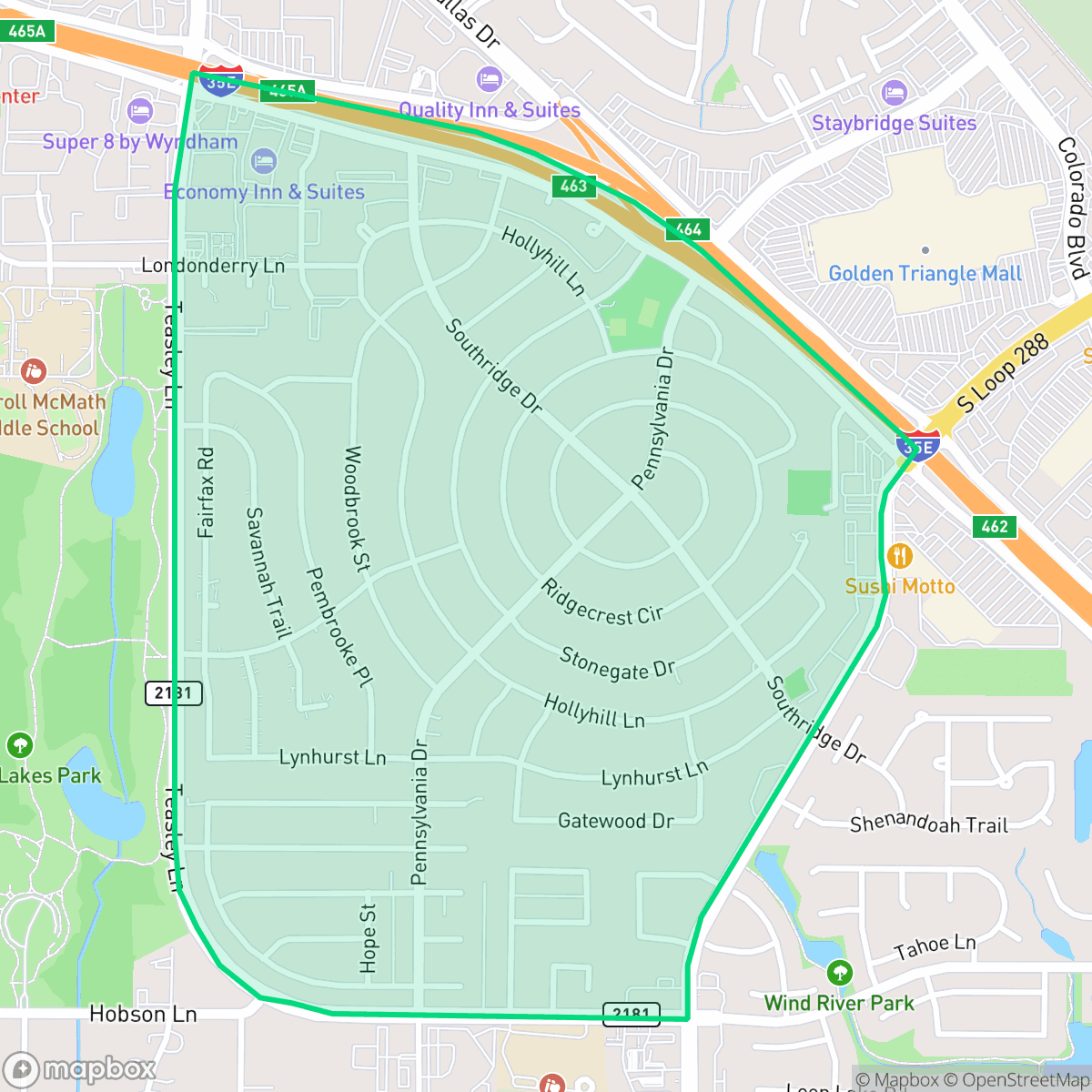
Established in 1966 on Denton’s south side, the Southridge subdivision is one of the city's most iconic post-World War II neighborhoods. Located south of Interstate 35 along Teasley Lane and Lillian Miller Parkway, Southridge is distinguished by its unique spiral or curvilinear street pattern rather than a standard grid. The neighborhood features a well-preserved collection of Styled Ranch and Mid-Century Modern homes built primarily between the 1960s and 1980s, characterized by low-pitched roofs, asymmetrical facades, and natural materials. Notable streets include Woodbrook Street, Hollyhill Lane, and Ridgecrest Circle. A central neighborhood hub, the member-run Southridge Recreation Club, was established in 1971. Recognizing its architectural significance, the City of Denton initiated a historic resource survey in 2025 to evaluate Southridge for potential National Register of Historic Places and local historic district designations.
The area serves as a quiet residential enclave characterized by its unique post-war housing stock and significant open green spaces. Residents have access to local dining options along major corridors, though the layout prioritizes vehicle travel over pedestrian access. According to iHuus data, the neighborhood maintains a strong sense of visual character that distinguishes it from more standard grid-based developments in the region.
Families are drawn to the stability of the Denton Independent School District, which serves the area with comprehensive extracurricular programs despite the logistical pressures of local population growth. While the neighborhood provides a peaceful environment with low industrial proximity, prospective residents should anticipate higher levels of road noise and a reliance on personal vehicles for daily errands. The area is well-suited for those who value architectural history and a suburban pace of life over high-density walkability.
Neighborhood Scores Across 15 Qualities
Residential spacing varies between closely packed apartments and single-family homes with minimal setbacks. This level of density is slightly higher than the Denton average, according to iHuus data.
Pedestrian access is hindered by high speed arterials and highway barriers that fragment the local sidewalk network. While some trails connect parks and schools, the overall walkability is below the Denton average according to iHuus data.
Large homes and frequent upscale amenities contribute to a visual appeal that is higher than the Denton average. Residents will find well-maintained properties and spacious driveways throughout many parts of the neighborhood, according to iHuus data.
A large central park with walking trails and a pond provides significant space for pets, though greenery near some apartment complexes can be fragmented. This level of accessibility for pet owners is consistent with the Denton average.
Open land and scattered homes provide a semi-rural atmosphere, though this sense of openness is slightly lower than the Denton average due to pockets of dense suburban apartment complexes and commercial strips. According to iHuus data, the area features a mix of woodland edges and light industrial warehouses alongside these developed clusters.
Local activity is characterized by a steady but low-density suburban energy that is slightly more subdued than the Denton average. While various dining and essential services are accessible, the area's layout is primarily car-dependent with limited walkable amenities.
Steady sounds from nearby busy streets are common here, making the acoustic environment slightly less peaceful than the Denton average. According to iHuus data, residents may experience a persistent background hum from local vehicle movement.
Frequent unhealthy air quality levels present a significant risk to sensitive groups. According to iHuus data, conditions in this area are worse than the Denton city average.
Residential life is largely undisturbed by heavy industry, though some areas near the western edge may experience dust and noise from nearby earth-moving operations. This neighborhood has slightly more industrial presence than the Denton average due to its proximity to warehouse districts and major highway corridors.
Health insurance coverage among residents is higher than the Denton average. According to iHuus data, most people in the area have access to medical coverage.
Political leanings in Southridge are split evenly between conservative and liberal views. This ideological balance reflects the broader political landscape found across Denton.
Residents live among a varied mix of young adults, families, and older individuals; this demographic spread is slightly more balanced than the Denton average according to iHuus data.
Flood risk levels in this area are consistent with the Denton average, as FEMA has not yet finalized detailed studies for this specific location. According to iHuus data, residents should remain aware of moderate uncertainty regarding precise flood mapping for the neighborhood.
Address-Level Insights for Southridge


iHuus Neighborhood Intelligence Insights
Get address-level neighborhood insights for Southridge
- Street-level scores — see how individual blocks compare, not just neighborhood averages
- Micro-zone boundaries — identify quiet pockets, flood boundaries, and walkable clusters before you visit
- 15 dimensions in full — walkability, noise, air quality, school quality, insurance coverage, population age profile, urban/rural index, and more
- Boundary risk alerts — know if your address sits near a block boundary where scores drop, the kind of detail no listing will ever mention
- School insights — individual school ratings and insights, not just district-level data
- Compare before you commit — side-by-side data across neighborhoods, down to block precision
No credit card required
Compare with Any Neighborhood
| Dimension | Southridge | Cement City |
|---|---|---|
| 🚶 Walkabilityavg 7.51 | ||
| 🔊 Acoustic Comfortavg 4.56 | ||
| 🤫 Privacy Indexavg 5.87 | ||
| 🎨 Visual Appealavg 6.57 | ||
| 🐕 Dog Friendlinessavg 7.07 | ||
| 🗺️ Urban-Rural Indexavg 7.32 | ||
| ✨ Neighborhood Vibeavg 4.5 | ||
| 🏥 Health Insurance Coverageavg 6.86 | ||
| 🌿 Air Qualityavg 3.91 | ||
| 🏭 Industrial Proximityavg 8.87 | ||
| 🌊 Flood Safetyavg 4.19 | ||
| 🗳️ Ideological Leanavg 6.05 | ||
| 👥 Population Age Profileavg 4.44 | ||
| 🔥 Fire Safety | ||
| 🏫 School Quality |
Southridge Rankings
School Districts Serving Southridge
School Insights for Southridge
Below average outcomes; significant attendance and academic challenges.
School Insights
See what's really behind every school rating near Southridge
- Individual school ratings — each school's own score with outcome context, not just a district average
- Enrollment & class size data — student-to-teacher ratio and how it compares to the state average
- Full demographics breakdown — ethnicity and gender composition for every school in the enrollment zone
- Every school in the district — all schools within the enrollment boundary ranked by rating, not just the closest one
- Grade levels & benchmarks — elementary through high school, with below/above state-average flags
No credit card required