Pecan, Denton
Updated · 5,895 residents
The Pecan neighborhood offers a unique blend of historic charm and musical culture, with Panhandle Street serving as a local hub for practicing musicians. Residents benefit from a strong grid layout that encourages walking, alongside a quiet suburban atmosphere that balances residential comfort with proximity to the city center. According to iHuus data, the area maintains a high degree of residential privacy while remaining well-connected to the surrounding Denton community.
Key Highlights
About Pecan
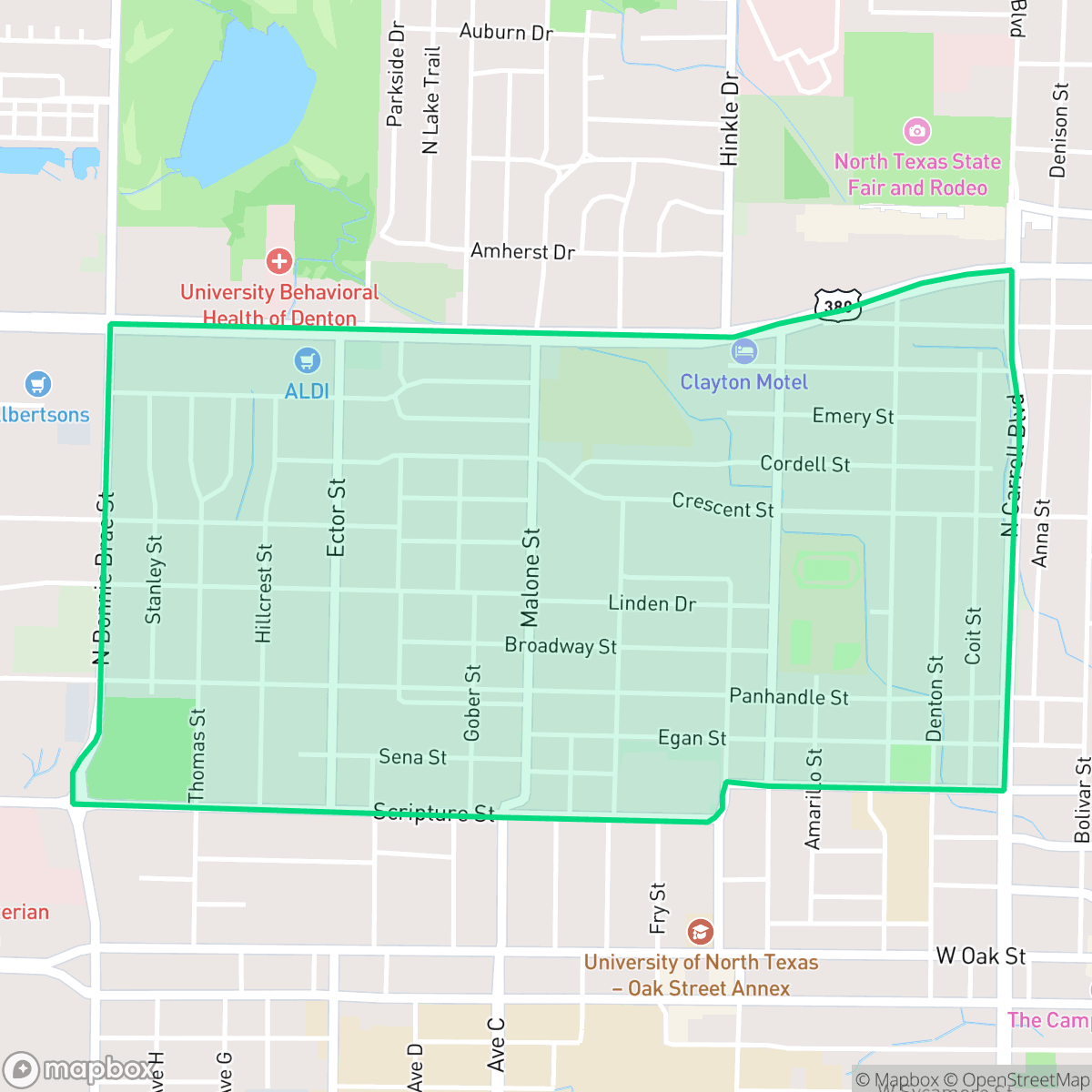
The PECAN neighborhood in Denton, Texas—an acronym for the Panhandle, Egan, Congress Area of Neighbors—is one of the city's oldest residential areas, located just northwest of the downtown square. Developed primarily during the 1920s and 1930s as Denton's northern edge, the neighborhood features a diverse mix of historic homes, local families, and university students. The neighborhood association was formally established in 1995–1996 to preserve the area's character and foster community connections. Culturally, the neighborhood is defined by a vibrant musical identity; Panhandle Street is locally nicknamed "Jamhandle" due to the high concentration of resident musicians and bands practicing in the area.
Located just northwest of the Denton square, the area is defined by its mature tree canopy and a mix of single-family homes and mid-sized apartment complexes. The neighborhood maintains a calm, suburban environment that is popular among both families and university students. With a high level of industrial separation, the streets are largely free from heavy commercial activity, creating a peaceful living environment that integrates well with local green spaces and neighborhood parks.
While the area provides excellent walkability and a consistent residential feel, prospective residents should note specific environmental factors. Data from iHuus indicates that while the neighborhood is generally quiet, road traffic contributes to moderate noise levels. Furthermore, the area faces challenges regarding flood safety, and families with children should consider the performance variance across local schools, such as Newton Rayzor Elementary and Calhoun Middle, when evaluating the district's overall educational offerings.
Neighborhood Scores Across 15 Qualities
Residential lots feature moderate separation with private fenced backyards and typical urban spacing. According to iHuus data, the level of buffer between neighbors is roughly consistent with the Denton average.
Consistent sidewalk access and a clear grid layout make much of the area easy to navigate on foot. While the neighborhood matches the city average for walkability, heavy traffic on main arterial roads can reduce pedestrian comfort in certain sections.
Modest yards and uniform roof geometries define this area, which offers slightly less visual variety than the Denton average. Residential views consist primarily of middle-class housing and apartment complexes with regular, functional landscaping.
Tree-lined streets and public athletic fields provide decent walking areas for pets, though opportunities for pet exercise are slightly below the Denton average. According to iHuus data, the presence of a large public park in the northeast quadrant adds a notable benefit for dog owners.
Open land and scattered homes are common here, making the area feel slightly more rural than the Denton average. Residents will find a mix of wooded patches and fields alongside more established residential grids.
Frequent visits to local cafes and diverse dining options are common here, as this area possesses a significantly higher concentration of social hubs than the Denton average. While many streets offer a calm, suburban atmosphere, the presence of various restaurants and community landmarks creates a noticeably active environment according to iHuus data.
Steady traffic sounds from nearby busy streets are common here; this level of acoustic activity is roughly consistent with the Denton average.
Air quality in this area fluctuates between acceptable and unhealthy levels, presenting occasional concerns for sensitive groups. According to iHuus data, these conditions are roughly consistent with the average seen across Denton.
Residential and light commercial uses dominate this area with no detectable warehouses or heavy industrial facilities. This lack of industrial proximity is even more pronounced here than in the Denton average.
Health insurance accessibility is slightly below the Denton city average, according to iHuus data. This indicates a moderate level of coverage among the resident population.
Voting patterns and census indicators show a strong liberal leaning that is notably higher than the Denton city average, according to iHuus data.
Residents live alongside a diverse mix of young adults, families, and seniors. This age distribution is largely consistent with the average found across Denton.
Flood risk in Pecan is elevated because portions of the area sit within a designated 100-year floodplain. According to iHuus data, this level of risk is notably higher than the Denton city average and may necessitate flood insurance.
Address-Level Insights for Pecan


iHuus Neighborhood Intelligence Insights
Get address-level neighborhood insights for Pecan
- Street-level scores — see how individual blocks compare, not just neighborhood averages
- Micro-zone boundaries — identify quiet pockets, flood boundaries, and walkable clusters before you visit
- 15 dimensions in full — walkability, noise, air quality, school quality, insurance coverage, population age profile, urban/rural index, and more
- Boundary risk alerts — know if your address sits near a block boundary where scores drop, the kind of detail no listing will ever mention
- School insights — individual school ratings and insights, not just district-level data
- Compare before you commit — side-by-side data across neighborhoods, down to block precision
No credit card required
Compare with Any Neighborhood
| Dimension | Pecan | Cement City |
|---|---|---|
| 🚶 Walkabilityavg 7.51 | ||
| 🔊 Acoustic Comfortavg 4.56 | ||
| 🤫 Privacy Indexavg 5.87 | ||
| 🎨 Visual Appealavg 6.57 | ||
| 🐕 Dog Friendlinessavg 7.07 | ||
| 🗺️ Urban-Rural Indexavg 7.32 | ||
| ✨ Neighborhood Vibeavg 4.5 | ||
| 🏥 Health Insurance Coverageavg 6.86 | ||
| 🌿 Air Qualityavg 3.91 | ||
| 🏭 Industrial Proximityavg 8.87 | ||
| 🌊 Flood Safetyavg 4.19 | ||
| 🗳️ Ideological Leanavg 6.05 | ||
| 👥 Population Age Profileavg 4.44 | ||
| 🔥 Fire Safety | ||
| 🏫 School Quality |
Pecan Rankings
School Districts Serving Pecan
School Insights for Pecan
Below average outcomes; significant attendance and academic challenges.
School Insights
See what's really behind every school rating near Pecan
- Individual school ratings — each school's own score with outcome context, not just a district average
- Enrollment & class size data — student-to-teacher ratio and how it compares to the state average
- Full demographics breakdown — ethnicity and gender composition for every school in the enrollment zone
- Every school in the district — all schools within the enrollment boundary ranked by rating, not just the closest one
- Grade levels & benchmarks — elementary through high school, with below/above state-average flags
No credit card required