Oak Hickory Historic District, Denton
Updated · 1,281 residents
The Oak Hickory Historic District is a vibrant, pedestrian-friendly enclave known for its diverse architectural heritage and proximity to the heart of Denton. Residents enjoy high walkability and a lively atmosphere, though the area experiences moderate noise levels from local road traffic.
Key Highlights
About Oak Hickory Historic District
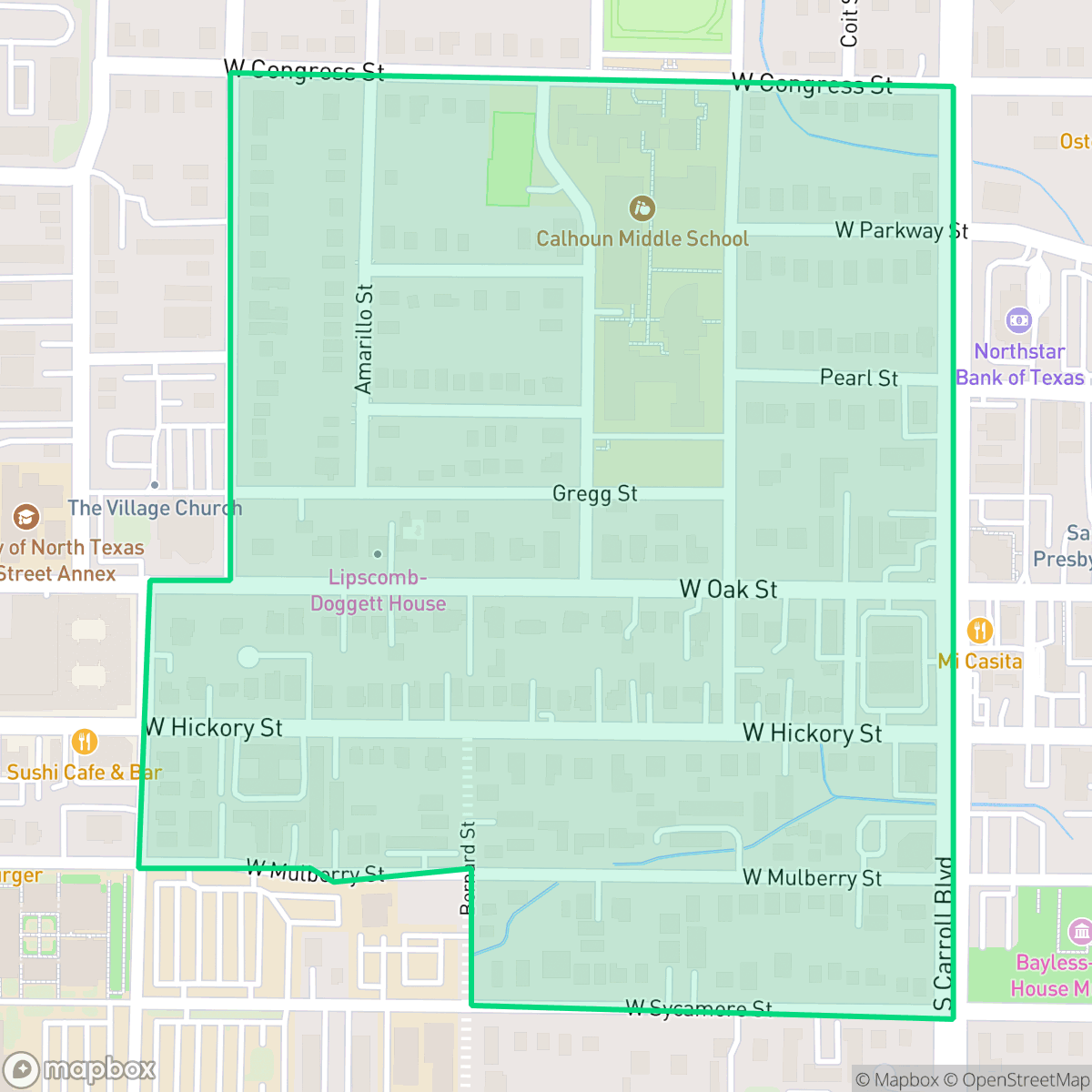
Adopted as a historic district in 1985, Denton’s Oak-Hickory Historic District encompasses 70 historic buildings along Oak, Hickory, Denton, and Mounts streets. Historically known as "Silk Stocking Row," the neighborhood developed west of the courthouse square between 1878 and 1931 as wealthy merchants, civic leaders, and professionals constructed elegant residences. The area features a highly eclectic array of architectural styles, including Queen Anne Victorian, Classical Revival, Tudor, Georgian, and Craftsman. Notable landmarks include the 1885 Scripture-Deavenport House, the 1895 Lipscomb-Doggett House, and the 1900 Blewett House—the first home in Denton to feature central heating. Today, the university-adjacent neighborhood is celebrated for its preservation efforts and deep connection to Denton's early economic and civic development.
The neighborhood serves as a central hub for those seeking a mix of historic charm and modern urban convenience. With a high walkability score, the area is well-suited for residents who prefer navigating by foot, offering easy access to local schools and commercial zones. The local vibe is notably active, supported by a variety of unique dining establishments and community spaces. According to iHuus data, the area maintains a high level of industrial safety, ensuring that residents are removed from heavy industrial hazards and benefit from a purely residential and light commercial environment.
Prospective residents should consider the trade-offs of living in a central, high-traffic environment. While the area is highly accessible, the average noise level from road traffic is approximately 59 decibels, which may impact acoustic comfort. Additionally, the neighborhood faces significant challenges regarding flood safety, and prospective buyers should review local environmental disclosures carefully. It is best suited for individuals who prioritize walkability and proximity to the city center over absolute quiet or flood-resistant terrain.
Neighborhood Scores Across 15 Qualities
Residential spacing is somewhat limited, with some buildings situated closely together or sharing boundaries. According to iHuus data, this level of separation is slightly lower than the Denton city average.
Extensive sidewalks on both sides of the streets and clear pedestrian paths make most errands easy to complete on foot. According to iHuus data, this connectivity is notably superior to the Denton city average.
Standard residential architecture and tidy but small yards define the area. This level of visual variety is slightly lower than the Denton city average according to iHuus data.
Continuous grassy verges and nearby athletic fields provide some walking space for pets, though overall accessibility to open greenery is below the Denton average according to iHuus data.
Open land and scattered homes among woodlands create a more semi-rural atmosphere than the more urbanized Denton average, according to iHuus data.
Access to diverse dining, historic landmarks, and green spaces makes this area significantly more lively than the Denton average. According to iHuus data, the district features a rich infrastructure of local cafes, restaurants, and cultural sites.
Steady ambient noise from nearby busy streets is a frequent presence, though acoustic levels remain more comfortable than the Denton city average.
Air quality levels fluctuate between acceptable and unhealthy ranges, with occasional concerns for sensitive groups. These conditions are roughly in line with the rest of Denton, according to iHuus data.
Industrial activity and large warehouses are absent from this area. According to iHuus data, the district contains only residential, educational, and light commercial land uses, making it even more free of industrial hazards than the Denton average.
Health insurance accessibility is slightly lower than the Denton average, according to iHuus data.
Voting patterns and census indicators reflect a strongly liberal political leaning that is significantly more pronounced than the Denton city average.
Young adults comprise the majority of the population here, resulting in a significantly lower average age than the rest of Denton. According to iHuus data, there is a modest presence of families and older residents, but the area skews much younger than the city average.
Significant flood hazards exist in this area, resulting in much higher vulnerability to water damage than the Denton average. Residents should expect elevated or potentially prohibitive flood insurance costs according to iHuus data.
Address-Level Insights for Oak Hickory Historic District


iHuus Neighborhood Intelligence Insights
Get address-level neighborhood insights for Oak Hickory Historic District
- Street-level scores — see how individual blocks compare, not just neighborhood averages
- Micro-zone boundaries — identify quiet pockets, flood boundaries, and walkable clusters before you visit
- 15 dimensions in full — walkability, noise, air quality, school quality, insurance coverage, population age profile, urban/rural index, and more
- Boundary risk alerts — know if your address sits near a block boundary where scores drop, the kind of detail no listing will ever mention
- School insights — individual school ratings and insights, not just district-level data
- Compare before you commit — side-by-side data across neighborhoods, down to block precision
No credit card required
Compare with Any Neighborhood
| Dimension | Oak Hickory Historic District | Cement City |
|---|---|---|
| 🚶 Walkabilityavg 7.51 | ||
| 🔊 Acoustic Comfortavg 4.56 | ||
| 🤫 Privacy Indexavg 5.87 | ||
| 🎨 Visual Appealavg 6.57 | ||
| 🐕 Dog Friendlinessavg 7.07 | ||
| 🗺️ Urban-Rural Indexavg 7.32 | ||
| ✨ Neighborhood Vibeavg 4.5 | ||
| 🏥 Health Insurance Coverageavg 6.86 | ||
| 🌿 Air Qualityavg 3.91 | ||
| 🏭 Industrial Proximityavg 8.87 | ||
| 🌊 Flood Safetyavg 4.19 | ||
| 🗳️ Ideological Leanavg 6.05 | ||
| 👥 Population Age Profileavg 4.44 | ||
| 🔥 Fire Safety | ||
| 🏫 School Quality |
Oak Hickory Historic District Rankings
School Districts Serving Oak Hickory Historic District
School Insights for Oak Hickory Historic District
Below average outcomes; significant attendance and academic challenges.
School Insights
See what's really behind every school rating near Oak Hickory Historic District
- Individual school ratings — each school's own score with outcome context, not just a district average
- Enrollment & class size data — student-to-teacher ratio and how it compares to the state average
- Full demographics breakdown — ethnicity and gender composition for every school in the enrollment zone
- Every school in the district — all schools within the enrollment boundary ranked by rating, not just the closest one
- Grade levels & benchmarks — elementary through high school, with below/above state-average flags
No credit card required