Downtown, Denton
Updated · 4,738 residents
Downtown Denton serves as a vibrant social hub defined by its historic square and active arts scene. While the neighborhood offers a mostly walkable environment for residents, the area remains car-dependent due to its surrounding transit corridors and light industrial gaps.
Key Highlights
About Downtown
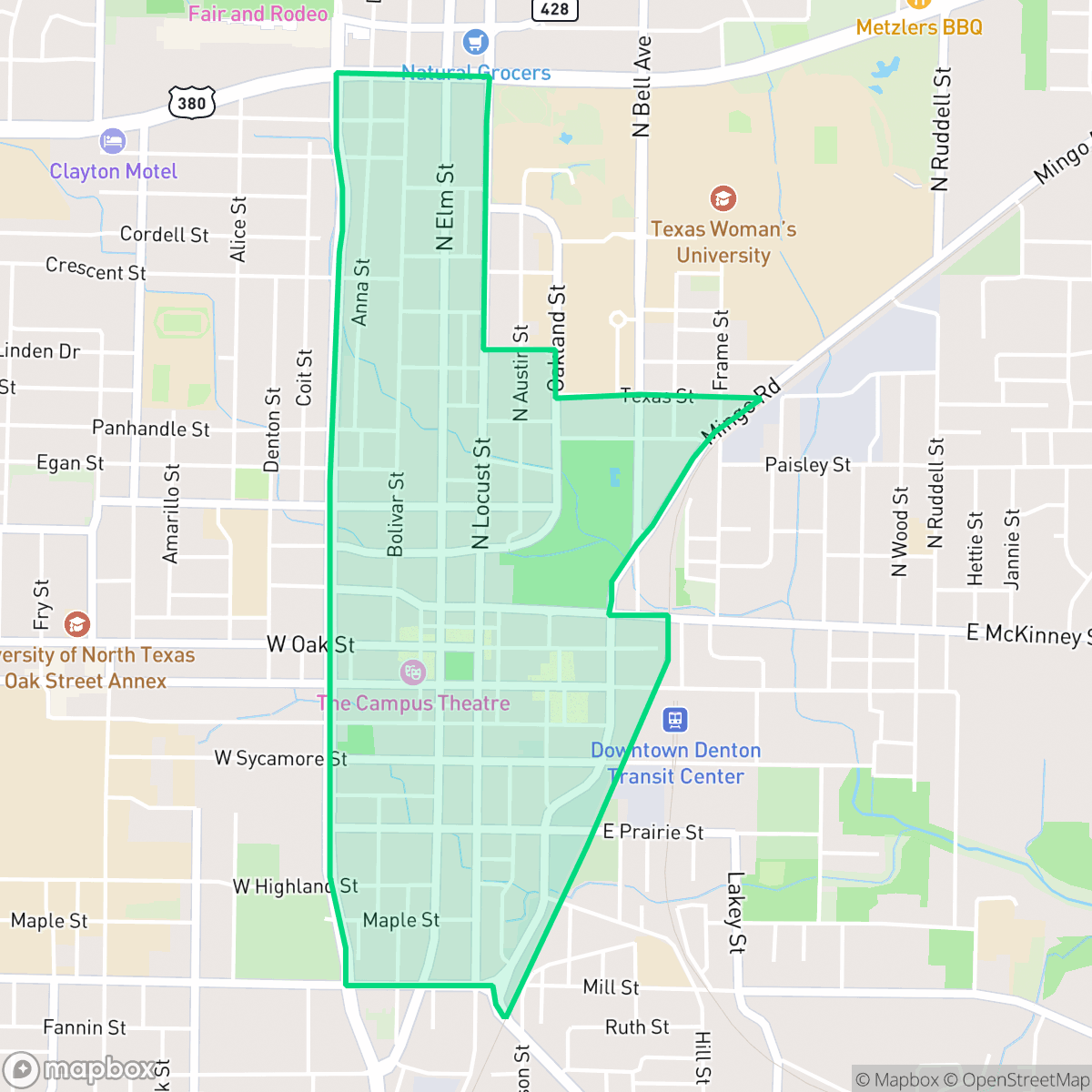
Downtown Denton, established in 1857 as the Denton County seat, serves as the historic and cultural heart of the city. The neighborhood is anchored by the iconic 1896 Denton County Courthouse-on-the-Square, a Romanesque Revival and Second Empire masterpiece designed by W.C. Dodson. The surrounding district, a designated National Register Historic District, features over 50 preserved buildings that once housed early 20th-century commerce, including the Wright Opera House, now home to the landmark Recycled Books. Following a period of mid-century decline, the area underwent extensive revitalization through the Texas Main Street Program. Today, it is defined by its vibrant music scene, influenced by the nearby University of North Texas and Texas Woman's University, and its role as a hub for local arts, dining, and community festivals held on the courthouse square.
The neighborhood functions as a central nexus for dining and community engagement, attracting a diverse demographic of young professionals and long-term residents. It maintains a strongly liberal ideological leaning and features a blend of low-rise apartments and single-family homes. The grid-based layout supports reliable pedestrian access, though the presence of nearby busy streets results in moderate traffic noise throughout the day. According to iHuus data, the area is notably more developed than the surrounding city, which contains more open land and woodland. Prospective residents should note that the area faces specific environmental and infrastructure considerations. It is located within a significant floodplain, and air quality can fluctuate, occasionally impacting sensitive groups. Additionally, while the community is lively and well-connected to local schools, it features less green space and visual variety than other parts of the city. It is best suited for those who prioritize proximity to urban amenities over quiet, expansive residential settings.
Neighborhood Scores Across 15 Qualities
Residential spacing varies between dense apartment layouts and more traditional urban lots with moderate buffering. According to iHuus data, privacy levels are roughly consistent with the Denton city average.
Pedestrian access is reliable due to a consistent grid system and sidewalks on many streets, though heavy traffic on main arterial roads can impact comfort. While the area is slightly less walkable than the Denton average, the proximity to schools and commercial zones supports easy local movement.
Housing consists primarily of multi-family units, townhomes, and modest apartment complexes with uniform rooflines. This area features less visual variety and greenery compared to the Denton average, according to iHuus data.
Grassy verges, sidewalks, and nearby public parks provide decent walking areas for pets, though overall dog friendliness is slightly below the Denton city average according to iHuus data.
An urban layout featuring a blend of low-rise apartments, single-family homes, and commercial corners characterizes this area. According to iHuus data, this neighborhood feels more developed than the surrounding Denton area, which contains more open land and scattered woodland.
Social activity is significantly higher than the Denton average, driven by a dense concentration of diverse dining options and local landmarks. While the area offers a vibrant mix of eateries and community spaces, the layout remains car-dependent due to the presence of light industrial units and railway corridors.
Steady traffic hum from nearby busy streets is common here. This level of acoustic activity is slightly higher than the Denton average, according to iHuus data.
Air quality levels fluctuate between acceptable and unhealthy, presenting occasional concerns for sensitive groups. This condition is largely in line with the average for Denton.
Industrial activity is very low throughout the area, consisting primarily of residential and light commercial uses. While a few warehouses and an electrical substation are located on the edges of the neighborhood, the level of heavy industry is slightly below the Denton city average according to iHuus data.
Health insurance coverage levels in this area are lower than the Denton city average, according to iHuus data.
Voting patterns and census indicators show a predominantly liberal leaning that is notably higher than the Denton city average, according to iHuus data.
Residents encounter a varied demographic of young adults, families, and older individuals. This population spread is slightly more concentrated toward younger age groups than the Denton average, according to iHuus data.
Flood risk in this area is notably higher than the Denton average, as parts of the neighborhood sit within a designated 100-year floodplain. According to iHuus data, residents should anticipate a greater need for flood insurance.
Address-Level Insights for Downtown


iHuus Neighborhood Intelligence Insights
Get address-level neighborhood insights for Downtown
- Street-level scores — see how individual blocks compare, not just neighborhood averages
- Micro-zone boundaries — identify quiet pockets, flood boundaries, and walkable clusters before you visit
- 15 dimensions in full — walkability, noise, air quality, school quality, insurance coverage, population age profile, urban/rural index, and more
- Boundary risk alerts — know if your address sits near a block boundary where scores drop, the kind of detail no listing will ever mention
- School insights — individual school ratings and insights, not just district-level data
- Compare before you commit — side-by-side data across neighborhoods, down to block precision
No credit card required
Compare with Any Neighborhood
| Dimension | Downtown | Cement City |
|---|---|---|
| 🚶 Walkabilityavg 7.51 | ||
| 🔊 Acoustic Comfortavg 4.56 | ||
| 🤫 Privacy Indexavg 5.87 | ||
| 🎨 Visual Appealavg 6.57 | ||
| 🐕 Dog Friendlinessavg 7.07 | ||
| 🗺️ Urban-Rural Indexavg 7.32 | ||
| ✨ Neighborhood Vibeavg 4.5 | ||
| 🏥 Health Insurance Coverageavg 6.86 | ||
| 🌿 Air Qualityavg 3.91 | ||
| 🏭 Industrial Proximityavg 8.87 | ||
| 🌊 Flood Safetyavg 4.19 | ||
| 🗳️ Ideological Leanavg 6.05 | ||
| 👥 Population Age Profileavg 4.44 | ||
| 🔥 Fire Safety | ||
| 🏫 School Quality |
Downtown Rankings
School Districts Serving Downtown
School Insights for Downtown
Below average outcomes; significant attendance and academic challenges.
School Insights
See what's really behind every school rating near Downtown
- Individual school ratings — each school's own score with outcome context, not just a district average
- Enrollment & class size data — student-to-teacher ratio and how it compares to the state average
- Full demographics breakdown — ethnicity and gender composition for every school in the enrollment zone
- Every school in the district — all schools within the enrollment boundary ranked by rating, not just the closest one
- Grade levels & benchmarks — elementary through high school, with below/above state-average flags
No credit card required