Wolf Creek, Dallas
Updated · 36,051 residents
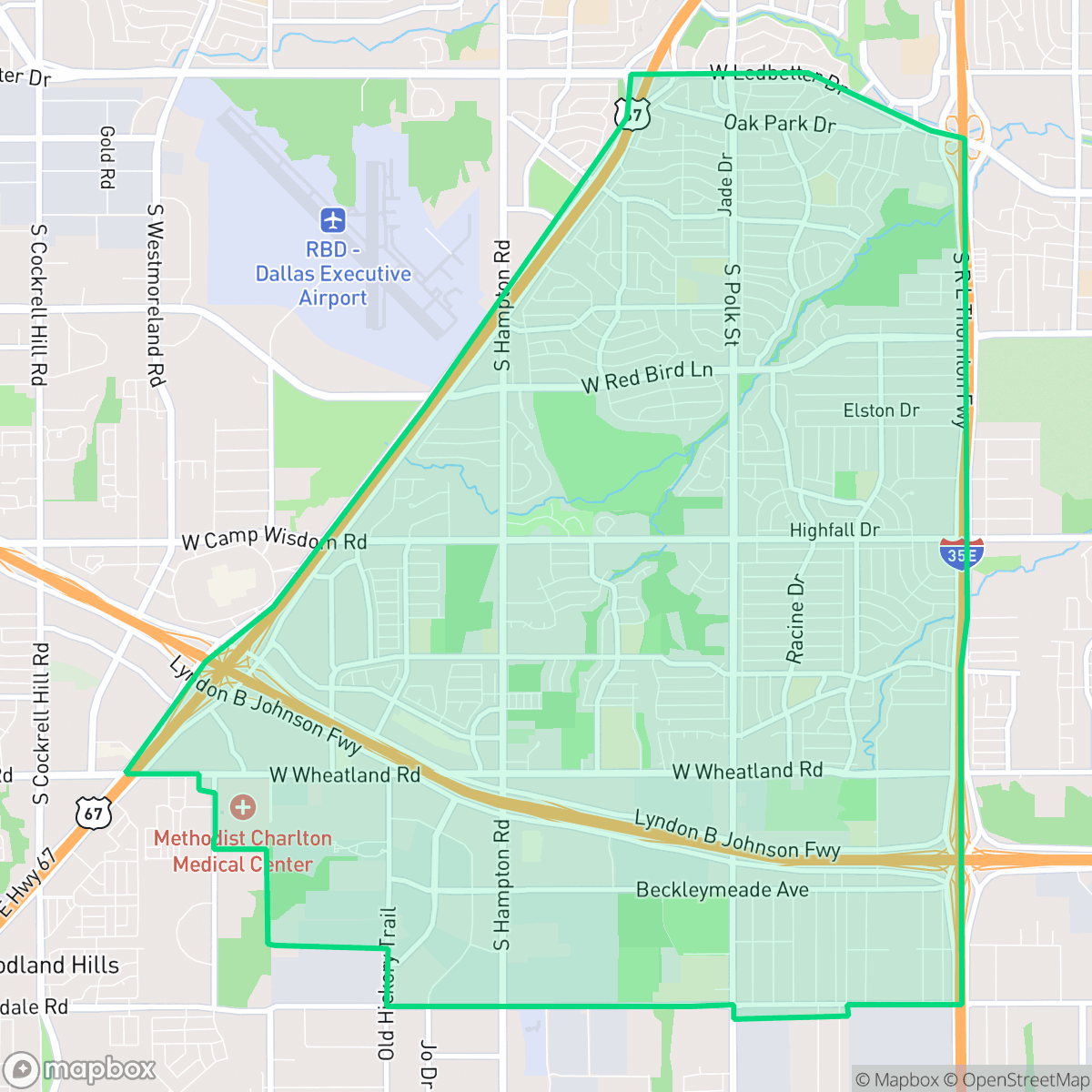
Wolf Creek is a dense suburban neighborhood in southern Dallas defined by its mix of residential tracts and industrial logistics hubs. While the area offers consistent sidewalk access and green verges for walking, its proximity to major highways and warehouses contributes to a car-dependent environment with notable road traffic noise.
Key Highlights
About Wolf Creek
The Wolf Creek neighborhood in southern Dallas encompasses the historic 19th-century settlement of Wheatland, originally known as Sprowls’ Corner. Settled in the 1840s and annexed by Dallas in the mid-1950s, the area is home to two prominent local landmarks located along South Hampton Road. The Wheatland United Methodist Church, tracing its roots to 1847, is recognized as the oldest Methodist congregation west of the Trinity River; its historic building, featuring a steeple and stained-glass windows added in 1912, is a designated Recorded Texas Historic Landmark. Adjacent to it is the historic Wheatland Cemetery (originally Branson-Brotherton Cemetery), formally established in 1872 on land donated by early pioneer farmers Tom Branson and H.K. Brotherton. The cemetery holds the graves of early settlers and veterans dating back to the Mexican-American War.
The area functions as a classic suburban landscape, blending single-family homes with large-scale warehouse operations near major highway corridors. According to iHuus data, the neighborhood features a mix of standard tract housing and multi-family complexes, creating a varied residential density. While the layout includes green verges and small wooded patches that support dog walking, the overall character is shaped by its industrial proximity and the presence of logistics centers that generate significant daytime traffic. Residents navigate a landscape where daily amenities often require a vehicle, as the neighborhood is primarily car-oriented despite its accessible sidewalk network. The area presents a complex educational landscape, with access to both high-performing magnet programs and neighborhood campuses within the Dallas, Duncanville, and Lancaster school districts. Prospective residents should consider that the neighborhood faces challenges regarding flood safety and acoustic comfort, with road traffic noise being a consistent factor in the local environment, as noted by iHuus data.
Neighborhood Scores Across 15 Qualities
Residential spacing varies between closely packed multi-family units and single-family homes with small yards. According to iHuus data, the level of separation between neighbors is slightly above the Dallas average.
Residential streets feature consistent sidewalks and accessible park areas, though major highway interchanges and large parking lots create significant barriers for pedestrians. According to iHuus data, connectivity is lower than the Dallas average due to these highway-driven interruptions.
Uniform rooflines and small yards characterize most residential streets, making the visual landscape slightly less varied than the Dallas average. While some pockets feature manicured lawns and private pools, much of the area consists of consistent tract housing and dense apartment complexes.
Large public parks and wide residential verges offer decent space for pet walking, though some areas contain narrow sidewalks and parking lots that offer less open greenery than the Dallas average.
Open land and scattered residential pockets are interspersed with large industrial warehouses, creating a landscape that feels slightly more rural than the typical Dallas urban environment according to iHuus data.
Suburban streets and industrial corridors provide a serene atmosphere, though limited local business density means most dining and services require a vehicle. The area's energy is slightly more subdued than the typical Dallas neighborhood average.
Frequent noise from nearby railroad tracks and major freeway corridors is characteristic of this area. According to iHuus data, acoustic comfort is notably lower than the Dallas average.
Frequent unhealthy air quality levels present a significant risk to sensitive groups. According to iHuus data, the atmosphere in this area is slightly worse than the Dallas average.
Residential and light commercial spaces dominate the area, though large logistics hubs and heavy truck traffic near the southern edge and highway interchanges create notable noise and congestion. According to iHuus data, the neighborhood contains fewer industrial hazards than the Dallas average.
Health insurance coverage among Wolf Creek residents is slightly below the Dallas average. This indicates a moderate level of access to employer-sponsored or private medical plans according to iHuus data.
Voting patterns and census indicators show a significantly more liberal political leaning than the Dallas average. This ideological trend is reflected in the local community landscape according to iHuus data.
Residents live alongside a balanced mix of young professionals, families, and seniors. This demographic spread is consistent with the broader Dallas area according to iHuus data.
Significant flood risk exists due to the area's location within a 100-year floodplain, which is notably higher than the Dallas average. Residents should expect that flood insurance will likely be a requirement for properties here according to iHuus data.
Address-Level Insights for Wolf Creek


iHuus Neighborhood Intelligence Insights
Get address-level neighborhood insights for Wolf Creek
- Street-level scores — see how individual blocks compare, not just neighborhood averages
- Micro-zone boundaries — identify quiet pockets, flood boundaries, and walkable clusters before you visit
- 15 dimensions in full — walkability, noise, air quality, school quality, insurance coverage, population age profile, urban/rural index, and more
- Boundary risk alerts — know if your address sits near a block boundary where scores drop, the kind of detail no listing will ever mention
- School insights — individual school ratings and insights, not just district-level data
- Compare before you commit — side-by-side data across neighborhoods, down to block precision
No credit card required
Compare with Any Neighborhood
| Dimension | Wolf Creek | Arts District |
|---|---|---|
| 🚶 Walkabilityavg 7.43 | ||
| 🔊 Acoustic Comfortavg 3.98 | ||
| 🤫 Privacy Indexavg 5.4 | ||
| 🎨 Visual Appealavg 6.6 | ||
| 🐕 Dog Friendlinessavg 6.65 | ||
| 🗺️ Urban-Rural Indexavg 6.6 | ||
| ✨ Neighborhood Vibeavg 4.96 | ||
| 🏥 Health Insurance Coverageavg 5.31 | ||
| 🌿 Air Qualityavg 4.05 | ||
| 🏭 Industrial Proximityavg 8.56 | ||
| 🌊 Flood Safetyavg 3.3 | ||
| 🗳️ Ideological Leanavg 7.84 | ||
| 👥 Population Age Profileavg 4.6 | ||
| 🔥 Fire Safety | ||
| 🏫 School Quality |
Wolf Creek Rankings
School Districts Serving Wolf Creek
School Insights for Wolf Creek
Below average outcomes; significant attendance and academic challenges.
School Insights
See what's really behind every school rating near Wolf Creek
- Individual school ratings — each school's own score with outcome context, not just a district average
- Enrollment & class size data — student-to-teacher ratio and how it compares to the state average
- Full demographics breakdown — ethnicity and gender composition for every school in the enrollment zone
- Every school in the district — all schools within the enrollment boundary ranked by rating, not just the closest one
- Grade levels & benchmarks — elementary through high school, with below/above state-average flags
No credit card required