Winnetka Heights, Dallas
Updated · 56,310 residents
Winnetka Heights is a historic North Oak Cliff enclave defined by its diverse early 20th-century architecture and expansive green spaces. While the area offers a quiet, semi-rural atmosphere with excellent opportunities for dog walking, residents should be aware of significant flood risks and the necessity of a vehicle for most daily errands.
Key Highlights
About Winnetka Heights
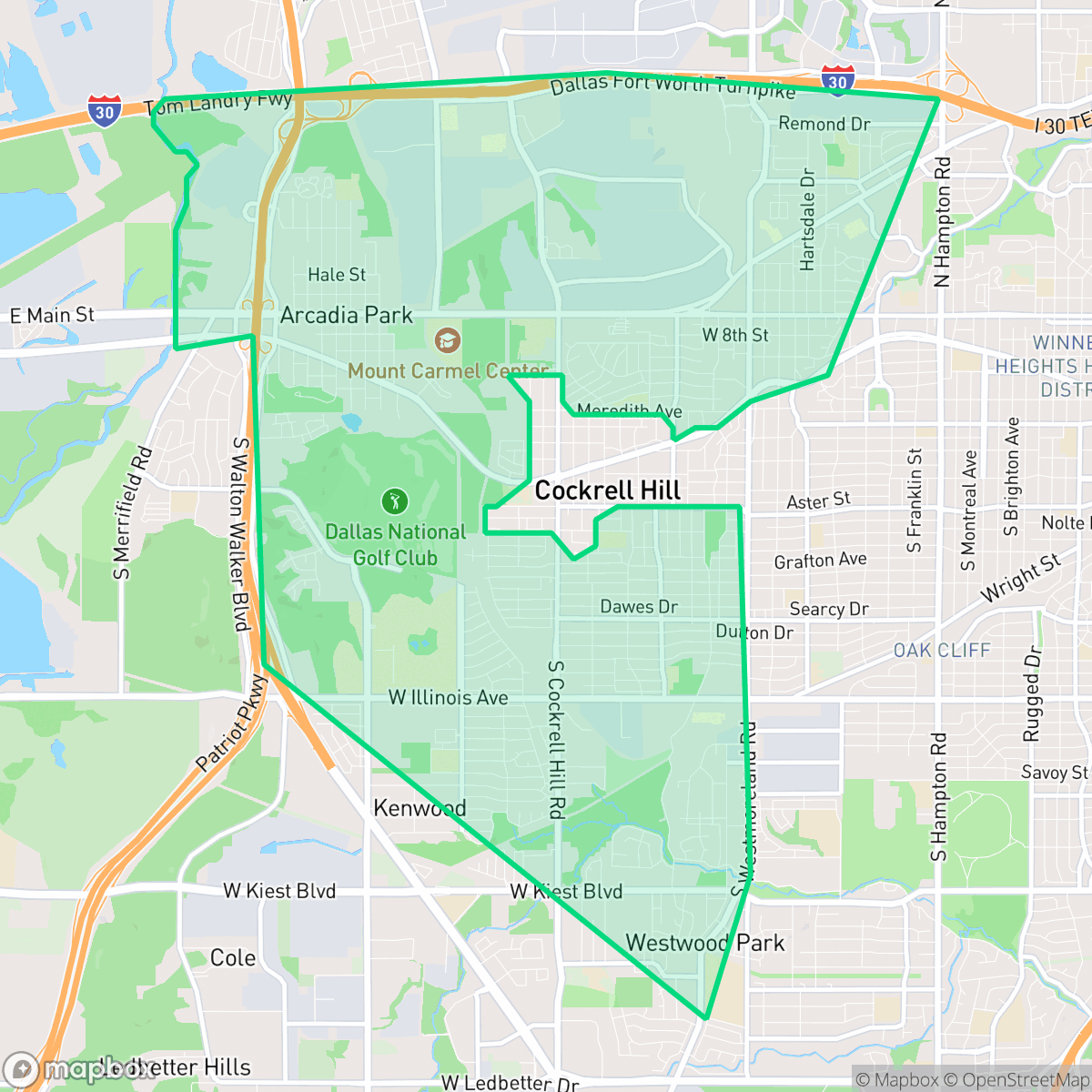
Winnetka Heights, located in North Oak Cliff, is Dallas’s second-largest historic district, featuring over 600 homes across 50 blocks. Platted in 1908 and developed starting in 1910 by J.P. Blake, R.S. Waldron, T.S. Miller Jr., and Leslie Stemmons, the neighborhood was marketed as an ideal suburb with modern amenities like paved streets and electricity. It is renowned for its diverse early 20th-century architecture, including opulent Prairie-style mansions, Craftsman bungalows, and cottages. Notable landmarks include the Turner House, formerly the residence of J.P. Blake, which now serves as the home of the Oak Cliff Society of Fine Arts. After experiencing a decline in the mid-20th century, the neighborhood underwent a significant revitalization beginning in the 1970s, leading to its designation as a Dallas Landmark District in 1981 and its listing on the National Register of Historic Places.
The neighborhood maintains a notably liberal political identity and a subdued, steady rhythm that feels distinct from the denser urban centers of Dallas. The landscape is characterized by functional, uniform housing and a moderate level of residential privacy, providing a consistent environment for its diverse population of families, young adults, and seniors. With minimal industrial presence, the area emphasizes a residential feel supported by scattered woodlands and open land that contribute to its semi-rural character.
Prospective residents should weigh the charm of the historic district against specific livability trade-offs, including a high risk of flooding and limited access to local health insurance coverage. While the grid layout allows for some pedestrian movement, the neighborhood remains largely car-dependent, and families should carefully research the specific academic performance of their assigned schools within the broader Dallas Independent School District, as outcomes vary significantly across the region.
Neighborhood Scores Across 15 Qualities
Residential spacing provides a moderate level of separation between neighbors, sitting slightly above the Dallas average. While some denser clusters and shared-wall structures exist, most homes feature standard suburban setbacks and small yard buffers.
Pedestrian movement is possible via a grid of residential streets and sidewalks, though some high-traffic arterials and heavy vegetation can make navigating the area more difficult than in other parts of Dallas. According to iHuus data, sidewalk connectivity is generally reliable for low-traffic areas but falls below the city average due to occasional gaps near industrial zones and major roadways.
Standard tract housing and apartment blocks define the landscape, featuring uniform rooflines and modest yards. This area offers a simpler visual profile than much of Dallas, with fewer luxury amenities or large private landscapes visible in the neighborhood.
Abundant greenbelts, wooded areas, and a large public park with trails provide excellent space for pets. According to iHuus data, these accessible natural spaces offer slightly more dog walking opportunities than the Dallas average.
Expansive open land and woodland areas provide a sense of openness that is slightly higher than the Dallas average. Residents will find a landscape characterized by scattered homes amidst fields and natural greenery.
A mix of industrial warehouses and residential streets creates a quiet rhythm with occasional pockets of local dining. The area is slightly less active than the city average, often requiring a car to reach various services and social hubs.
Steady traffic noise from nearby busy streets is present, though the acoustic environment remains slightly quieter than the Dallas average according to iHuus data.
Air quality in Winnetka Heights fluctuates between acceptable and unhealthy levels, matching the typical conditions found across Dallas. Sensitive groups should monitor local reports for occasional periods of concern, according to iHuus data.
Primarily composed of residential and light commercial spaces, this area lacks heavy warehouses or industrial hazards. The level of industrial proximity is slightly lower than the Dallas average, providing a landscape dominated by homes, retail, and green spaces.
Health insurance coverage among residents is notably lower than the Dallas average, according to iHuus data. This indicates a higher proportion of uninsured individuals living in the area.
Voting patterns and census indicators reflect a notably more liberal political leaning than the Dallas average, according to iHuus data.
A varied mix of young adults, families, and seniors resides here, representing a demographic spread that is slightly lower than the Dallas average. According to iHuus data, this creates a balanced residential environment without a heavy concentration of any single age group.
Significant flood hazards exist here, which may lead to elevated or prohibitive insurance costs. According to iHuus data, the risk levels in this area are much higher than the Dallas average.
Address-Level Insights for Winnetka Heights


iHuus Neighborhood Intelligence Insights
Get address-level neighborhood insights for Winnetka Heights
- Street-level scores — see how individual blocks compare, not just neighborhood averages
- Micro-zone boundaries — identify quiet pockets, flood boundaries, and walkable clusters before you visit
- 15 dimensions in full — walkability, noise, air quality, school quality, insurance coverage, population age profile, urban/rural index, and more
- Boundary risk alerts — know if your address sits near a block boundary where scores drop, the kind of detail no listing will ever mention
- School insights — individual school ratings and insights, not just district-level data
- Compare before you commit — side-by-side data across neighborhoods, down to block precision
No credit card required
Compare with Any Neighborhood
| Dimension | Winnetka Heights | Arts District |
|---|---|---|
| 🚶 Walkabilityavg 7.43 | ||
| 🔊 Acoustic Comfortavg 3.98 | ||
| 🤫 Privacy Indexavg 5.4 | ||
| 🎨 Visual Appealavg 6.6 | ||
| 🐕 Dog Friendlinessavg 6.65 | ||
| 🗺️ Urban-Rural Indexavg 6.6 | ||
| ✨ Neighborhood Vibeavg 4.96 | ||
| 🏥 Health Insurance Coverageavg 5.31 | ||
| 🌿 Air Qualityavg 4.05 | ||
| 🏭 Industrial Proximityavg 8.56 | ||
| 🌊 Flood Safetyavg 3.3 | ||
| 🗳️ Ideological Leanavg 7.84 | ||
| 👥 Population Age Profileavg 4.6 | ||
| 🔥 Fire Safety | ||
| 🏫 School Quality |
Winnetka Heights Rankings
School Districts Serving Winnetka Heights
School Insights for Winnetka Heights
Below average outcomes; significant attendance and academic challenges.
School Insights
See what's really behind every school rating near Winnetka Heights
- Individual school ratings — each school's own score with outcome context, not just a district average
- Enrollment & class size data — student-to-teacher ratio and how it compares to the state average
- Full demographics breakdown — ethnicity and gender composition for every school in the enrollment zone
- Every school in the district — all schools within the enrollment boundary ranked by rating, not just the closest one
- Grade levels & benchmarks — elementary through high school, with below/above state-average flags
No credit card required