West End Historic District, Dallas
Updated · 751 residents
The West End Historic District is a high-energy urban hub defined by its dense, red-brick architecture and significant cultural landmarks. While it offers a vibrant atmosphere for visitors, the area is notably loud due to heavy road traffic and presents challenges for those seeking privacy or a pet-friendly environment.
Key Highlights
About West End Historic District
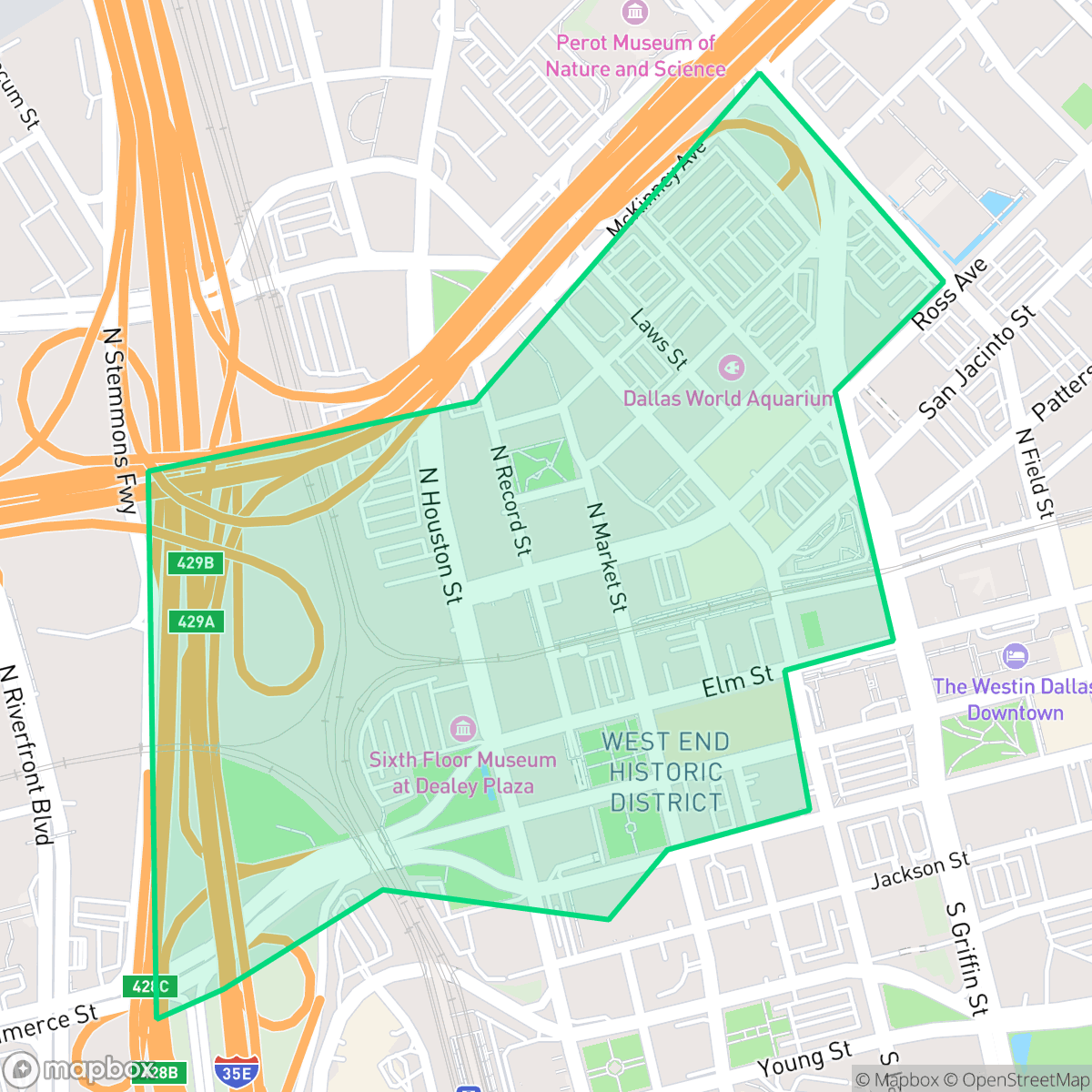
The West End Historic District traces its origins to the mid-1800s as Dallas's first trading post, established by John Neely Bryan. Following the arrival of the Houston & Texas Central Railroad in 1872, the area transformed into a bustling manufacturing and warehouse hub. Today, the district is defined by its cohesive late-19th and early-20th-century architecture, featuring multi-story red-brick warehouses, Chicago-style commercial structures, and the striking Richardsonian Romanesque "Old Red" Courthouse built in 1892. The neighborhood gained global prominence as the site of the 1963 assassination of President John F. Kennedy at Dealey Plaza. To prevent demolition, developer Preston Carter Jr. spearheaded a major revitalization in 1976, converting the historic brick warehouses into a vibrant dining, tourism, and innovation district. It was listed on the National Register of Historic Places in 1978.
The neighborhood functions as a dense, concrete-heavy center of activity characterized by a high-energy atmosphere and proximity to major transit corridors. Visitors and residents frequent local destinations like the Dallas Holocaust and Human Rights Museum, alongside a variety of popular dining options. According to iHuus data, the area maintains a distinct urban intensity that sets it apart from quieter residential districts, blending active commercial traffic with a fast-paced environment.
Living in this district involves significant trade-offs, particularly regarding acoustic comfort and car dependency. The area experiences elevated noise levels from road traffic, and the low walkability score suggests that residents rely heavily on vehicles for daily errands. While the district is not ideal for pet owners or those prioritizing seclusion, it serves as a central location for professionals who value proximity to the city's core. Families may find educational opportunities through the Dallas Independent School District, which includes high-performing options like the Dr. Wright L. Lassiter Jr. Early College High School.
Neighborhood Scores Across 15 Qualities
Residential spacing varies significantly due to a combination of dense commercial structures and large, isolated open floodplains. This level of privacy is slightly lower than the Dallas average according to iHuus data.
High speed highway interchanges and fragmented sidewalk networks make pedestrian movement uncomfortable. This area is significantly less walkable than the Dallas average due to limited access across major roads.
The landscape features standard residential structures with modest yards and significant institutional buildings. Large parking lots and a lack of luxury amenities contribute to a visual profile that is slightly below the Dallas average according to iHuus data.
Abundant riverfront green space and connected trails provide significant opportunities for pet owners. This level of accessibility to wide, traffic-safe paths is notably higher than the Dallas average, according to iHuus data.
Streetscapes and green spaces are distributed in nearly equal measure, making the area less dense than the Dallas average. According to iHuus data, the landscape features a combination of institutional buildings, large infrastructure, and open river basins.
Activity levels fluctuate between quiet warehouse zones and dense, high-energy corridors featuring diverse dining and museums; overall, the neighborhood rhythm is roughly in line with the Dallas average.
Frequent loud disturbances from nearby heavy rail and transit infrastructure characterize this area. According to iHuus data, acoustic comfort in this district is significantly lower than the Dallas average.
Air quality in this area fluctuates between acceptable and unhealthy levels, matching the general trend seen across Dallas. Sensitive groups should remain aware of occasional days when air conditions may present a health concern.
Residential areas blend with active commercial zones and light industrial units, resulting in lower industrial density than the Dallas average. Residents should expect some daytime commercial traffic, though heavy industrial hazards are largely absent from this district.
Voting patterns and census indicators show a significantly more liberal leaning than the Dallas average, according to iHuus data.
Residents experience a balanced demographic spread of young adults, families, and older individuals. This age distribution is relatively consistent with the broader Dallas area, according to iHuus data.
Properties in this area are situated within a designated floodplain, making flood insurance a common necessity. This level of risk is notably higher than the average found throughout Dallas, according to iHuus data.
Address-Level Insights for West End Historic District


iHuus Neighborhood Intelligence Insights
Get address-level neighborhood insights for West End Historic District
- Street-level scores — see how individual blocks compare, not just neighborhood averages
- Micro-zone boundaries — identify quiet pockets, flood boundaries, and walkable clusters before you visit
- 15 dimensions in full — walkability, noise, air quality, school quality, insurance coverage, population age profile, urban/rural index, and more
- Boundary risk alerts — know if your address sits near a block boundary where scores drop, the kind of detail no listing will ever mention
- School insights — individual school ratings and insights, not just district-level data
- Compare before you commit — side-by-side data across neighborhoods, down to block precision
No credit card required
Compare with Any Neighborhood
| Dimension | West End Historic District | Arts District |
|---|---|---|
| 🚶 Walkabilityavg 7.43 | ||
| 🔊 Acoustic Comfortavg 3.98 | ||
| 🤫 Privacy Indexavg 5.4 | ||
| 🎨 Visual Appealavg 6.6 | ||
| 🐕 Dog Friendlinessavg 6.65 | ||
| 🗺️ Urban-Rural Indexavg 6.6 | ||
| ✨ Neighborhood Vibeavg 4.96 | ||
| 🏥 Health Insurance Coverageavg 5.31 | ||
| 🌿 Air Qualityavg 4.05 | ||
| 🏭 Industrial Proximityavg 8.56 | ||
| 🌊 Flood Safetyavg 3.3 | ||
| 🗳️ Ideological Leanavg 7.84 | ||
| 👥 Population Age Profileavg 4.6 | ||
| 🔥 Fire Safety | ||
| 🏫 School Quality |
West End Historic District Rankings
School Districts Serving West End Historic District
School Insights for West End Historic District
Below average outcomes; significant attendance and academic challenges.
School Insights
See what's really behind every school rating near West End Historic District
- Individual school ratings — each school's own score with outcome context, not just a district average
- Enrollment & class size data — student-to-teacher ratio and how it compares to the state average
- Full demographics breakdown — ethnicity and gender composition for every school in the enrollment zone
- Every school in the district — all schools within the enrollment boundary ranked by rating, not just the closest one
- Grade levels & benchmarks — elementary through high school, with below/above state-average flags
No credit card required