Roseland Neighborhood, Dallas
Updated · 2,081 residents
Roseland is a densely populated and highly walkable neighborhood in Dallas known for its urban character and proximity to city amenities. Residents benefit from a lively atmosphere and access to local schools, though the area is notably loud due to persistent road traffic and offers limited privacy in its multi-family housing developments.
Key Highlights
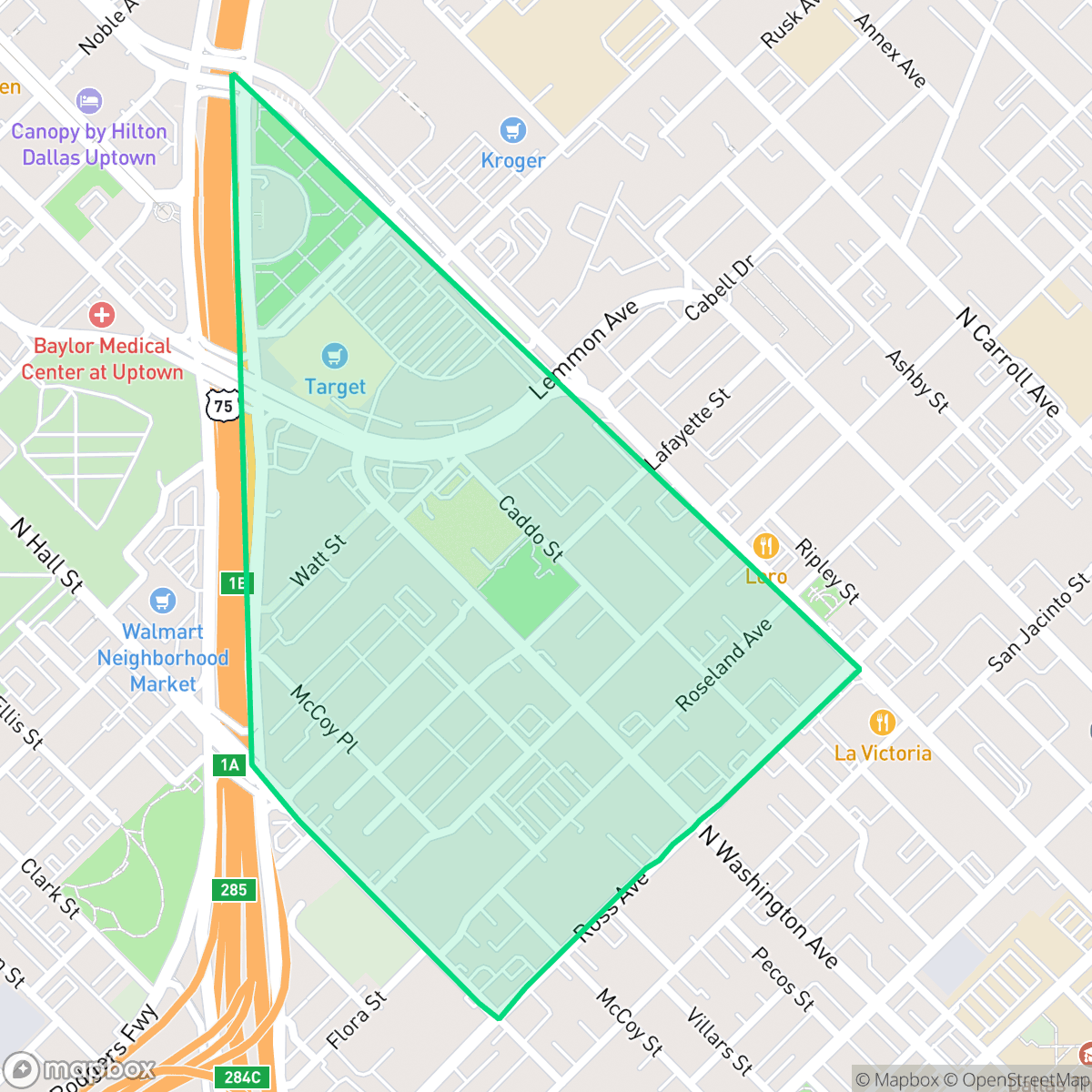
About Roseland Neighborhood
The Roseland neighborhood in Dallas, Texas, sits on the eastern portion of historic Freedmantown (or North Dallas), a post-emancipation Black community established in 1869. Between 1940 and 1942, the Dallas Housing Authority acquired over 140 tracts of land here to build Roseland Homes. Completed in 1942, it was Dallas’s first public housing development designed for Black residents and the first of its kind west of the Mississippi. The project displaced more than 100 private homes in the historic enclave. In the early 2000s, the original barracks-style complex was demolished and redeveloped into a mixed-income community of townhomes and senior living facilities. Today, the site retains its cultural significance, anchored by the historic community center locally known as 'The Rose'.
The neighborhood maintains a high-density urban environment characterized by modern apartment complexes and townhomes. Its central location provides residents with excellent walkability and access to diverse commercial services, including local dining and community institutions. The area is defined by a high grey-to-green ratio, reflecting its focus on multi-family residential and commercial infrastructure rather than expansive open landscapes.
Prospective residents should consider the trade-offs associated with this high-density setting. The neighborhood experiences significant noise levels from nearby road traffic, and the layout of the residential structures results in limited privacy for occupants. While the area lacks significant industrial hazards, it is positioned in a zone with low flood safety ratings. Families may find value in the local educational options, such as the well-regarded Ignite Middle at Jw Ray Learning Center, though the broader district experiences varied academic outcomes.
Neighborhood Scores Across 15 Qualities
Densely packed residential structures and narrow gaps between buildings result in significantly less privacy than the Dallas average. Many homes feature shared walls or very close proximity to neighboring units, according to iHuus data.
Pedestrian infrastructure is robust throughout the area, featuring continuous sidewalks and clear crosswalks at major intersections. This level of connectivity is notably higher than the Dallas average, allowing for easy movement through both residential and commercial blocks.
Standard urban density characterizes the area with a mix of apartment complexes and older single-family homes. The visual landscape features tidy but modest yards and lacks the lush greenery or luxury amenities found more frequently across Dallas.
Accessible dog walking is supported by a centrally located public park and various green buffer zones, though overall access to green space is slightly below the Dallas average. Some street segments offer minimal grass verges, making certain areas less ideal for off-leash movement.
Residential streets and green spaces are balanced with developed areas, making the landscape notably less dense than the Dallas average. According to iHuus data, this provides a transition between open space and built environments.
Dense clusters of diverse dining and social destinations create a high-energy atmosphere that is significantly more active than the Dallas average. Residents can access a wide variety of local eateries and community hubs within a landscape characterized by constant movement and urban density.
Frequent noise from nearby railroad tracks and heavy freeway traffic makes this area significantly louder than the Dallas average, according to iHuus data.
Air quality levels typically fluctuate between acceptable and unhealthy, presenting occasional concerns for sensitive groups. This level of-air quality is consistent with the broader Dallas average, according to iHuus data.
Residential and commercial structures dominate the landscape with an absence of heavy warehouses or industrial hazards. This area offers a cleaner environment than the Dallas average according to iHuus data.
Health insurance access is significantly higher than the Dallas average, according to iHuus data. Most residents in this area have access to medical coverage.
Political leanings in this area skew more liberal than the Dallas average. Residents may encounter a community with a modest presence of opposing viewpoints according to iHuus data.
Residents live alongside a balanced mix of young adults, families, and seniors. This demographic spread is slightly lower than the Dallas average, according to iHuus data.
Address-Level Insights for Roseland Neighborhood


iHuus Neighborhood Intelligence Insights
Get address-level neighborhood insights for Roseland Neighborhood
- Street-level scores — see how individual blocks compare, not just neighborhood averages
- Micro-zone boundaries — identify quiet pockets, flood boundaries, and walkable clusters before you visit
- 15 dimensions in full — walkability, noise, air quality, school quality, insurance coverage, population age profile, urban/rural index, and more
- Boundary risk alerts — know if your address sits near a block boundary where scores drop, the kind of detail no listing will ever mention
- School insights — individual school ratings and insights, not just district-level data
- Compare before you commit — side-by-side data across neighborhoods, down to block precision
No credit card required
Compare with Any Neighborhood
| Dimension | Roseland Neighborhood | Arts District |
|---|---|---|
| 🚶 Walkabilityavg 7.43 | ||
| 🔊 Acoustic Comfortavg 3.98 | ||
| 🤫 Privacy Indexavg 5.4 | ||
| 🎨 Visual Appealavg 6.6 | ||
| 🐕 Dog Friendlinessavg 6.65 | ||
| 🗺️ Urban-Rural Indexavg 6.6 | ||
| ✨ Neighborhood Vibeavg 4.96 | ||
| 🏥 Health Insurance Coverageavg 5.31 | ||
| 🌿 Air Qualityavg 4.05 | ||
| 🏭 Industrial Proximityavg 8.56 | ||
| 🌊 Flood Safetyavg 3.3 | ||
| 🗳️ Ideological Leanavg 7.84 | ||
| 👥 Population Age Profileavg 4.6 | ||
| 🔥 Fire Safety | ||
| 🏫 School Quality |
Roseland Neighborhood Rankings
School Districts Serving Roseland Neighborhood
School Insights for Roseland Neighborhood
Below average outcomes; significant attendance and academic challenges.
School Insights
See what's really behind every school rating near Roseland Neighborhood
- Individual school ratings — each school's own score with outcome context, not just a district average
- Enrollment & class size data — student-to-teacher ratio and how it compares to the state average
- Full demographics breakdown — ethnicity and gender composition for every school in the enrollment zone
- Every school in the district — all schools within the enrollment boundary ranked by rating, not just the closest one
- Grade levels & benchmarks — elementary through high school, with below/above state-average flags
No credit card required