Reunion District, Dallas
Updated · 686 residents
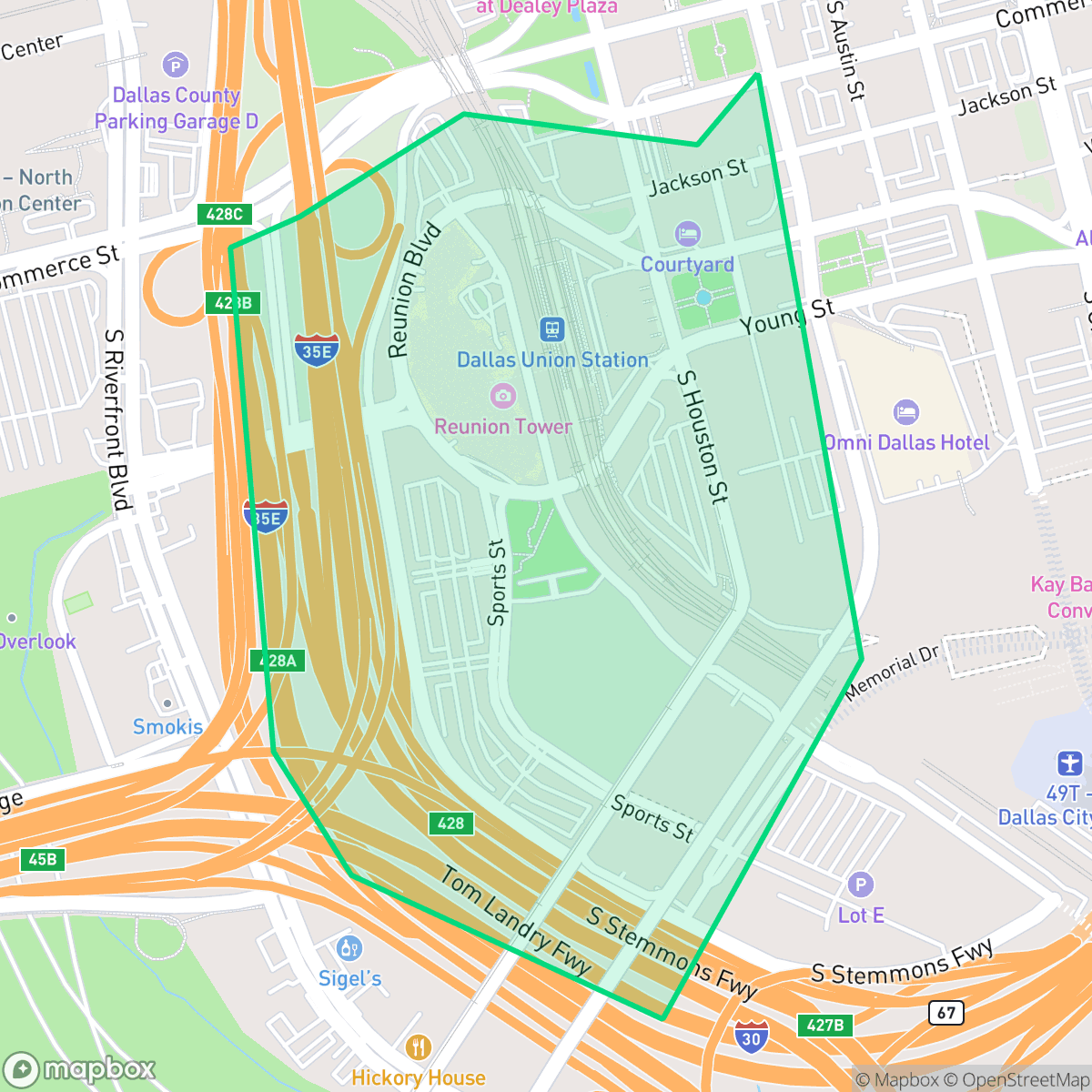
The Reunion District is a high-energy, concrete-dense urban core in downtown Dallas defined by its exceptional walkability and immediate access to major transit hubs. While the area offers a vibrant lifestyle with renowned dining and iconic skyline views, residents should expect significant noise from nearby road and rail traffic alongside limited residential privacy.
Key Highlights
About Reunion District
The Reunion District in downtown Dallas traces its name to La Réunion, a mid-19th-century utopian socialist commune established nearby by European colonists. Conceived in the 1970s by developer John Scovell and Ray Hunt, the district was created through the nation’s first major public-private urban redevelopment partnership. The neighborhood is anchored by the historic Eddie Bernice Johnson Union Station and the iconic 561-foot Reunion Tower, completed in 1978 and designed by Welton Becket & Associates. Locally nicknamed 'The Ball,' the tower is integrated with the Hyatt Regency Dallas. From 1980 to 2009, the district also hosted the Reunion Arena, the former home of the Dallas Mavericks and Dallas Stars. Today, the area is undergoing a multi-billion-dollar mixed-use revitalization.
The area functions as a central transit and entertainment hub, characterized by a dense, high-rise urban environment. It serves as a focal point for visitors and locals alike, offering proximity to landmarks like the Sixth Floor Museum and various high-end dining establishments. According to iHuus data, the neighborhood achieves a perfect walkability score, making it ideal for those who prioritize car-free living and immediate access to the city's core infrastructure. Residents benefit from a highly active environment where the pulse of the city is constantly present.
Prospective residents should consider the trade-offs inherent in such a central location. The environment is notably loud, with ambient noise levels influenced by constant road and rail activity. Furthermore, the district offers limited privacy due to its high-density design. While it provides excellent protection against flood risks, the area is best suited for individuals who prefer an active, fast-paced urban lifestyle over a quiet or secluded residential experience.
Neighborhood Scores Across 15 Qualities
Residential spacing varies significantly due to the proximity of high density commercial buildings and large, isolated floodplains. This creates a landscape of mixed seclusion that is slightly higher than the Dallas average according to iHuus data.
High speed highway interchanges and a lack of continuous sidewalks make pedestrian travel difficult. According to iHuus data, walkability in this area is significantly lower than the Dallas average.
Visual interest is limited by institutional-style buildings and large parking lots, resulting in a landscape that is less aesthetically varied than the Dallas average. According to iHuus data, the area lacks luxury residential amenities and features standard, utilitarian structures.
Abundant riverfront green space and visible trail networks provide significantly more space for pets than the Dallas average. According to iHuus data, the high density of accessible trails and open areas makes this an ideal location for dog owners.
A combination of multi-level highway infrastructure and open river basins creates a landscape that is slightly less dense than the Dallas average. This area features a balance of industrial parcels and institutional spaces alongside significant transit infrastructure.
Activity levels are below the Dallas average, as the area shifts between a quiet industrial landscape and a dense urban core. According to iHuus data, the environment is characterized more by functional transit corridors and warehouse zones than by continuous social energy.
Constant noise from nearby heavy rail and airport flight paths makes this area significantly louder than the Dallas average. Residents should expect persistent acoustic disturbances throughout the day.
Air quality levels here are consistent with the Dallas average, though residents may encounter occasional days with pollutants that are unhealthy for sensitive groups. According to iHuus data, the atmosphere fluctuates between acceptable and concerning levels periodically.
Active commercial traffic and nearby rail lines create significantly higher levels of noise and air pollution than the Dallas average. While some areas remain purely residential, the district contains notable proximity to major highway junctions and industrial-adjacent activity.
Voting patterns and census indicators show a predominantly liberal leaning that is notably higher than the Dallas average, according to iHuus data.
Residents experience a relatively balanced distribution of age groups, with a demographic spread that is slightly less varied than the Dallas city average. According to iHuus data, the population includes a mix of young professionals, families, and older adults.
Flood risk in this area is significantly higher than the Dallas average, with potential for elevated or prohibitive insurance costs due to coastal high-hazard zone designations. According to iHuus data, residents should prepare for more stringent flood mitigation requirements.
Address-Level Insights for Reunion District


iHuus Neighborhood Intelligence Insights
Get address-level neighborhood insights for Reunion District
- Street-level scores — see how individual blocks compare, not just neighborhood averages
- Micro-zone boundaries — identify quiet pockets, flood boundaries, and walkable clusters before you visit
- 15 dimensions in full — walkability, noise, air quality, school quality, insurance coverage, population age profile, urban/rural index, and more
- Boundary risk alerts — know if your address sits near a block boundary where scores drop, the kind of detail no listing will ever mention
- School insights — individual school ratings and insights, not just district-level data
- Compare before you commit — side-by-side data across neighborhoods, down to block precision
No credit card required
Compare with Any Neighborhood
| Dimension | Reunion District | Arts District |
|---|---|---|
| 🚶 Walkabilityavg 7.43 | ||
| 🔊 Acoustic Comfortavg 3.98 | ||
| 🤫 Privacy Indexavg 5.4 | ||
| 🎨 Visual Appealavg 6.6 | ||
| 🐕 Dog Friendlinessavg 6.65 | ||
| 🗺️ Urban-Rural Indexavg 6.6 | ||
| ✨ Neighborhood Vibeavg 4.96 | ||
| 🏥 Health Insurance Coverageavg 5.31 | ||
| 🌿 Air Qualityavg 4.05 | ||
| 🏭 Industrial Proximityavg 8.56 | ||
| 🌊 Flood Safetyavg 3.3 | ||
| 🗳️ Ideological Leanavg 7.84 | ||
| 👥 Population Age Profileavg 4.6 | ||
| 🔥 Fire Safety | ||
| 🏫 School Quality |
Reunion District Rankings
School Districts Serving Reunion District
School Insights for Reunion District
Below average outcomes; significant attendance and academic challenges.
School Insights
See what's really behind every school rating near Reunion District
- Individual school ratings — each school's own score with outcome context, not just a district average
- Enrollment & class size data — student-to-teacher ratio and how it compares to the state average
- Full demographics breakdown — ethnicity and gender composition for every school in the enrollment zone
- Every school in the district — all schools within the enrollment boundary ranked by rating, not just the closest one
- Grade levels & benchmarks — elementary through high school, with below/above state-average flags
No credit card required