Preston Hollow, Dallas
Updated · 85,093 residents
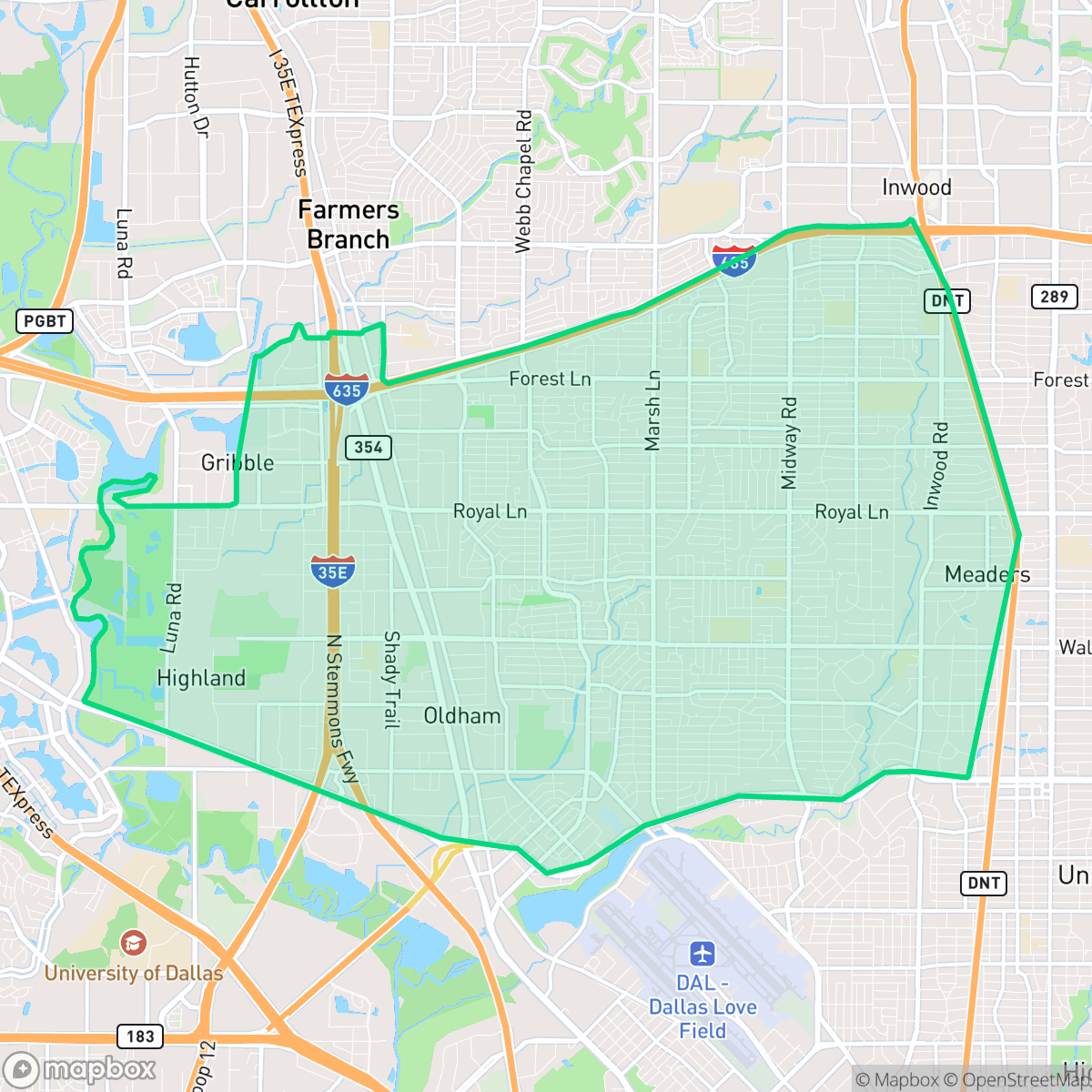
Preston Hollow is a prestigious Dallas neighborhood characterized by its expansive estate lots, mature tree canopy, and diverse architectural styles. According to iHuus data, the area offers a balanced suburban environment with solid walkability and consistent access to green spaces for residents.
Key Highlights
About Preston Hollow
Traced to 1850s land grants and dairy farms, Preston Hollow was developed in the 1920s and 1930s by Ira P. DeLoache, who carved residential lots from a former farm. Incorporated as an independent municipality in 1939, its town hall operated out of DeLoache's real estate office—now known as "Ebby's Little White House"—before Dallas annexed the town in 1945. Preston Hollow is defined by its tree-lined, curbless streets, sprawling estate lots, and diverse architecture. Notable landmarks include the 1938 Crespi Estate designed by Maurice Fatio, Tudor homes by Charles Dilbeck, and the John Gillin Residence, Frank Lloyd Wright’s only Dallas design. Renowned for its privacy, this prestigious enclave has attracted high-profile residents, including former President George W. Bush, business magnate Ross Perot, and entrepreneur Mark Cuban.
The neighborhood is defined by its quiet, tree-lined streets and a mix of traditional residential estates and newer construction. While the area maintains a serene atmosphere, it benefits from a well-established sidewalk network that connects residents to local retail and community hubs. The landscape is characterized by manicured properties and private pools, contributing to a visual appeal that stands out within the broader Dallas metropolitan area. Residents enjoy a stable environment that blends residential privacy with convenient access to major thoroughfares.
Prospective residents should consider that while the neighborhood is primarily residential, its proximity to major transit corridors results in moderate road noise. Although iHuus data indicates high marks for walkability, the area remains largely car-dependent for daily errands. Educational options are varied, ranging from top-tier elementary schools to local high schools, making it a destination for families seeking a stable, long-term community.
Neighborhood Scores Across 15 Qualities
Residential spacing offers a moderate amount of separation between neighbors, sitting slightly above the Dallas average. While many single-family homes feature clear yard buffers, certain denser clusters within the area provide less private distance between structures.
Established sidewalk networks and accessible commercial hubs make many daily errands possible on foot. According to iHuus data, the pedestrian infrastructure is slightly more consistent than the average found across Dallas.
Expansive properties featuring complex architecture and private backyard pools are common here. This area offers a more polished aesthetic than the Dallas average, according to iHuus data.
Abundant parks and continuous grass vergers provide ample space for pet walking. This level of accessible green space is slightly above the Dallas average according to iHuus data.
Spacious residential layouts feature a dense tree canopy and significant green space. This balance of vegetation and built environment is consistent with the Dallas average.
Residential life here maintains a steady, tranquil pace characterized by peaceful suburban blocks and ample green space. While some pockets offer various dining and social hubs, the area's overall energy is consistent with the city average.
Frequent noise from nearby major roadways and transit paths is common in this area. According to iHuus data, acoustic comfort levels are slightly lower than the Dallas average.
Air quality levels fluctuate between acceptable and unhealthy for sensitive groups, though the atmosphere remains better than the Dallas average according to iHuus data.
Industrial activity is almost non-existent here, as the area is comprised primarily of residential and institutional uses. According to iHuus data, the lack of warehouses or heavy manufacturing makes this neighborhood slightly cleaner than the Dallas average regarding industrial proximity.
Health insurance access in this area is roughly in line with the Dallas average. According to iHuus data, nearly half of the resident population is covered by a health insurance plan.
Political leanings in this area are largely liberal, though the community is less progressive than the Dallas average according to iHuus data.
Residents live alongside a diverse range of age groups, including young professionals, established families, and seniors. This demographic distribution is slightly more varied than the average seen across Dallas.
Flood risk levels in this area are slightly above the Dallas average. According to iHuus data, FEMA has not yet completed a detailed flood study for this specific part of the neighborhood.
Address-Level Insights for Preston Hollow


iHuus Neighborhood Intelligence Insights
Get address-level neighborhood insights for Preston Hollow
- Street-level scores — see how individual blocks compare, not just neighborhood averages
- Micro-zone boundaries — identify quiet pockets, flood boundaries, and walkable clusters before you visit
- 15 dimensions in full — walkability, noise, air quality, school quality, insurance coverage, population age profile, urban/rural index, and more
- Boundary risk alerts — know if your address sits near a block boundary where scores drop, the kind of detail no listing will ever mention
- School insights — individual school ratings and insights, not just district-level data
- Compare before you commit — side-by-side data across neighborhoods, down to block precision
No credit card required
Compare with Any Neighborhood
| Dimension | Preston Hollow | Arts District |
|---|---|---|
| 🚶 Walkabilityavg 7.43 | ||
| 🔊 Acoustic Comfortavg 3.98 | ||
| 🤫 Privacy Indexavg 5.4 | ||
| 🎨 Visual Appealavg 6.6 | ||
| 🐕 Dog Friendlinessavg 6.65 | ||
| 🗺️ Urban-Rural Indexavg 6.6 | ||
| ✨ Neighborhood Vibeavg 4.96 | ||
| 🏥 Health Insurance Coverageavg 5.31 | ||
| 🌿 Air Qualityavg 4.05 | ||
| 🏭 Industrial Proximityavg 8.56 | ||
| 🌊 Flood Safetyavg 3.3 | ||
| 🗳️ Ideological Leanavg 7.84 | ||
| 👥 Population Age Profileavg 4.6 | ||
| 🔥 Fire Safety | ||
| 🏫 School Quality |
Preston Hollow Rankings
School Districts Serving Preston Hollow
School Insights for Preston Hollow
Below average outcomes; significant attendance and academic challenges.
School Insights
See what's really behind every school rating near Preston Hollow
- Individual school ratings — each school's own score with outcome context, not just a district average
- Enrollment & class size data — student-to-teacher ratio and how it compares to the state average
- Full demographics breakdown — ethnicity and gender composition for every school in the enrollment zone
- Every school in the district — all schools within the enrollment boundary ranked by rating, not just the closest one
- Grade levels & benchmarks — elementary through high school, with below/above state-average flags
No credit card required