Oak Lawn, Dallas
Updated · 45,092 residents
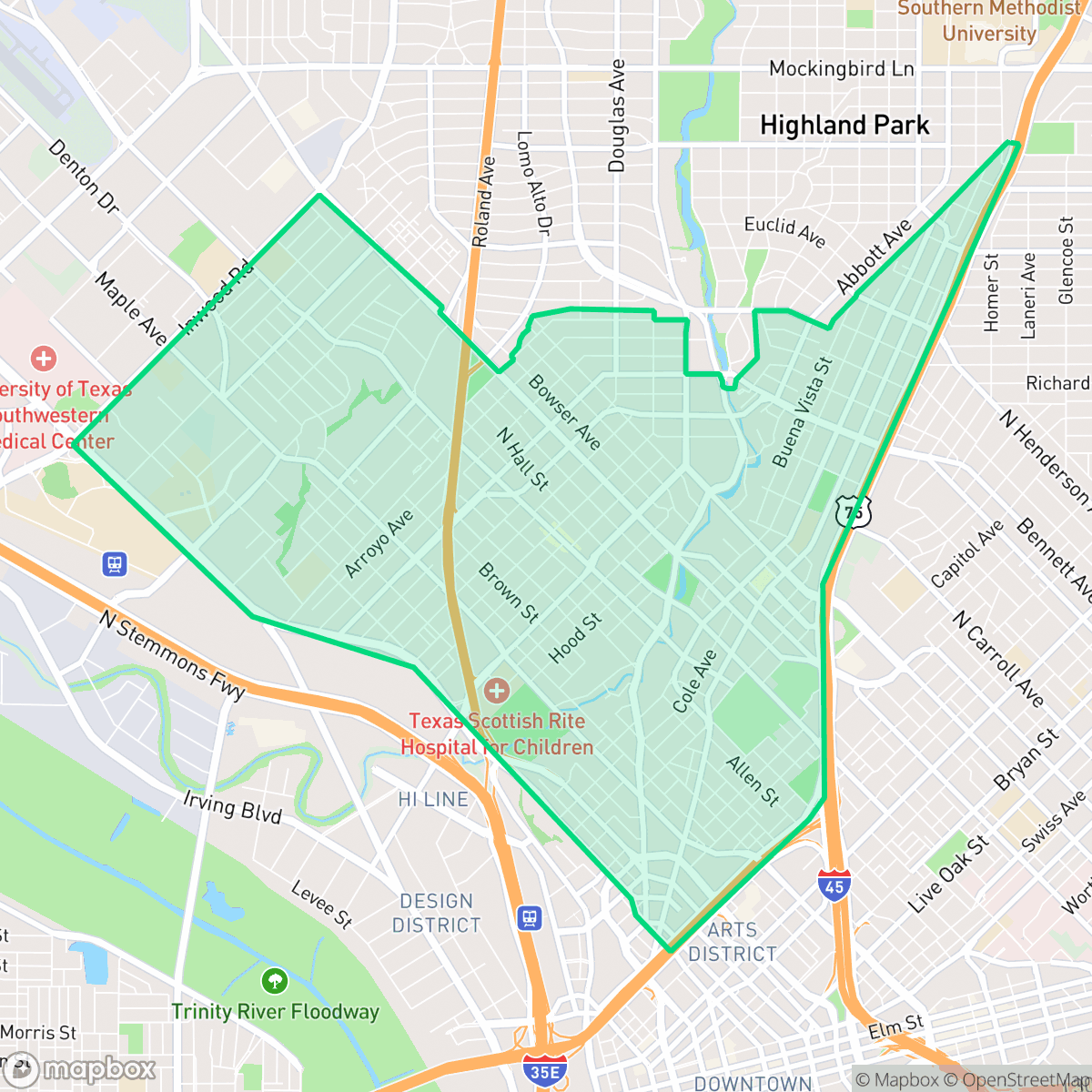
Oak Lawn is a highly walkable urban hub in Dallas known for its vibrant nightlife and diverse dining scene. Residents live in a dense environment characterized by close-proximity apartments and high-energy street activity, often accompanied by noticeable road noise.
Key Highlights
About Oak Lawn
Traced back to the 1840s settlement of Cedar Springs, Dallas’s Oak Lawn neighborhood was subdivided in the 1880s by developer William H. Gaston, who named it for its majestic oak trees. By the early 20th century, the neighborhood grew rapidly via streetcar lines, developing a rich architectural stock of 1920s Tudor cottages, craftsman bungalows, and historic landmarks like the Melrose Hotel. Oak Lawn evolved into a counterculture hub in the late 1960s, quickly establishing itself as the epicenter of Dallas’s LGBTQ+ community. Centered around the vibrant "Crossroads" intersection at Cedar Springs Road, the neighborhood became a sanctuary of activism and pride. In 2018, Oak Lawn made history when the Texas Historical Commission awarded it the state's first official LGBTQ+ historical marker.
The area functions as a dense urban core, blending mid-rise apartment complexes with a wide array of commercial amenities. It offers a high degree of walkability, allowing residents to access numerous restaurants, cafes, and entertainment venues without relying on a vehicle. The visual landscape is defined by modern multi-family structures and well-maintained commercial corridors, creating a lively atmosphere that remains active throughout the day and night.
Those considering a move here should note the trade-offs associated with high-density living, including limited privacy due to shared walls and proximity to neighbors. The neighborhood experiences elevated noise levels from road traffic, reflecting its status as a central urban district. While it lacks the quiet seclusion of suburban areas, it provides excellent access to city services and diverse social opportunities, making it well-suited for professionals and individuals who prioritize proximity to urban lifestyle amenities over acoustic tranquility.
Neighborhood Scores Across 15 Qualities
Residential structures and apartment complexes are positioned in very close proximity with narrow gaps or shared walls. This density results in significantly less privacy than the Dallas average according to iHuus data.
A dense, interconnected grid of sidewalks and clearly marked crosswalks makes navigating the area on foot exceptionally easy. According to iHuus data, this level of pedestrian connectivity and infrastructure is significantly higher than the Dallas average.
A mix of luxury multi-family developments and affluent residential pockets with mature tree canopies provides a visually pleasing environment that sits slightly above the Dallas average. According to iHuus data, the area features high-end architectural geometries and well-maintained landscaping throughout its denser residential blocks.
Abundant tree canopies, wide green verges, and large central parks provide ample space for pet exercise. According to iHuus data, the availability of these walking trails and parklands is on par with the Dallas average.
A blend of single-family homes and large apartment complexes defines the landscape, resulting in a more suburban feel than the typical Dallas urban density. This area features a noticeable balance between residential streets and commercial developments, lacking the high-density urban core found elsewhere in the city.
Vibrant dining and social destinations are abundant throughout the area, creating a level of activity significantly higher than the Dallas average. Residents can expect a dense concentration of nightlife and diverse eateries, though accessibility to these spots varies by specific block.
Persistent sounds from nearby major freeways and transit corridors characterize this area. According to iHuus data, acoustic comfort is significantly lower than the Dallas average.
Air quality levels in Oak Lawn fluctuate between acceptable and unhealthy ranges. According to iHuus data, these conditions are consistent with the typical levels found throughout Dallas.
Industrial activity and heavy warehouses are virtually non-existent here, providing an environment significantly cleaner of heavy industry than the Dallas average. According to iHuus data, the area consists almost entirely of residential, retail, and light commercial uses without visible manufacturing hazards.
Health insurance enrollment is notably higher than the Dallas average, providing most residents with greater access to medical services. According to iHuus data, a significant majority of the population is covered.
Political leanings in this area are largely liberal, though the community shows a slightly less progressive tilt than the Dallas average according to iHuus data.
Residents experience a balanced demographic spread of young professionals, families, and seniors. This age distribution is largely in line with the broader Dallas average, according to iHuus data.
Flood risk levels in this area are slightly higher than the Dallas average, though a lack of detailed FEMA studies means the exact level of risk remains unverified. Residents should remain cautious as the specific flood potential for these properties has not been fully assessed.
Address-Level Insights for Oak Lawn


iHuus Neighborhood Intelligence Insights
Get address-level neighborhood insights for Oak Lawn
- Street-level scores — see how individual blocks compare, not just neighborhood averages
- Micro-zone boundaries — identify quiet pockets, flood boundaries, and walkable clusters before you visit
- 15 dimensions in full — walkability, noise, air quality, school quality, insurance coverage, population age profile, urban/rural index, and more
- Boundary risk alerts — know if your address sits near a block boundary where scores drop, the kind of detail no listing will ever mention
- School insights — individual school ratings and insights, not just district-level data
- Compare before you commit — side-by-side data across neighborhoods, down to block precision
No credit card required
Compare with Any Neighborhood
| Dimension | Oak Lawn | Arts District |
|---|---|---|
| 🚶 Walkabilityavg 7.43 | ||
| 🔊 Acoustic Comfortavg 3.98 | ||
| 🤫 Privacy Indexavg 5.4 | ||
| 🎨 Visual Appealavg 6.6 | ||
| 🐕 Dog Friendlinessavg 6.65 | ||
| 🗺️ Urban-Rural Indexavg 6.6 | ||
| ✨ Neighborhood Vibeavg 4.96 | ||
| 🏥 Health Insurance Coverageavg 5.31 | ||
| 🌿 Air Qualityavg 4.05 | ||
| 🏭 Industrial Proximityavg 8.56 | ||
| 🌊 Flood Safetyavg 3.3 | ||
| 🗳️ Ideological Leanavg 7.84 | ||
| 👥 Population Age Profileavg 4.6 | ||
| 🔥 Fire Safety | ||
| 🏫 School Quality |
Oak Lawn Rankings
School Districts Serving Oak Lawn
School Insights for Oak Lawn
Below average outcomes; significant attendance and academic challenges.
School Insights
See what's really behind every school rating near Oak Lawn
- Individual school ratings — each school's own score with outcome context, not just a district average
- Enrollment & class size data — student-to-teacher ratio and how it compares to the state average
- Full demographics breakdown — ethnicity and gender composition for every school in the enrollment zone
- Every school in the district — all schools within the enrollment boundary ranked by rating, not just the closest one
- Grade levels & benchmarks — elementary through high school, with below/above state-average flags
No credit card required