Oak Cliff, Dallas
Updated · 33,565 residents
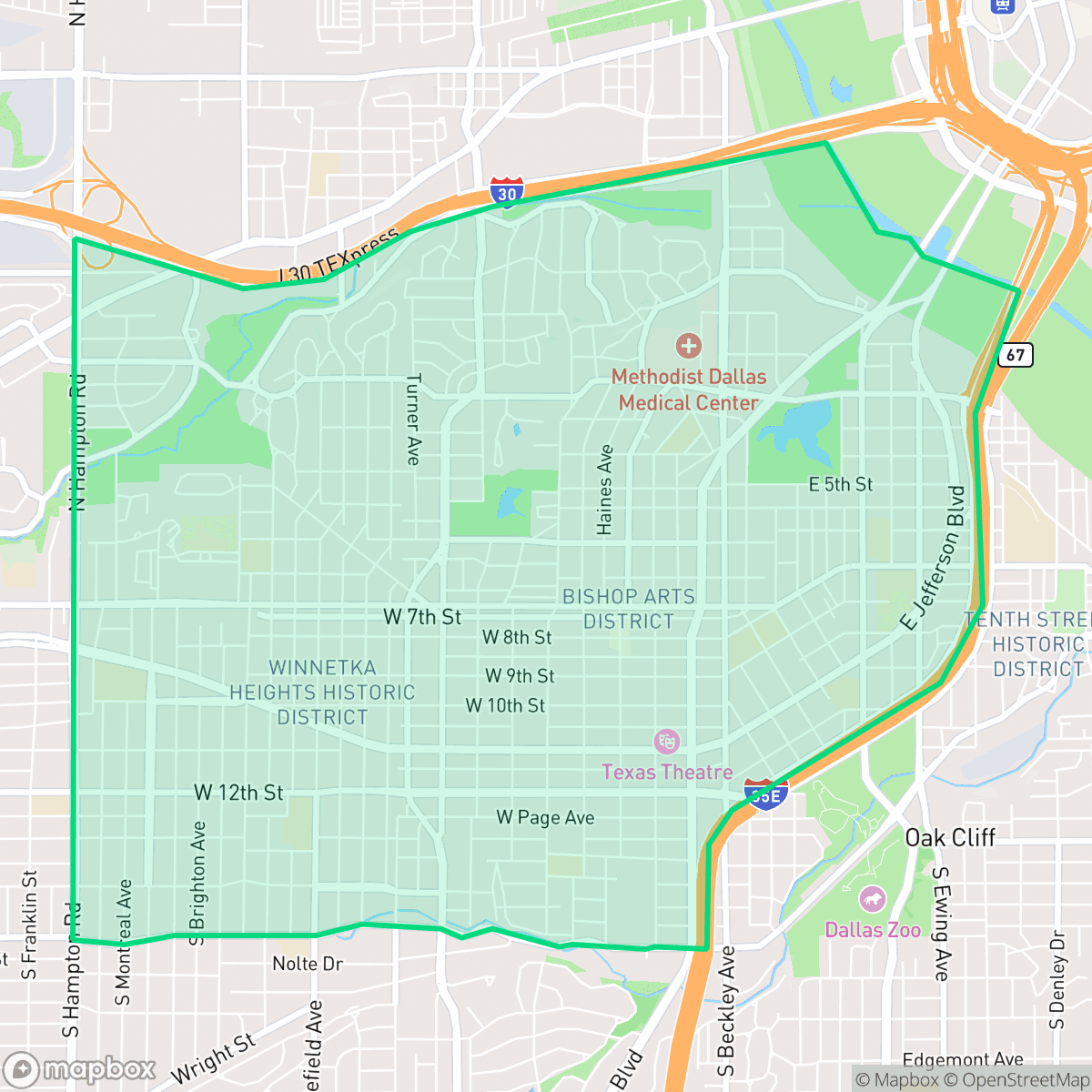
Oak Cliff is a culturally rich Dallas neighborhood defined by its walkable streets, historic architecture, and the vibrant Bishop Arts District. Residents benefit from a dense, grid-based layout that prioritizes pedestrian access while maintaining a distinct, established suburban character.
Key Highlights
About Oak Cliff
Founded in 1887 by Thomas L. Marsalis and John S. Armstrong on the former site of Hord’s Ridge, Oak Cliff was originally developed as an elite residential and resort town before its annexation by Dallas in 1903. The neighborhood retains a distinct architectural identity, featuring Victorian-era estates, Craftsman bungalows, and the historic Lake Cliff Park district, which centers around an 1888 man-made lake. Oak Cliff is also home to the Bishop Arts District, Dallas’s largest intact trolley-era shopping hub, which was revitalized by artists in the 1970s and is now a vibrant, independent cultural center. Among its most famous landmarks is the 1931 Texas Theatre, constructed by Howard Hughes and infamous as the arrest site of Lee Harvey Oswald following the assassination of President John F. Kennedy.
The area functions as a dense suburban landscape, blending historic residential charm with a robust network of local services. It stands out for its high walkability and strong sense of community, anchored by a mix of single-family homes and multi-family complexes. While the neighborhood lacks heavy industrial activity, it maintains a steady, moderate rhythm of daily life supported by diverse local dining and social establishments. The local education landscape is varied, featuring high-performing specialized campuses within the broader Dallas Independent School District that offer significant opportunities for families who utilize the district's application systems.
Prospective residents should consider the trade-offs inherent in a mature urban environment, including moderate noise levels from road traffic and standard density that results in closer proximity to neighbors. The area is well-suited for those who value architectural character and a walkable lifestyle over the expansive, secluded lots found in newer suburban developments. While it offers a high degree of connectivity and cultural appeal, individuals should be prepared for the typical urban challenges of a well-established district, such as managing the complexities of a large school system and navigating the realities of a high-density environment.
Neighborhood Scores Across 15 Qualities
Residential spacing varies between detached homes and multi-family units, offering a level of buffering that is slightly higher than the Dallas average. According to iHuus data, most properties feature modest yards or small gaps between neighbors.
Dense sidewalk networks and frequent crosswalks make most errands achievable on foot. This level of pedestrian connectivity is notably higher than the Dallas average, according to iHuus data.
Large homes with manicured lawns and mature tree canopies are interspersed with more standard, uniform urban housing. This landscape offers a mix of affluent estates and middle-class residential pockets that is roughly in line with the Dallas average.
Abundant greenbelts, lakefront trails, and wide grass verges provide ample space for pet exercise. These accessible outdoor areas ensure the neighborhood is nearly as pet-friendly as the Dallas average.
Residential pockets feature a blend of single-family homes and apartment complexes interspersed with industrial warehouses and commercial corridors. This landscape presents a variation of suburban and low-rise urban density that is roughly consistent with the Dallas average.
A noticeable concentration of social spots and diverse dining options creates a more lively atmosphere than the Dallas average. While some blocks offer a steady rhythm of local services, many areas remain car-dependent due to a layout that favors suburban-style spacing.
Steady traffic sounds from nearby busy streets characterize the area. According to iHuus data, the acoustic environment is slightly more active than the Dallas average.
Air quality in this area fluctuates between acceptable and unhealthy levels, mirroring the city average. Residents with respiratory sensitivities should monitor local conditions during periods of poor air quality according to iHuus data.
Industrial presence is minimal, as the area consists almost entirely of residential, retail, and institutional uses. This neighborhood offers a cleaner environment than the Dallas average due to the absence of heavy warehouses or large-scale industrial facilities.
Health insurance access among residents is lower than the Dallas average, according to iHuus data. This indicates a higher proportion of uninsured individuals within the community compared to the rest of the city.
Voting patterns and census indicators show a significantly more liberal political leaning than the Dallas average. Residents can expect a community with distinct progressive social and political characteristics.
Residents live alongside a balanced mix of young professionals, families, and seniors. According to iHuus data, the age distribution in Oak Cliff is consistent with the broader Dallas area.
Frequent flooding concerns exist due to the area's location within a designated floodplain. According to iHuus data, the risk level in Oak Cliff is slightly higher than the Dallas average, making flood insurance a common necessity for residents.
Address-Level Insights for Oak Cliff


iHuus Neighborhood Intelligence Insights
Get address-level neighborhood insights for Oak Cliff
- Street-level scores — see how individual blocks compare, not just neighborhood averages
- Micro-zone boundaries — identify quiet pockets, flood boundaries, and walkable clusters before you visit
- 15 dimensions in full — walkability, noise, air quality, school quality, insurance coverage, population age profile, urban/rural index, and more
- Boundary risk alerts — know if your address sits near a block boundary where scores drop, the kind of detail no listing will ever mention
- School insights — individual school ratings and insights, not just district-level data
- Compare before you commit — side-by-side data across neighborhoods, down to block precision
No credit card required
Compare with Any Neighborhood
| Dimension | Oak Cliff | Arts District |
|---|---|---|
| 🚶 Walkabilityavg 7.43 | ||
| 🔊 Acoustic Comfortavg 3.98 | ||
| 🤫 Privacy Indexavg 5.4 | ||
| 🎨 Visual Appealavg 6.6 | ||
| 🐕 Dog Friendlinessavg 6.65 | ||
| 🗺️ Urban-Rural Indexavg 6.6 | ||
| ✨ Neighborhood Vibeavg 4.96 | ||
| 🏥 Health Insurance Coverageavg 5.31 | ||
| 🌿 Air Qualityavg 4.05 | ||
| 🏭 Industrial Proximityavg 8.56 | ||
| 🌊 Flood Safetyavg 3.3 | ||
| 🗳️ Ideological Leanavg 7.84 | ||
| 👥 Population Age Profileavg 4.6 | ||
| 🔥 Fire Safety | ||
| 🏫 School Quality |
Oak Cliff Rankings
School Districts Serving Oak Cliff
School Insights for Oak Cliff
Below average outcomes; significant attendance and academic challenges.
School Insights
See what's really behind every school rating near Oak Cliff
- Individual school ratings — each school's own score with outcome context, not just a district average
- Enrollment & class size data — student-to-teacher ratio and how it compares to the state average
- Full demographics breakdown — ethnicity and gender composition for every school in the enrollment zone
- Every school in the district — all schools within the enrollment boundary ranked by rating, not just the closest one
- Grade levels & benchmarks — elementary through high school, with below/above state-average flags
No credit card required