Northwest Dallas, Dallas
Updated · 3,842 residents
Northwest Dallas is defined by its industrial landscape, proximity to Dallas Love Field, and unique mid-century residential pockets. While the area offers diverse dining and specialized architecture, it is primarily a car-dependent environment with notable noise levels from heavy logistics traffic and major highways.
Key Highlights
About Northwest Dallas
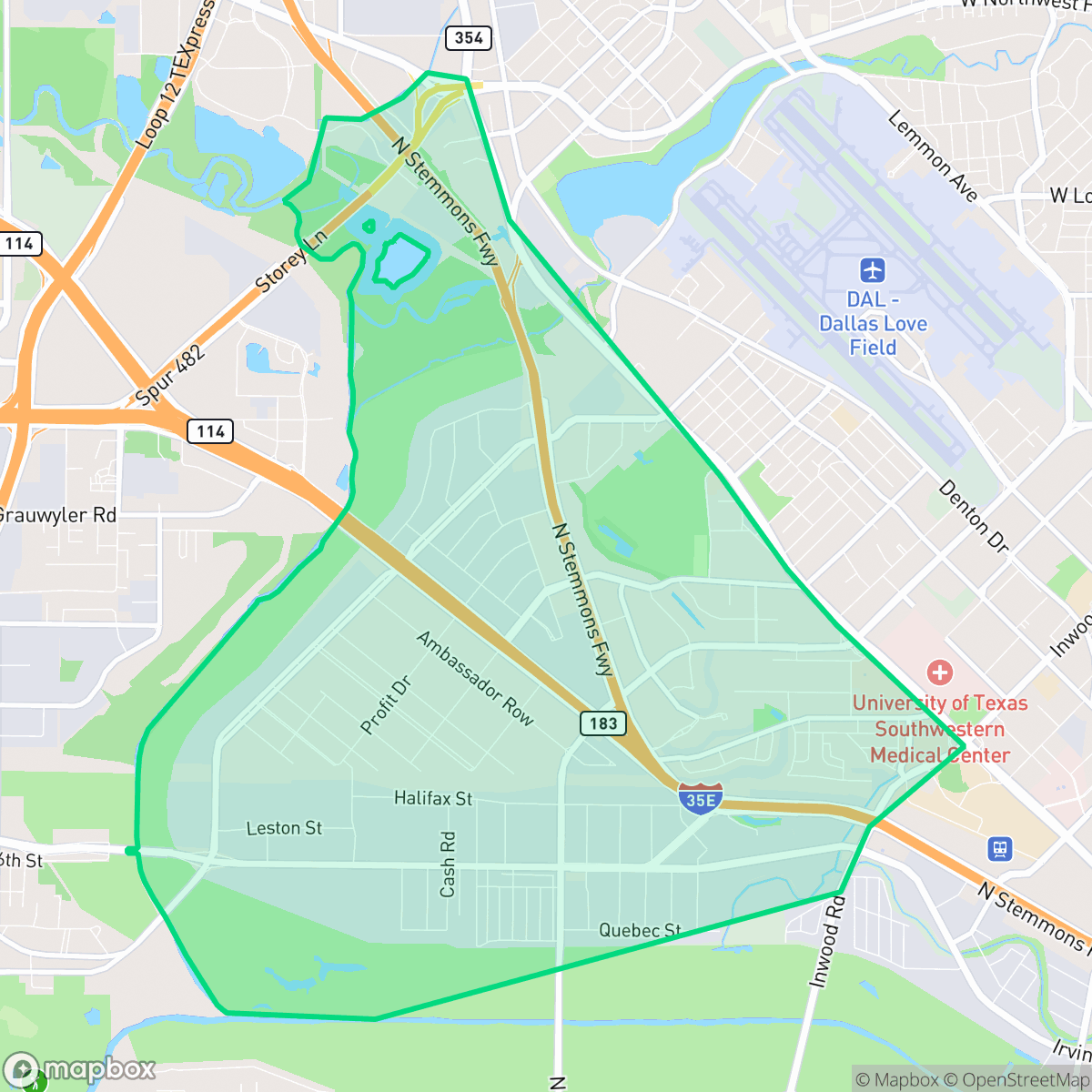
Settled as farmland in the mid-to-late 19th century by Peters Colony pioneers, the area now known as Northwest Dallas was home to early families like the Coxes, who operated a prominent local dairy until the mid-20th century. In 1954, developers Robert Gump and William Gaynier transformed part of this farmland into the Midway Hills subdivision. This development became famous for its "Disney Streets"—such as Pinocchio Drive, Cinderella Lane, and Wonderland Trail—which were showcased in the 1954 Parade of Homes and feature mid-century modern and ranch-style architecture. Today, Northwest Dallas is a diverse hub encompassing residential enclaves, Bachman Lake, the Asian Trade District, and the bustling Dallas Love Field airport.
The area functions as a critical logistics and industrial corridor, characterized by a dense network of warehouses, freight infrastructure, and transit routes. This commercial activity supports a variety of local dining options and serves as a functional hub for those working in transport or aviation. Beyond the industrial footprint, the neighborhood maintains pockets of suburban residential life, offering a mix of mid-rise office spaces and established housing that contrasts with the surrounding heavy infrastructure.
Prospective residents should note that the neighborhood is highly car-dependent, with limited walkability and significant noise exposure from road traffic. The environment is dominated by large-scale logistics centers and paved surfaces, which influences the local acoustic and visual character. It is best suited for individuals who prioritize proximity to major transit corridors and the airport over a quiet or highly pedestrian-friendly residential experience.
Neighborhood Scores Across 15 Qualities
Residential spacing varies throughout the area, ranging from closely positioned houses with narrow side yards to dense multi-family units and warehouses. According to iHuus data, levels of privacy and buffer between neighbors are slightly lower than the Dallas average.
Large highway interchanges and industrial blocks make much of the area difficult for pedestrians. While some residential streets offer quiet walking conditions, the overall walkability is below the Dallas average due to disconnected sidewalks.
Visual variety is limited due to a landscape dominated by standard tract housing, large industrial warehouses, and commercial complexes. According to iHuus data, the area appears less aesthetically diverse than the Dallas average.
Limited continuous walking trails and fragmented green spaces near highways exist here, though nearby golf courses and larger parks offer beneficial greenery for pet owners. Overall dog friendliness is slightly below the Dallas average according to iHuus data.
A blend of industrial warehouses and open green spaces defines the landscape, matching the typical urban-rural balance found across Dallas. Residents will encounter a variety of environments, ranging from dense logistics corridors to pockets of undeveloped land and river-adjacent greenery.
A tranquil, industrial-suburban atmosphere prevails here, characterized by a low level of social activity compared to the city average. Most residents will find the area relies heavily on vehicles for errands, as many dining and service options are situated within warehouse and freight corridors.
Frequent noise from nearby highways and railroad corridors makes this area significantly louder than the Dallas average. Residents may experience persistent auditory disturbances due to proximity to major transit paths, according to iHuus data.
Air quality fluctuates between acceptable and unhealthy levels, though conditions are slightly better than the Dallas average. Sensitive groups should monitor local reports for occasional periods of concern.
Extensive logistics hubs, warehouses, and rail lines are prominent throughout the area, resulting in much higher industrial density than the Dallas average. Residents may encounter increased heavy truck traffic and noise from nearby distribution centers and utility infrastructure.
Health insurance access is notably lower than the Dallas average, indicating a significant portion of the population lacks coverage. According to iHuus data, residents may face higher out-of-pocket medical expenses due to limited local coverage rates.
Voting patterns and census indicators show a significantly more liberal leaning than the Dallas average. Residents can expect a political landscape that is more progressive than most other parts of the city.
Residents experience a balanced demographic mix of young adults, families, and seniors. According to iHuus data, this age distribution is slightly more varied than the typical profile found across Dallas.
Significant flood risk exists due to the area being located within a 100-year floodplain; according to iHuus data, this risk level is notably higher than the Dallas average and typically necessitates flood insurance.
Address-Level Insights for Northwest Dallas


iHuus Neighborhood Intelligence Insights
Get address-level neighborhood insights for Northwest Dallas
- Street-level scores — see how individual blocks compare, not just neighborhood averages
- Micro-zone boundaries — identify quiet pockets, flood boundaries, and walkable clusters before you visit
- 15 dimensions in full — walkability, noise, air quality, school quality, insurance coverage, population age profile, urban/rural index, and more
- Boundary risk alerts — know if your address sits near a block boundary where scores drop, the kind of detail no listing will ever mention
- School insights — individual school ratings and insights, not just district-level data
- Compare before you commit — side-by-side data across neighborhoods, down to block precision
No credit card required
Compare with Any Neighborhood
| Dimension | Northwest Dallas | Arts District |
|---|---|---|
| 🚶 Walkabilityavg 7.43 | ||
| 🔊 Acoustic Comfortavg 3.98 | ||
| 🤫 Privacy Indexavg 5.4 | ||
| 🎨 Visual Appealavg 6.6 | ||
| 🐕 Dog Friendlinessavg 6.65 | ||
| 🗺️ Urban-Rural Indexavg 6.6 | ||
| ✨ Neighborhood Vibeavg 4.96 | ||
| 🏥 Health Insurance Coverageavg 5.31 | ||
| 🌿 Air Qualityavg 4.05 | ||
| 🏭 Industrial Proximityavg 8.56 | ||
| 🌊 Flood Safetyavg 3.3 | ||
| 🗳️ Ideological Leanavg 7.84 | ||
| 👥 Population Age Profileavg 4.6 | ||
| 🔥 Fire Safety | ||
| 🏫 School Quality |
Northwest Dallas Rankings
School Districts Serving Northwest Dallas
School Insights for Northwest Dallas
Below average outcomes; significant attendance and academic challenges.
School Insights
See what's really behind every school rating near Northwest Dallas
- Individual school ratings — each school's own score with outcome context, not just a district average
- Enrollment & class size data — student-to-teacher ratio and how it compares to the state average
- Full demographics breakdown — ethnicity and gender composition for every school in the enrollment zone
- Every school in the district — all schools within the enrollment boundary ranked by rating, not just the closest one
- Grade levels & benchmarks — elementary through high school, with below/above state-average flags
No credit card required