Northeast Dallas, Dallas
Updated · 230,018 residents
Northeast Dallas is defined by its hilly terrain, proximity to White Rock Lake, and a distinct mix of established suburban pockets and dense apartment communities. The area offers a relatively walkable environment for a suburban setting, though residents should anticipate noise from major highway corridors and varying levels of housing density.
Key Highlights
About Northeast Dallas
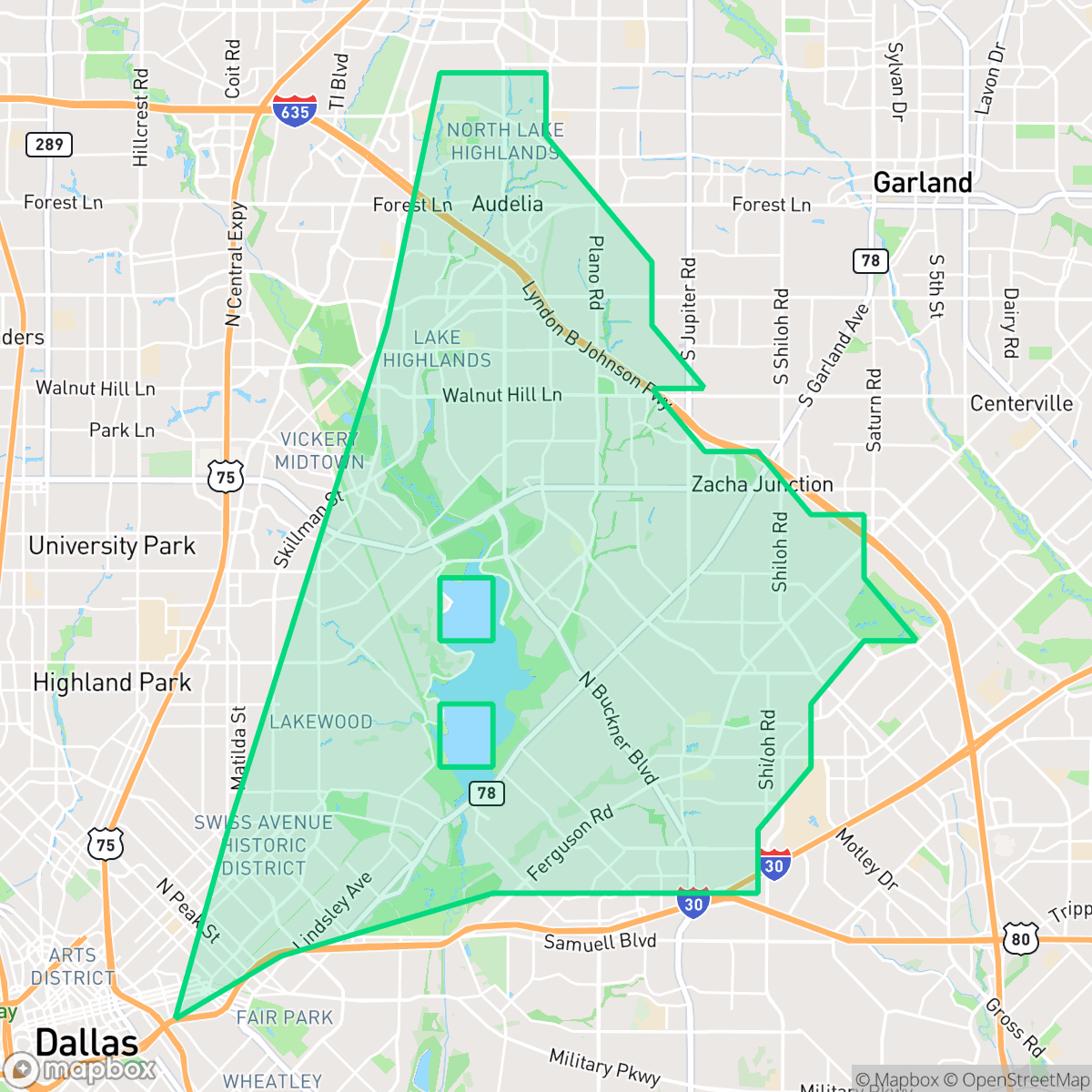
Northeast Dallas, bounded by U.S. Highway 75 and Northwest Highway, is a diverse region shaped by mid-century suburban expansion and unique master-planned developments. The area is dominated by Lake Highlands, a neighborhood characterized by hilly topography, mid-century modern brick ranches, and proximity to White Rock Lake. To the west, the massive apartment community known as The Village was pioneered in the 1970s as a hub for the city’s young singles. Adjacent to it, Vickery Meadow was initially developed during the same era for affluent, childless professionals. Following demographic shifts in the 1980s, Vickery Meadow transitioned into an incredibly dense, multicultural enclave, famously serving as a vital landing point for international immigrants and refugees. Together, these distinct pockets define the architectural and cultural evolution of Northeast Dallas.
The area serves as a significant residential hub, balancing the quiet, tree-lined streets of Lake Highlands with the high-density, multicultural corridors of Vickery Meadow. Residents benefit from a robust network of public schools, including several top-rated elementary campuses that maintain strong student-teacher ratios. The neighborhood is characterized by its suburban grid, which provides consistent sidewalk connectivity and access to local parks, making it a functional choice for families and professionals seeking proximity to major employment centers. Prospective residents should consider the trade-offs between the area's suburban appeal and its urban density. While many sections offer tranquil, green spaces and standard suburban privacy, others are located near major transit arteries, resulting in elevated road noise and higher traffic volumes. The neighborhood is well-suited for those who prioritize school access and diverse community options, provided they are comfortable with a car-dependent lifestyle in areas where local commercial amenities are not immediately walkable.
Neighborhood Scores Across 15 Qualities
Privacy levels are consistent with the city average, featuring a mix of shared-wall apartment complexes and single-family homes with moderate yard spacing. While some areas contain dense housing clusters, others provide more separation through wooded buffers and larger setbacks.
Pedestrian access is generally easy due to well-defined sidewalks and clear crosswalks, making the area slightly more walkable than the Dallas average. While many residential streets and greenbelt trails are highly accessible, major highways and industrial zones can create significant barriers to movement.
Many areas feature large homes with manicured landscapes and private pools, providing a visual quality that is slightly above the Dallas average. This aesthetic is complemented by a mature tree canopy in certain residential sections, though other parts of the neighborhood consist of standard high-density apartment complexes.
Extensive parklands, wooded trails, and wide grassy verges between sidewalks provide ample space for pets. While some industrial pockets have limited public greenery, the area generally offers comparable access to green space as the rest of the city.
A varied landscape of single-family homes, apartment complexes, and industrial warehouses creates a suburban feel that is very similar to the city average. This mix of residential pockets and large-scale logistics infrastructure provides a transition between dense urban utility and residential sprawl.
A mix of calm suburban blocks and lively commercial pockets defines the area, offering a variety of dining and social hubs that are slightly more active than the city average. While some sections feature dense, high-energy urban nodes, many parts of the neighborhood remain car-dependent with limited walkability to local amenities.
Local traffic from nearby busy streets creates a consistent background noise level that is slightly higher than the Dallas average, according to iHuus data.
Air quality levels in this area fluctuate between acceptable and unhealthy, presenting occasional concerns for sensitive groups. According to iHuus data, these conditions are consistent with the city average.
Primarily residential and light commercial, this area lacks heavy industrial hazards or large-scale warehouses. The lack of significant industrial activity is very similar to the city average.
Health insurance coverage levels in this area are slightly above the Dallas average. Residents may find a moderate availability of coverage options according to iHuus data.
Political leanings in this area align closely with the broader Dallas average, featuring a liberal majority with a modest presence of opposing viewpoints according to iHuus data.
Residents live alongside a balanced mix of young adults, families, and older individuals. This demographic spread is consistent with the overall average found across Dallas.
Flood risk is notable in this area due to its location within a designated floodplain, which is slightly higher than the Dallas average. According to iHuus data, properties here may require flood insurance due to the increased susceptibility to rising waters.
Address-Level Insights for Northeast Dallas


iHuus Neighborhood Intelligence Insights
Get address-level neighborhood insights for Northeast Dallas
- Street-level scores — see how individual blocks compare, not just neighborhood averages
- Micro-zone boundaries — identify quiet pockets, flood boundaries, and walkable clusters before you visit
- 15 dimensions in full — walkability, noise, air quality, school quality, insurance coverage, population age profile, urban/rural index, and more
- Boundary risk alerts — know if your address sits near a block boundary where scores drop, the kind of detail no listing will ever mention
- School insights — individual school ratings and insights, not just district-level data
- Compare before you commit — side-by-side data across neighborhoods, down to block precision
No credit card required
Compare with Any Neighborhood
| Dimension | Northeast Dallas | Arts District |
|---|---|---|
| 🚶 Walkabilityavg 7.43 | ||
| 🔊 Acoustic Comfortavg 3.98 | ||
| 🤫 Privacy Indexavg 5.4 | ||
| 🎨 Visual Appealavg 6.6 | ||
| 🐕 Dog Friendlinessavg 6.65 | ||
| 🗺️ Urban-Rural Indexavg 6.6 | ||
| ✨ Neighborhood Vibeavg 4.96 | ||
| 🏥 Health Insurance Coverageavg 5.31 | ||
| 🌿 Air Qualityavg 4.05 | ||
| 🏭 Industrial Proximityavg 8.56 | ||
| 🌊 Flood Safetyavg 3.3 | ||
| 🗳️ Ideological Leanavg 7.84 | ||
| 👥 Population Age Profileavg 4.6 | ||
| 🔥 Fire Safety | ||
| 🏫 School Quality |
Northeast Dallas Rankings
School Districts Serving Northeast Dallas
School Insights for Northeast Dallas
Below average outcomes; significant attendance and academic challenges.
School Insights
See what's really behind every school rating near Northeast Dallas
- Individual school ratings — each school's own score with outcome context, not just a district average
- Enrollment & class size data — student-to-teacher ratio and how it compares to the state average
- Full demographics breakdown — ethnicity and gender composition for every school in the enrollment zone
- Every school in the district — all schools within the enrollment boundary ranked by rating, not just the closest one
- Grade levels & benchmarks — elementary through high school, with below/above state-average flags
No credit card required