North Dallas, Dallas
Updated · 40,424 residents
North Dallas is a sprawling, affluent suburban region defined by its midcentury modern architecture, expansive lots, and mature tree-lined streets. While the area is largely car-dependent, it offers high visual appeal and pockets of excellent walkability near local parks and greenways. Residents benefit from strong community services and high rates of health insurance coverage.
Key Highlights
About North Dallas
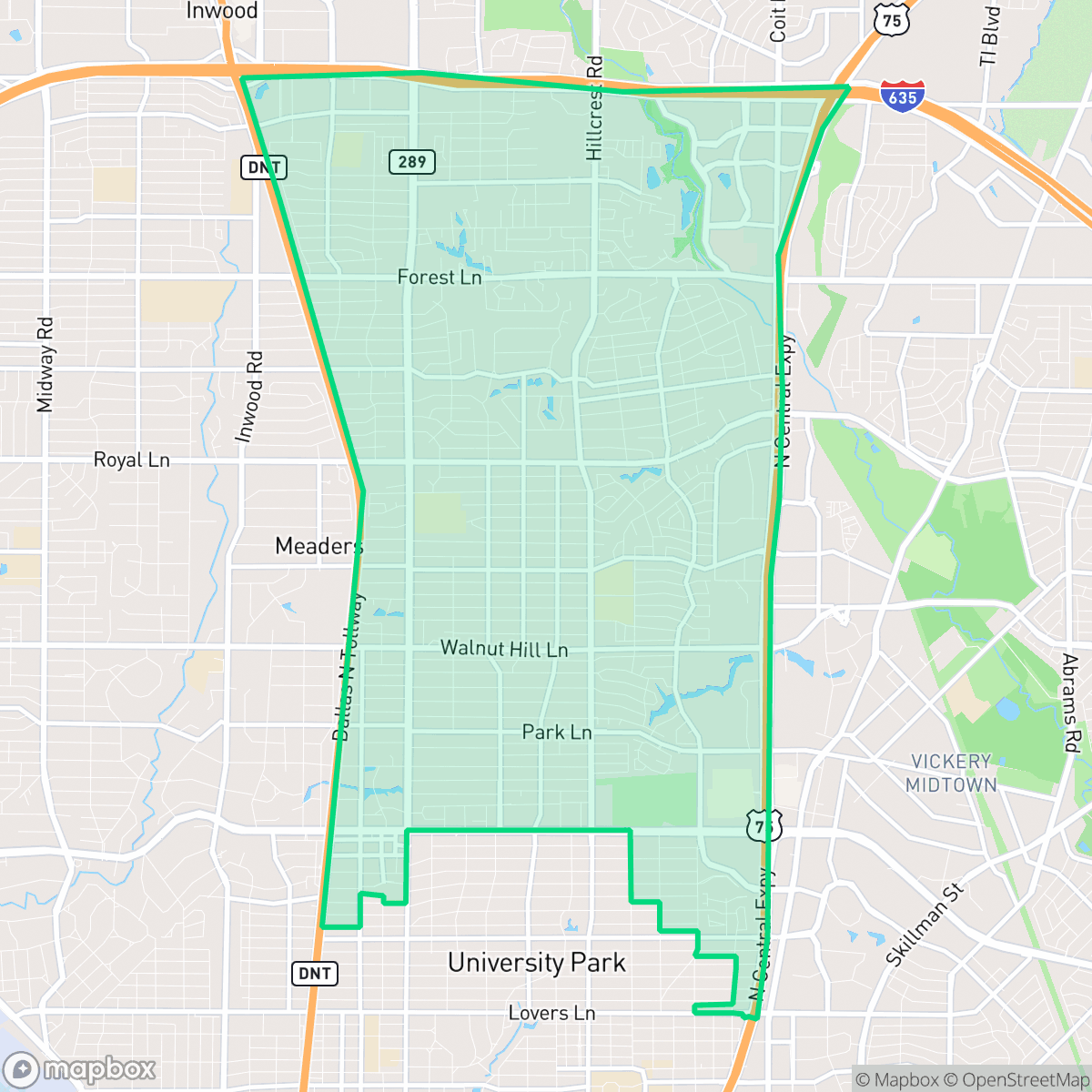
Historically, "North Dallas" referred to a prominent post-Civil War African American enclave established in 1869, initially known as Freedmantown (now part of Uptown/State-Thomas). This self-sustaining community thrived for decades, boasting institutions like the Moorland YMCA, Booker T. Washington High School, and the historic Freedman’s Cemetery. However, the construction of the Central Expressway (US 75) in the 1940s physically divided the neighborhood, initiating its decline and eventual displacement. Modernly, the term "North Dallas" has shifted to describe the sprawling suburban expansion north of Northwest Highway. Developed heavily in the mid-to-late 20th century, this modern region is characterized by car-centric master-planned subdivisions like Prestonwood and Bent Tree, which are known for their midcentury modern homes and spacious lots.
The neighborhood is characterized by a diverse residential landscape that ranges from massive estate homes with private pools to mid-rise apartment clusters. It maintains a strong visual appeal, with well-manicured grounds and heavy tree buffers that provide a sense of privacy in many residential pockets. Residents enjoy access to several large parks and a diagonal greenway system, which enhances the walkability of the area despite its suburban nature. The community is largely residential, with a mix of commercial corridors that provide essential services and dining options along major thoroughfares.
Living here involves balancing the benefits of a serene, well-established environment with the realities of a car-centric infrastructure. While the area offers high health insurance coverage and access to elite educational options like the Highland Park Independent School District, residents should expect moderate noise levels from nearby highway traffic. It is well-suited for those who value spacious living and suburban amenities but prefer to remain within reach of the broader Dallas metropolitan area.
Neighborhood Scores Across 15 Qualities
Residential spacing varies significantly across the area, ranging from dense apartment clusters to detached homes with moderate yard buffers. According to iHuus data, the level of separation between neighbors is roughly in line with the Dallas average.
Pedestrian infrastructure is above the city average, featuring continuous sidewalk networks and clear crosswalks in many residential clusters. While major highways and rail corridors can create occasional barriers, much of the area offers navigable paths and connected greenways.
Expansive estates with complex architecture, private swimming pools, and well-maintained grounds characterize much of the area. This level of visual amenity and property scale is notably higher than the Dallas average, according to iHuus data.
Wide grass verges and accessible parklands provide safe walking environments for pets. According to iHuus data, the abundance of greenbelts and connected paths makes this area more dog friendly than the Dallas average.
Residential streets and green spaces are distributed in nearly equal measure, presenting a suburban character that is slightly less dense than the Dallas average. According to iHuus data, the area features a mix of single-family homes, mature tree canopies, and mid-rise residential blocks.
A mix of energetic commercial pockets and quiet residential blocks creates a vibe that is slightly more active than the city average. While many social hubs and diverse dining options are present, much of the area remains car-dependent with limited walkability between destinations.
Frequent noise from nearby highways and transit corridors is common here. According to iHuus data, acoustic comfort levels are slightly lower than the Dallas average.
Air quality in North Dallas fluctuates between acceptable and unhealthy levels, matching the typical conditions found across the city. Sensitive groups should remain aware of occasional days with higher pollution levels, according to iHuus data.
Residential and light commercial uses dominate the area with an absence of heavy warehouses or industrial hazards. According to iHuus data, this lack of industrial proximity is notably higher than the city average.
Health insurance enrollment among residents is significantly higher than the Dallas average, according to iHuus data. This indicates a high level of medical coverage stability within the community.
Political views in this area are balanced between conservative and liberal leanings, which is notably less partisan than the Dallas city average. According to iHuus data, residents can expect a diverse range of perspectives within the community.
Residents live alongside a balanced mix of young professionals, families, and seniors. According to iHuus data, this demographic spread is more varied than the average across Dallas.
Flood risk in this area is notably higher than the Dallas average, though current FEMA studies for this specific zone remain incomplete. Residents should remain aware of potential vulnerabilities despite the lack of a detailed federal flood study.
Address-Level Insights for North Dallas


iHuus Neighborhood Intelligence Insights
Get address-level neighborhood insights for North Dallas
- Street-level scores — see how individual blocks compare, not just neighborhood averages
- Micro-zone boundaries — identify quiet pockets, flood boundaries, and walkable clusters before you visit
- 15 dimensions in full — walkability, noise, air quality, school quality, insurance coverage, population age profile, urban/rural index, and more
- Boundary risk alerts — know if your address sits near a block boundary where scores drop, the kind of detail no listing will ever mention
- School insights — individual school ratings and insights, not just district-level data
- Compare before you commit — side-by-side data across neighborhoods, down to block precision
No credit card required
Compare with Any Neighborhood
| Dimension | North Dallas | Arts District |
|---|---|---|
| 🚶 Walkabilityavg 7.43 | ||
| 🔊 Acoustic Comfortavg 3.98 | ||
| 🤫 Privacy Indexavg 5.4 | ||
| 🎨 Visual Appealavg 6.6 | ||
| 🐕 Dog Friendlinessavg 6.65 | ||
| 🗺️ Urban-Rural Indexavg 6.6 | ||
| ✨ Neighborhood Vibeavg 4.96 | ||
| 🏥 Health Insurance Coverageavg 5.31 | ||
| 🌿 Air Qualityavg 4.05 | ||
| 🏭 Industrial Proximityavg 8.56 | ||
| 🌊 Flood Safetyavg 3.3 | ||
| 🗳️ Ideological Leanavg 7.84 | ||
| 👥 Population Age Profileavg 4.6 | ||
| 🔥 Fire Safety | ||
| 🏫 School Quality |
North Dallas Rankings
School Districts Serving North Dallas
School Insights for North Dallas
Below average outcomes; significant attendance and academic challenges.
School Insights
See what's really behind every school rating near North Dallas
- Individual school ratings — each school's own score with outcome context, not just a district average
- Enrollment & class size data — student-to-teacher ratio and how it compares to the state average
- Full demographics breakdown — ethnicity and gender composition for every school in the enrollment zone
- Every school in the district — all schools within the enrollment boundary ranked by rating, not just the closest one
- Grade levels & benchmarks — elementary through high school, with below/above state-average flags
No credit card required