Near East, Dallas
Updated · 11,797 residents
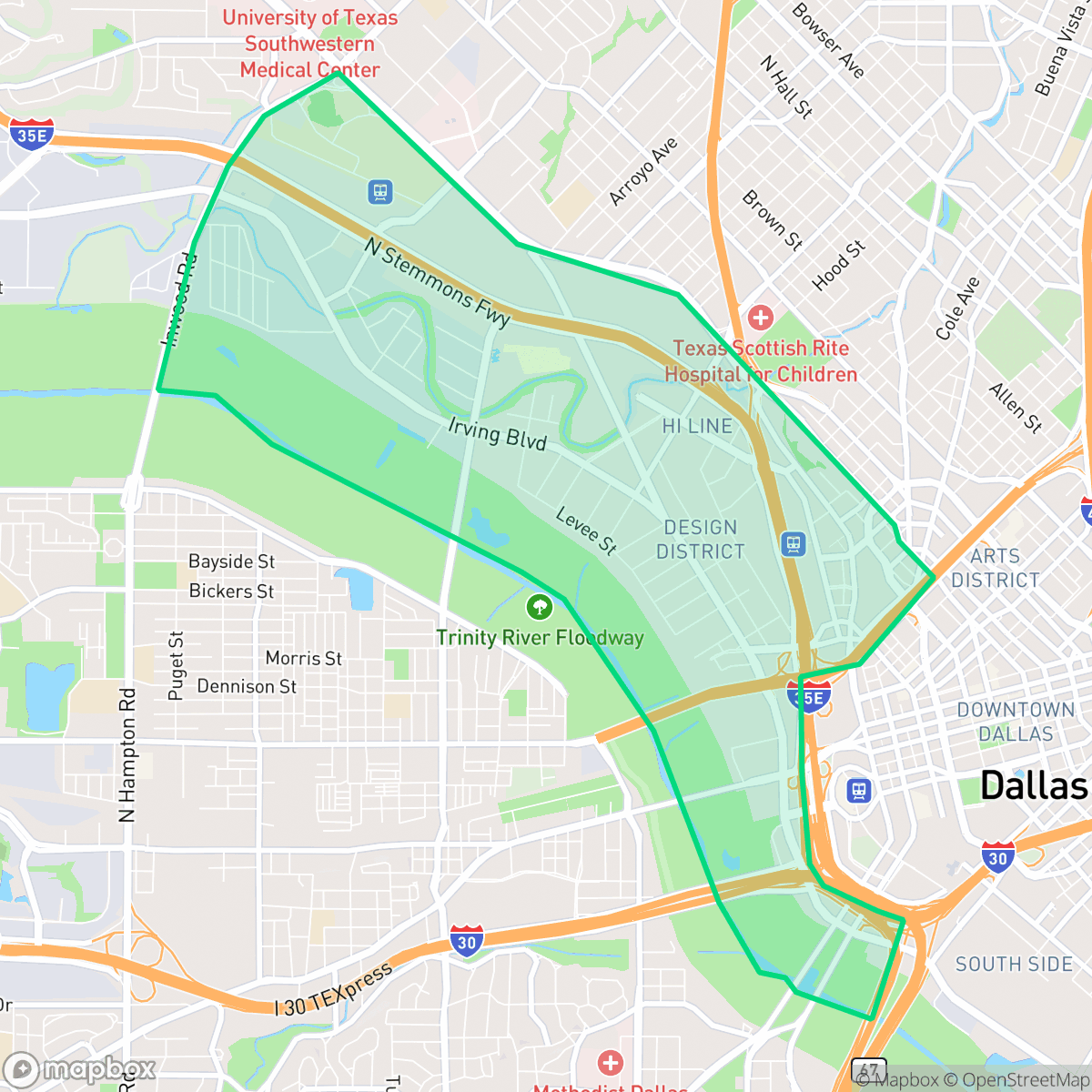
Near East is a dense industrial and commercial district defined by its historic masonry warehouses and proximity to major highway infrastructure. While the area offers significant riverfront green space for outdoor recreation, residents face high levels of ambient traffic noise and limited pedestrian accessibility.
Key Highlights
About Near East
The Near East neighborhood, historically designated alongside Deep Ellum as the Deep Ellum/Near East Side District, originated as a freedmen’s town settled by former slaves after the Civil War. Strategically located near the Houston and Texas Central and Texas and Pacific railroad junction (historically known as Central Track), the area quickly evolved into an industrial and commercial hub. In 1884, Robert S. Munger established his revolutionary cotton gin factory here. By the 1920s, the neighborhood flourished as a premier cultural and musical mecca for African Americans, defining the early blues and jazz eras with legendary street performances by Blind Lemon Jefferson and Lead Belly. Today, the district's character is preserved through historic conservation efforts stemming from the 1983 Near East Side Area Planning Study, maintaining its signature low-scale, early 20th-century masonry warehouses as a vibrant arts and entertainment district.
The neighborhood functions as a complex urban zone characterized by a mix of light industrial units, logistics hubs, and modern high-rise developments. It serves as a central point for diverse dining options, art galleries, and commercial services, often situated within converted historic structures. The area is heavily influenced by its location near major highway junctions, which dictates both its functional layout and its high-energy, concrete-heavy aesthetic. While it lacks the traditional grid of a residential suburb, it provides a unique urban experience for those who prioritize proximity to cultural hubs and professional services over quiet, low-traffic environments.
Livability in the area is defined by significant trade-offs, particularly regarding acoustic comfort and pedestrian infrastructure. The neighborhood is highly car-dependent, as high-speed highway interchanges create barriers that limit safe walking routes. Prospective residents should also consider the environmental context, including flood safety factors and the presence of logistics operations that contribute to constant daytime activity. It is best suited for individuals who enjoy an industrial-urban lifestyle and value access to extensive riverfront trails, provided they are comfortable with the noise levels associated with a major metropolitan transit corridor.
Neighborhood Scores Across 15 Qualities
Residential spacing is tighter than the Dallas average, with various areas featuring closely positioned buildings and shared footprints. According to iHuus data, some parts of the neighborhood consist of high-density multi-family structures with minimal buffers between neighbors.
Pedestrian access varies across the area, with well-connected sidewalks and plazas near major commercial blocks and parks. However, some sections are difficult to navigate on foot due to high speed highway interchanges that lack crossings, making the area less walkable than the Dallas average.
A blend of modern high-density apartments and commercial towers defines the skyline, though the area sits slightly below the city average for visual variety. According to iHuus data, the landscape is characterized by institutional structures and standard urban housing rather than lush residential greenery.
Access to riverfront trails and a large central park makes this area more dog friendly than the Dallas average. Wide green corridors and continuous park access provide reliable walking routes for pets, though some urban grid sections have limited greenery.
Streets and green spaces exist in roughly equal measure, though the area feels significantly less urban than the Dallas average. Residents will encounter a mix of residential grids alongside heavy industrial infrastructure and large-scale river basins.
Concentrated social hubs and diverse dining options create a much more vibrant atmosphere than the city average. While some pockets remain quiet and industrial, many blocks feature a high-energy landscape of high-rise developments and established local eateries.
Frequent traffic and transit noise from nearby freeways and railroad lines create a much louder environment than the Dallas average. According to iHuus data, this area experiences significantly higher levels of acoustic disturbance than most other parts of the city.
Air quality levels in this area are consistent with the Dallas average, presenting a mix of acceptable and unhealthy days for sensitive groups. According to iHuus data, residents should remain mindful of occasional periods of concern.
Occasional light commercial activity and logistics hubs introduce some truck traffic and operational hum, though the area remains notably more industrial than the Dallas average. Residents should note that while heavy industry is largely absent, some areas near large warehouses and highway junctions may experience increased transit noise.
Health insurance access is notably lower here than the Dallas average, according to iHuus data. Residents may face greater challenges accessing medical services due to limited coverage within the community.
Political leaning in this area is more liberal than the Dallas average, according to iHuus data. Residents will find a community with a clear liberal majority and a modest presence of opposing viewpoints.
Residents will find a relatively balanced mix of young adults, families, and older individuals, which is consistent with the broader Dallas area. According to iHuus data, the neighborhood lacks a heavy concentration of any single age demographic.
Located within a known floodplain, this area carries a significant risk of flooding during major weather events. According to iHuus data, the risk level is slightly higher than the Dallas average, and flood insurance is typically a requirement for properties here.
Address-Level Insights for Near East


iHuus Neighborhood Intelligence Insights
Get address-level neighborhood insights for Near East
- Street-level scores — see how individual blocks compare, not just neighborhood averages
- Micro-zone boundaries — identify quiet pockets, flood boundaries, and walkable clusters before you visit
- 15 dimensions in full — walkability, noise, air quality, school quality, insurance coverage, population age profile, urban/rural index, and more
- Boundary risk alerts — know if your address sits near a block boundary where scores drop, the kind of detail no listing will ever mention
- School insights — individual school ratings and insights, not just district-level data
- Compare before you commit — side-by-side data across neighborhoods, down to block precision
No credit card required
Compare with Any Neighborhood
| Dimension | Near East | Arts District |
|---|---|---|
| 🚶 Walkabilityavg 7.43 | ||
| 🔊 Acoustic Comfortavg 3.98 | ||
| 🤫 Privacy Indexavg 5.4 | ||
| 🎨 Visual Appealavg 6.6 | ||
| 🐕 Dog Friendlinessavg 6.65 | ||
| 🗺️ Urban-Rural Indexavg 6.6 | ||
| ✨ Neighborhood Vibeavg 4.96 | ||
| 🏥 Health Insurance Coverageavg 5.31 | ||
| 🌿 Air Qualityavg 4.05 | ||
| 🏭 Industrial Proximityavg 8.56 | ||
| 🌊 Flood Safetyavg 3.3 | ||
| 🗳️ Ideological Leanavg 7.84 | ||
| 👥 Population Age Profileavg 4.6 | ||
| 🔥 Fire Safety | ||
| 🏫 School Quality |
Near East Rankings
School Districts Serving Near East
School Insights for Near East
Below average outcomes; significant attendance and academic challenges.
School Insights
See what's really behind every school rating near Near East
- Individual school ratings — each school's own score with outcome context, not just a district average
- Enrollment & class size data — student-to-teacher ratio and how it compares to the state average
- Full demographics breakdown — ethnicity and gender composition for every school in the enrollment zone
- Every school in the district — all schools within the enrollment boundary ranked by rating, not just the closest one
- Grade levels & benchmarks — elementary through high school, with below/above state-average flags
No credit card required