Main Street District, Dallas
Updated · 438 residents
The Main Street District serves as a high-energy urban core, defined by its exceptional walkability and dense, historic architecture. While the area provides immediate access to downtown dining and cultural landmarks, residents must contend with notable road traffic noise and limited privacy within this bustling, concrete-heavy environment.
Key Highlights
About Main Street District
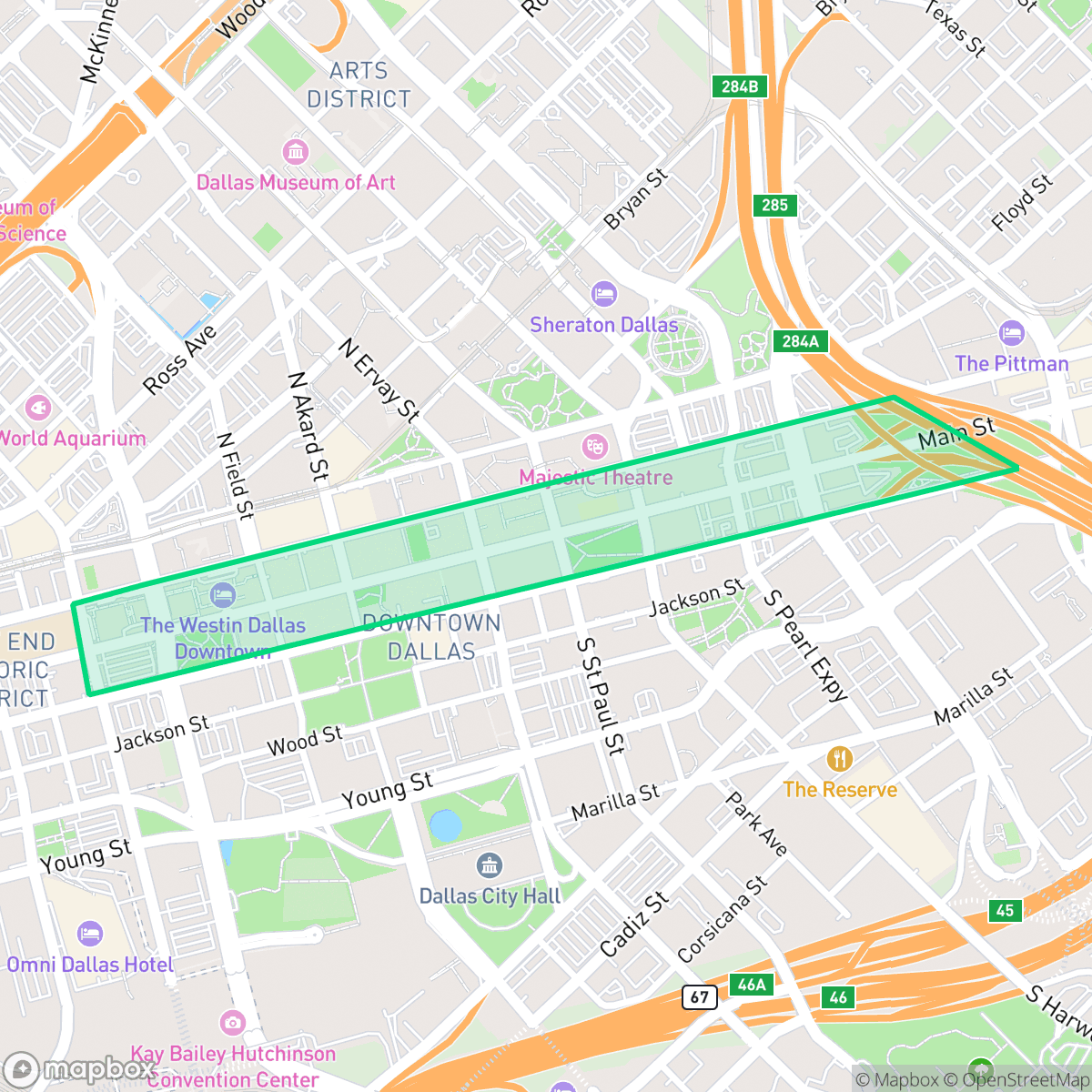
The Main Street District serves as the historic spine and commercial birthplace of downtown Dallas. Centered on Main Street—which became the city's first paved road in 1872—the area emerged as a thriving financial and retail hub at the turn of the 20th century. It was anchored by the iconic 1914 Neiman Marcus flagship store and Dallas's earliest high-rises, such as the 1909 Praetorian Building. The district features an impressive stock of Beaux-Arts, Classical Revival, and early modern architecture, including the landmark Adolphus Hotel (1912) and the Kirby Building (1913). After decades of decline as development shifted north, the neighborhood became the first in downtown Dallas to undergo extensive urban renewal in the late 1990s, pioneering the adaptive reuse of neglected historic skyscrapers into vibrant residential lofts and boutique hotels.
This neighborhood functions as a vibrant center for urban living, characterized by a dense, high-rise landscape that prioritizes pedestrian access over suburban amenities. Residents benefit from a highly walkable environment that places diverse dining options and cultural institutions, such as the Crow Museum of Asian Art, within a short distance. According to iHuus data, the area maintains a high level of activity, making it an ideal location for those who prefer an intense, city-centric lifestyle over quiet, residential seclusion. Living in this district involves specific trade-offs, particularly regarding acoustic comfort and personal space. The high density results in a lower privacy index, and the proximity to major roadways contributes to ambient noise levels averaging 62 decibels. While the area is well-positioned for flood safety, it presents challenges for pet owners due to limited green space, and families should be aware that local school options within the Dallas Independent School District vary significantly in quality and performance.
Neighborhood Scores Across 15 Qualities
Buildings and structures are positioned in close proximity with minimal separation between properties. This level of density is significantly higher than the average seen across Dallas.
Pedestrian navigation is easy due to wide sidewalks and frequent crossings. This area offers much better walkability than the Dallas average, according to iHuus data.
Upscale amenities and large residential properties contribute to a visual environment that is consistent with the Dallas average.
Limited access to public parks and a lack of wide green verges make this area less ideal for dog owners. This level of accessibility is notably lower than the Dallas city average, according to iHuus data.
High-density towers and extensive pavement define this area, which contains significantly less greenery than the Dallas average. According to iHuus data, the landscape is characterized by a heavy urban build with very little natural vegetation.
Dense high-rise developments and a wide variety of dining options create a level of activity and energy that is significantly higher than the Dallas average. This concrete-dominant landscape serves as a major regional attraction with constant movement and a vibrant atmosphere.
Frequent sounds from nearby transit corridors and rail lines contribute to a noisier environment than the Dallas average. Residents should expect significant acoustic disturbance due to the area's proximity to major thoroughfares and tracks.
Air quality in this area fluctuates between acceptable and unhealthy levels. According to iHuus data, these conditions are consistent with the average found across Dallas.
No warehouses, manufacturing facilities, or hazardous industrial sites are present within the district. This lack of industrial activity is notably cleaner than the Dallas average, consisting instead of purely residential and light commercial uses.
Voting patterns and census indicators reflect a more liberal political leaning than the Dallas average, according to iHuus data.
A balanced blend of young professionals, families, and older residents characterizes the area. This demographic distribution is largely consistent with the average found throughout Dallas.
Flood risk in this area is notably higher than the Dallas average, though a definitive assessment is currently unavailable due to incomplete federal studies. Residents should remain aware of potential vulnerabilities during heavy rain events according to iHuus data.
Address-Level Insights for Main Street District


iHuus Neighborhood Intelligence Insights
Get address-level neighborhood insights for Main Street District
- Street-level scores — see how individual blocks compare, not just neighborhood averages
- Micro-zone boundaries — identify quiet pockets, flood boundaries, and walkable clusters before you visit
- 15 dimensions in full — walkability, noise, air quality, school quality, insurance coverage, population age profile, urban/rural index, and more
- Boundary risk alerts — know if your address sits near a block boundary where scores drop, the kind of detail no listing will ever mention
- School insights — individual school ratings and insights, not just district-level data
- Compare before you commit — side-by-side data across neighborhoods, down to block precision
No credit card required
Compare with Any Neighborhood
| Dimension | Main Street District | Arts District |
|---|---|---|
| 🚶 Walkabilityavg 7.43 | ||
| 🔊 Acoustic Comfortavg 3.98 | ||
| 🤫 Privacy Indexavg 5.4 | ||
| 🎨 Visual Appealavg 6.6 | ||
| 🐕 Dog Friendlinessavg 6.65 | ||
| 🗺️ Urban-Rural Indexavg 6.6 | ||
| ✨ Neighborhood Vibeavg 4.96 | ||
| 🏥 Health Insurance Coverageavg 5.31 | ||
| 🌿 Air Qualityavg 4.05 | ||
| 🏭 Industrial Proximityavg 8.56 | ||
| 🌊 Flood Safetyavg 3.3 | ||
| 🗳️ Ideological Leanavg 7.84 | ||
| 👥 Population Age Profileavg 4.6 | ||
| 🔥 Fire Safety | ||
| 🏫 School Quality |
Main Street District Rankings
School Districts Serving Main Street District
School Insights for Main Street District
Below average outcomes; significant attendance and academic challenges.
School Insights
See what's really behind every school rating near Main Street District
- Individual school ratings — each school's own score with outcome context, not just a district average
- Enrollment & class size data — student-to-teacher ratio and how it compares to the state average
- Full demographics breakdown — ethnicity and gender composition for every school in the enrollment zone
- Every school in the district — all schools within the enrollment boundary ranked by rating, not just the closest one
- Grade levels & benchmarks — elementary through high school, with below/above state-average flags
No credit card required