M Streets, Dallas
Updated · 34,138 residents
M Streets is a highly walkable East Dallas neighborhood defined by its dense grid of historic architecture and vibrant local dining scene. Residents benefit from excellent pedestrian access to daily amenities, though the area features closely spaced homes and moderate traffic noise typical of a high-density urban environment.
Key Highlights
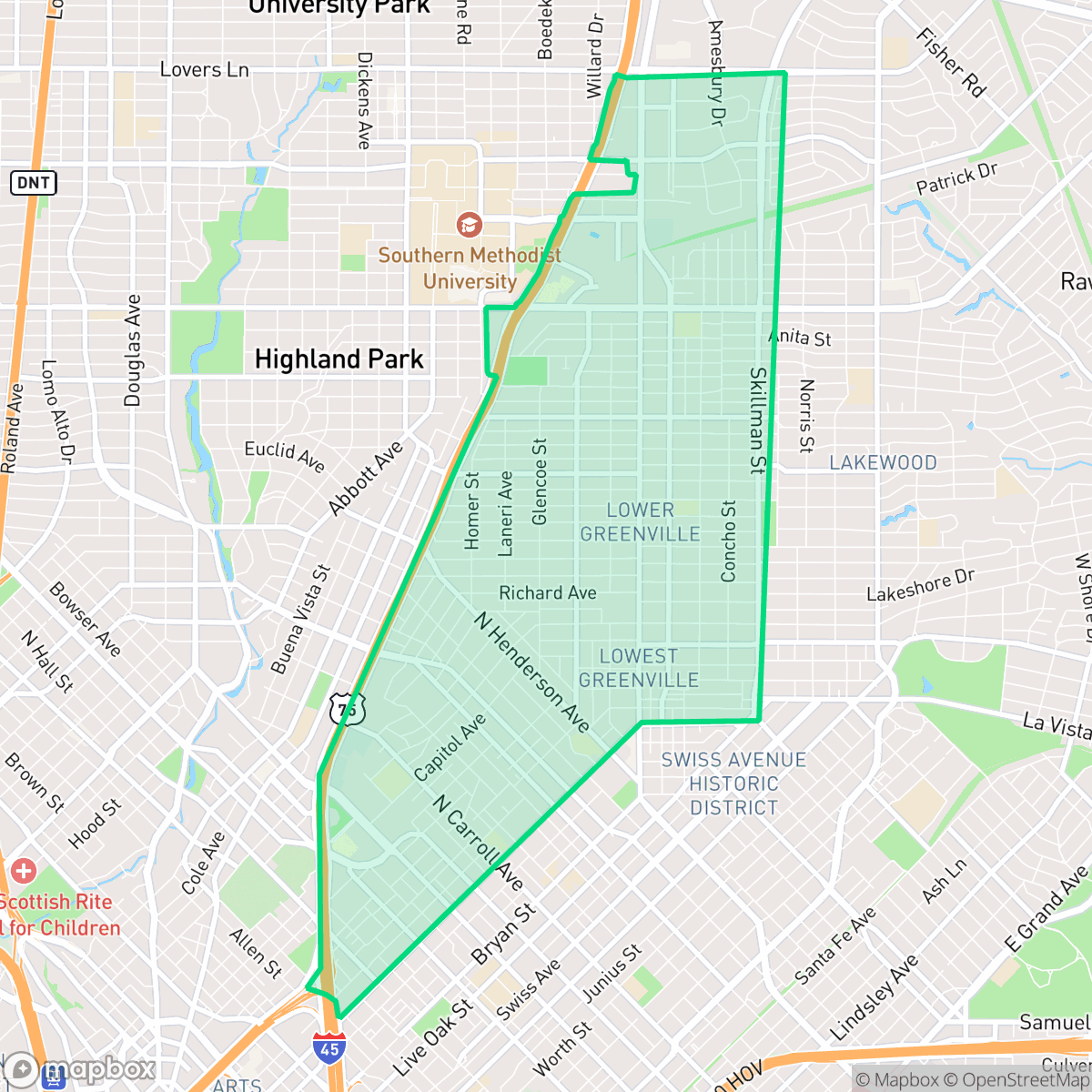
About M Streets
First developed in 1923 as the master-planned suburb of Greenland Hills, the M Streets neighborhood in East Dallas was established by brothers Frank and Fletcher McNeny on 98 acres of the former Bennett farm. The area earned its popular nickname because many of its major thoroughfares—such as McCommas Boulevard and Monticello Avenue—begin with the letter "M". Developed with strict architectural guidelines, the neighborhood features one of the nation's largest concentrations of Tudor Revival-style homes, built using post-WWI brick veneering techniques. These homes, along with Craftsman bungalows and Spanish Eclectic cottages, proved highly popular with young professionals during the Great Depression. Today, the neighborhood's unique historic character and mature canopy of pecan and oak trees are protected by the Greenland Hills and M Streets East Conservation Districts.
The area functions as a central hub for those seeking a blend of historic charm and modern urban convenience. With high walkability, the neighborhood supports a lifestyle where daily errands and social outings are easily managed on foot. The local scene is characterized by a diverse array of dining options, ranging from casual neighborhood pizza spots to popular coffee shops and wellness centers, which contribute to a lively atmosphere. The neighborhood remains a desirable location for those who value an active, accessible lifestyle within a dense, established community. Prospective residents should consider that the high density results in limited privacy, as many properties share walls or are situated on narrow lots with minimal separation. While the streets are lined with mature trees, access to large public green spaces is limited, with most outdoor activity occurring in private backyards. The area is well-suited for those who prioritize proximity to local businesses and a strong sense of community over expansive private acreage.
Neighborhood Scores Across 15 Qualities
Residential structures are densely packed with frequent shared walls and narrow gaps between buildings. This level of density is lower than the Dallas average, often resulting in minimal buffering between neighbors according to iHuus data.
A dense, consistent grid of sidewalks and clearly marked crossings makes navigating the area on foot easy. According to iHuus data, this level of connectivity and pedestrian safety is significantly higher than the Dallas average.
Large residential properties featuring mature landscaping and private pools create a more polished aesthetic than the typical Dallas area. While some sectors feature dense urban apartment blocks, many streets are characterized by spacious lots and well-maintained grounds according to iHuus data.
Local parks and green verges provide decent walking opportunities for pets, though options are below the Dallas average. While some areas feature accessible green spaces and tree-lined sidewalks, other sections of the neighborhood lack significant public park access.
Streets and green spaces exist in roughly equal measure, providing a suburban character that is less dense than the Dallas average. Residents will find a blend of multi-family apartment complexes and single-family homes interspersed with commercial blocks.
Diverse dining options and active social spots create a high-energy environment that is significantly more lively than the Dallas average. Residents can enjoy a dense mix of mid-rise urban pockets and suburban blocks featuring everything from upscale eateries to local coffee shops.
Local traffic from nearby busy streets creates a consistent hum that is typical for the area and aligns with the city average. Residents can expect moderate acoustic levels throughout the day according to iHuus data.
Air quality levels are consistent with the Dallas average, though residents may experience occasional days with unhealthy conditions that could affect sensitive groups.
The area consists exclusively of residential and light commercial structures with no detectable warehouses, factories, or heavy industrial sites. This lack of industrial presence is even more pronounced than the city average, providing a cleaner environment free from visible industrial hazards.
Health insurance access among residents is significantly higher than the Dallas average, according to iHuus data.
Political leanings in this area are more balanced than the broader Dallas area, characterized by a liberal majority with a noticeable presence of opposing viewpoints.
Residents can expect a balanced demographic mix of young adults, families, and older individuals. This age distribution remains closely aligned with the general Dallas average according to iHuus data.
Property within the 100-year floodplain is subject to increased flood risk, which typically necessitates flood insurance. According to iHuus data, the risk level in this area is slightly higher than the Dallas average.
Address-Level Insights for M Streets


iHuus Neighborhood Intelligence Insights
Get address-level neighborhood insights for M Streets
- Street-level scores — see how individual blocks compare, not just neighborhood averages
- Micro-zone boundaries — identify quiet pockets, flood boundaries, and walkable clusters before you visit
- 15 dimensions in full — walkability, noise, air quality, school quality, insurance coverage, population age profile, urban/rural index, and more
- Boundary risk alerts — know if your address sits near a block boundary where scores drop, the kind of detail no listing will ever mention
- School insights — individual school ratings and insights, not just district-level data
- Compare before you commit — side-by-side data across neighborhoods, down to block precision
No credit card required
Compare with Any Neighborhood
| Dimension | M Streets | Arts District |
|---|---|---|
| 🚶 Walkabilityavg 7.43 | ||
| 🔊 Acoustic Comfortavg 3.98 | ||
| 🤫 Privacy Indexavg 5.4 | ||
| 🎨 Visual Appealavg 6.6 | ||
| 🐕 Dog Friendlinessavg 6.65 | ||
| 🗺️ Urban-Rural Indexavg 6.6 | ||
| ✨ Neighborhood Vibeavg 4.96 | ||
| 🏥 Health Insurance Coverageavg 5.31 | ||
| 🌿 Air Qualityavg 4.05 | ||
| 🏭 Industrial Proximityavg 8.56 | ||
| 🌊 Flood Safetyavg 3.3 | ||
| 🗳️ Ideological Leanavg 7.84 | ||
| 👥 Population Age Profileavg 4.6 | ||
| 🔥 Fire Safety | ||
| 🏫 School Quality |
M Streets Rankings
School Districts Serving M Streets
School Insights for M Streets
Below average outcomes; significant attendance and academic challenges.
School Insights
See what's really behind every school rating near M Streets
- Individual school ratings — each school's own score with outcome context, not just a district average
- Enrollment & class size data — student-to-teacher ratio and how it compares to the state average
- Full demographics breakdown — ethnicity and gender composition for every school in the enrollment zone
- Every school in the district — all schools within the enrollment boundary ranked by rating, not just the closest one
- Grade levels & benchmarks — elementary through high school, with below/above state-average flags
No credit card required