Love Field Area, Dallas
Updated · 11,189 residents
The Love Field Area is a dense, industrial-suburban enclave defined by its immediate proximity to active aviation infrastructure and logistics hubs. While the neighborhood offers a grid-based layout with moderate walkability, residents experience high ambient noise levels from flight paths and road traffic. It is a practical choice for those prioritizing central access, though the environment is heavily influenced by its active commercial and transit-oriented landscape.
Key Highlights
About Love Field Area
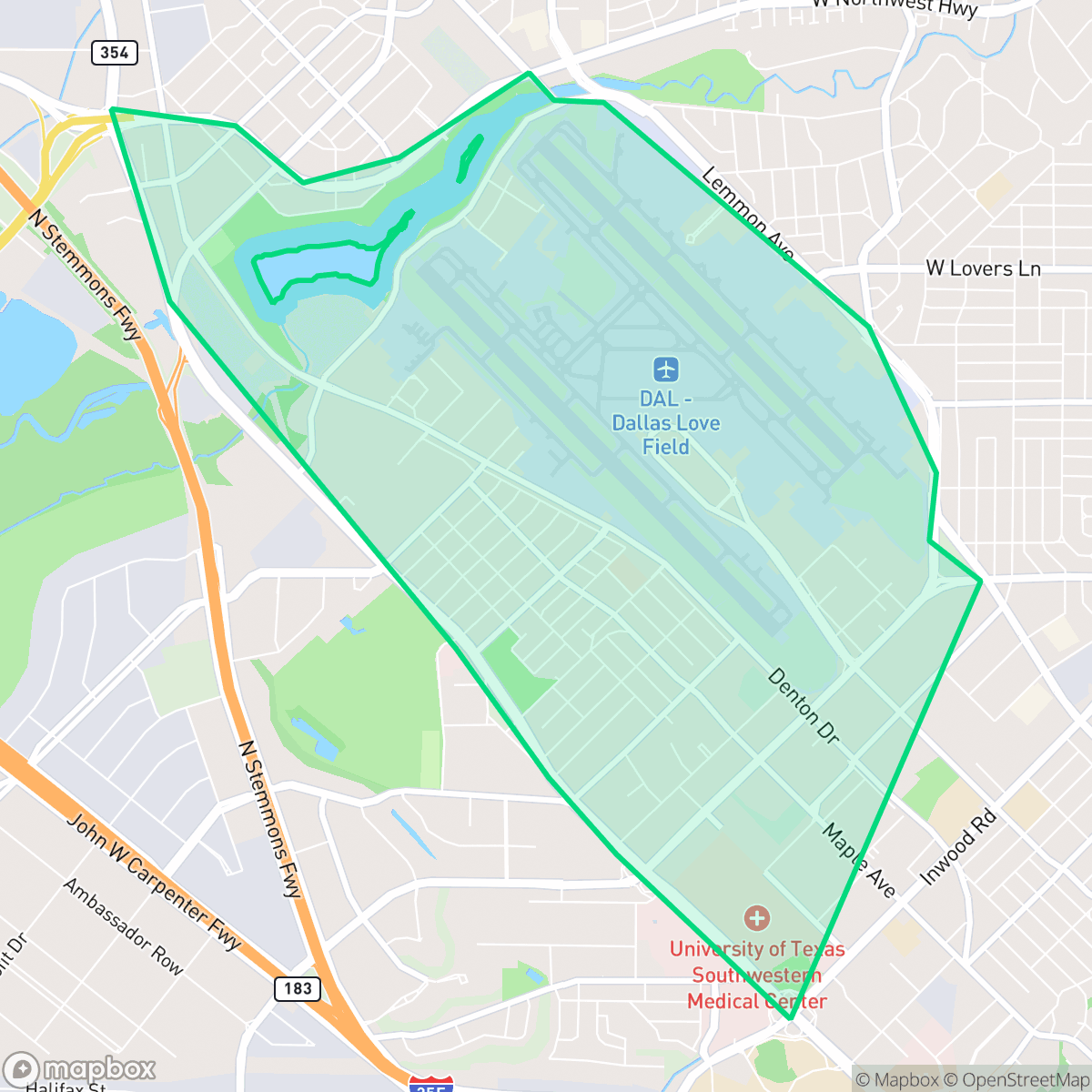
The Love Field Area neighborhood in northwest Dallas is deeply intertwined with its namesake, Dallas Love Field Airport. Originally established in 1917 as a World War I military training airfield named for Army Lieutenant Moss L. Love, the surrounding community grew in tandem with the airport's transition to a municipal hub in 1927 and its subsequent mid-century expansions. The residential landscape features a mix of historic, mid-century homes and modern infill developments, with the city implementing a Neighborhood Stabilization Overlay in Love Field West to preserve its architectural character. Local identity is anchored by aviation history, highlighted by the nearby Frontiers of Flight Museum and the global headquarters of Southwest Airlines. Residents also enjoy local natural landmarks like Bachman Lake Park, which serves as a scenic community oasis.
This neighborhood functions as a vital transit and logistics corridor, characterized by a dense mix of residential blocks, large-scale warehouses, and aviation facilities. The area features a variety of casual dining options and proximity to recreational spaces like Bachman Lake Park, though the overall atmosphere remains quiet and car-dependent. According to iHuus data, the built environment is dominated by significant grey infrastructure and paved surfaces, reflecting its role as a major transportation node within Dallas.
Prospective residents should note that acoustic comfort is a primary challenge, as the area experiences consistent noise from both ground transportation and aviation operations. While the community provides a stable, grid-based residential experience, it is best suited for those who value proximity to major transit hubs over a traditional, quiet suburban aesthetic. The neighborhood maintains a modest visual appeal, with housing density and industrial proximity serving as defining factors for daily life.
Neighborhood Scores Across 15 Qualities
Residential spacing varies significantly throughout the area, ranging from tightly packed multi-family units to single-family homes with moderate yards. According to iHuus data, the level of privacy and buffer between neighbors is roughly comparable to the Dallas average.
Extensive sidewalk networks and a structured grid layout facilitate safe pedestrian movement throughout much of the area. While some large highway interchanges and industrial blocks create barriers, the overall connectivity is roughly in line with the Dallas average.
Residential views vary from affluent pockets with mature tree canopies to areas dominated by industrial warehouses and standard tract housing. According to iHuus data, the visual variety in this area is slightly below the Dallas average.
Access to continuous walking trails and large parks varies by street, though proximity to nearby golf courses and lakefront parkland offers some greenery. According to iHuus data, the availability of wide green verges for pet walking is slightly below the Dallas average.
Large-scale airport infrastructure, industrial warehouses, and extensive paved surfaces characterize much of the landscape. This mix of heavy transit hubs and residential pockets creates an environment that is slightly less open than the Dallas average.
The area features a quiet, industrial-suburban atmosphere with a steady rhythm of services, though most dining and retail options require a vehicle to access. This level of activity is slightly lower than the city average, as many businesses are situated near warehouses and freight corridors.
Constant aircraft noise from the nearby airport runway dominates the area, making it significantly louder than most parts of Dallas. According to iHuus data, acoustic comfort is extremely low due to this immediate proximity to flight paths.
Air quality levels in this area fluctuate between acceptable and unhealthy, presenting occasional concerns for sensitive groups. According to iHuus data, the air quality in the Love Field Area is slightly better than the average for Dallas.
Frequent noise and heavy traffic from the adjacent airport, logistics warehouses, and wastewater treatment facilities make this area notably more industrial than the Dallas average. Residents may encounter significant activity from jet engines, semi-truck docking, and large-scale utility infrastructure near residential pockets.
Health insurance coverage among residents is notably lower than the Dallas average, according to iHuus data. This indicates a significant portion of the population lacks employer-sponsored or private medical coverage.
Voting patterns and census indicators show a strong liberal leaning that is more pronounced than the Dallas city average, according to iHuus data.
A balanced mix of young adults, families, and older residents characterizes the area, mirroring the demographic distribution seen across Dallas. According to iHuus data, there is no significant leaning toward one specific age demographic.
Flood risk is significantly higher here than the Dallas average, as portions of the area fall within a designated 100-year floodplain. According to iHuus data, residents should expect a higher likelihood of inundation and may be required to carry flood insurance.
Address-Level Insights for Love Field Area


iHuus Neighborhood Intelligence Insights
Get address-level neighborhood insights for Love Field Area
- Street-level scores — see how individual blocks compare, not just neighborhood averages
- Micro-zone boundaries — identify quiet pockets, flood boundaries, and walkable clusters before you visit
- 15 dimensions in full — walkability, noise, air quality, school quality, insurance coverage, population age profile, urban/rural index, and more
- Boundary risk alerts — know if your address sits near a block boundary where scores drop, the kind of detail no listing will ever mention
- School insights — individual school ratings and insights, not just district-level data
- Compare before you commit — side-by-side data across neighborhoods, down to block precision
No credit card required
Compare with Any Neighborhood
| Dimension | Love Field Area | Arts District |
|---|---|---|
| 🚶 Walkabilityavg 7.43 | ||
| 🔊 Acoustic Comfortavg 3.98 | ||
| 🤫 Privacy Indexavg 5.4 | ||
| 🎨 Visual Appealavg 6.6 | ||
| 🐕 Dog Friendlinessavg 6.65 | ||
| 🗺️ Urban-Rural Indexavg 6.6 | ||
| ✨ Neighborhood Vibeavg 4.96 | ||
| 🏥 Health Insurance Coverageavg 5.31 | ||
| 🌿 Air Qualityavg 4.05 | ||
| 🏭 Industrial Proximityavg 8.56 | ||
| 🌊 Flood Safetyavg 3.3 | ||
| 🗳️ Ideological Leanavg 7.84 | ||
| 👥 Population Age Profileavg 4.6 | ||
| 🔥 Fire Safety | ||
| 🏫 School Quality |
Love Field Area Rankings
School Districts Serving Love Field Area
School Insights for Love Field Area
Below average outcomes; significant attendance and academic challenges.
School Insights
See what's really behind every school rating near Love Field Area
- Individual school ratings — each school's own score with outcome context, not just a district average
- Enrollment & class size data — student-to-teacher ratio and how it compares to the state average
- Full demographics breakdown — ethnicity and gender composition for every school in the enrollment zone
- Every school in the district — all schools within the enrollment boundary ranked by rating, not just the closest one
- Grade levels & benchmarks — elementary through high school, with below/above state-average flags
No credit card required