Lake Highlands, Dallas
Updated · 54,442 residents
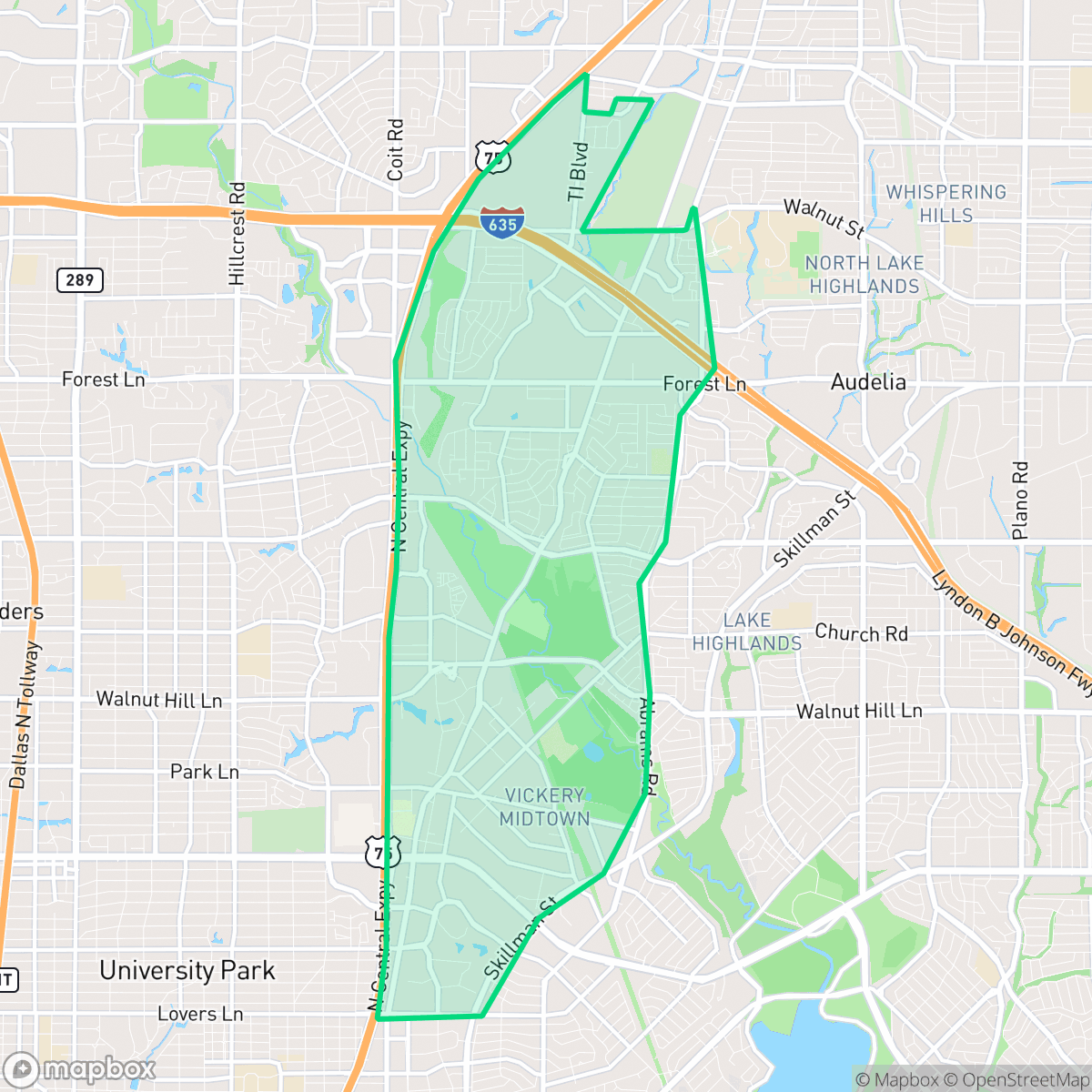
Lake Highlands is a distinct Northeast Dallas enclave known for its hilly, tree-lined topography and extensive access to outdoor recreation near White Rock Lake. The area offers high walkability and a strong network of public parks, though residents often encounter dense housing layouts and noticeable traffic noise from nearby arterial roads.
Key Highlights
About Lake Highlands
Located in northeast Dallas, Lake Highlands transitioned from 19th-century cotton fields and rolling farmland—originally settled by pioneers like the Goforth family—into a scenic residential enclave. In 1927, the Lake Highlands Company began developing the area near White Rock Lake, promoting its unique, hilly topography that contrasts with the typically flat Dallas landscape. Rapid post-World War II suburban expansion, led by developer Jack Ladenberger starting in 1946, transformed the remaining rural tracts into mid-century neighborhoods. Today, the community is defined by its extensive green spaces, including Flag Pole Hill, and architectural landmarks like the 1957 mid-century modern White Rock United Methodist Church, designed by renowned architect George Dahl.
The neighborhood functions as a dense suburban landscape that balances residential blocks with significant green corridors. It features a diverse mix of mid-century single-family homes and high-density apartment complexes. Residents benefit from consistent sidewalk networks and proximity to major recreational hubs, including Flag Pole Hill and various nature trails. Educational opportunities are provided through a split between the Richardson Independent School District and the Dallas Independent School District, offering a wide range of academic performance levels from top-tier magnet programs to neighborhood-focused schools.
Prospective residents should consider the trade-offs inherent in the area's density and location. While the neighborhood offers a vibrant suburban atmosphere, the proximity to major highways contributes to noticeable traffic noise and reduced acoustic comfort. Privacy can be limited in certain sectors due to the close spacing of multi-family housing and smaller yard sizes. Additionally, those evaluating the area should be aware of localized flood safety concerns and the varying quality of school campuses across the district boundaries. It remains a popular choice for those prioritizing outdoor accessibility and a central location within the Dallas metropolitan area.
Neighborhood Scores Across 15 Qualities
Privacy varies significantly throughout the area due to a mix of dense apartment clusters with shared walls and single-family homes with moderate yard buffers. This level of seclusion is slightly below the Dallas average, according to iHuus data.
Extensive sidewalk networks and pedestrian paths through parks make many areas of the neighborhood more walkable than the Dallas average. While most residential streets are well-connected, large highway corridors and major intersections can create occasional barriers to movement.
Large single-family homes with private pools and well-maintained landscapes characterize many areas here, making the visual landscape slightly more upscale than the Dallas average. Residential aesthetics range from affluent estates with complex rooflines to standard, functional multi-family apartment complexes.
Abundant forested nature preserves, wooded trails, and connected green corridors provide ample space for walking pets. This access to continuous parkland and wide, buffered paths is slightly above the Dallas average according to iHuus data.
Large patches of woodland and significant tree canopy define the landscape, creating a semi-rural feel that is slightly less dense than the Dallas average. Residents will find a mix of single-family homes and multi-unit complexes interspersed with notable green spaces and open land.
A mix of quiet residential streets and active commercial corridors provides a social atmosphere that is slightly more energetic than the Dallas average. While some areas offer diverse dining and social hubs, many parts of the neighborhood remain car-dependent with limited walkable amenities.
Frequent noise from nearby major freeways and railroad tracks makes this area louder than the Dallas average. According to iHuus data, residents may experience significant acoustic disturbances due to the proximity of heavy transit corridors.
Air quality in this area fluctuates between acceptable and unhealthy levels. According to iHuus data, the air quality is consistent with the typical levels found across Dallas.
Industrial hazards and heavy warehouses are largely absent, making this area slightly cleaner than the Dallas average regarding industrial proximity. Most of the neighborhood consists of residential, institutional, and light commercial spaces without significant exposure to large-scale manufacturing or heavy logistics hubs.
Health insurance access for Lake Highlands residents is slightly higher than the Dallas average, according to iHuus data.
Political leanings in this area align closely with the broader Dallas average, featuring a liberal majority alongside a modest presence of opposing views.
A balanced mix of young adults, families, and older residents characterizes the area. This demographic distribution is largely consistent with the broader Dallas average, according to iHuus data.
Frequent flooding is a significant concern in this area because parts of the neighborhood sit within a designated floodplain. According to iHuus data, the risk of inundation is higher than the average for Dallas.
Address-Level Insights for Lake Highlands


iHuus Neighborhood Intelligence Insights
Get address-level neighborhood insights for Lake Highlands
- Street-level scores — see how individual blocks compare, not just neighborhood averages
- Micro-zone boundaries — identify quiet pockets, flood boundaries, and walkable clusters before you visit
- 15 dimensions in full — walkability, noise, air quality, school quality, insurance coverage, population age profile, urban/rural index, and more
- Boundary risk alerts — know if your address sits near a block boundary where scores drop, the kind of detail no listing will ever mention
- School insights — individual school ratings and insights, not just district-level data
- Compare before you commit — side-by-side data across neighborhoods, down to block precision
No credit card required
Compare with Any Neighborhood
| Dimension | Lake Highlands | Arts District |
|---|---|---|
| 🚶 Walkabilityavg 7.43 | ||
| 🔊 Acoustic Comfortavg 3.98 | ||
| 🤫 Privacy Indexavg 5.4 | ||
| 🎨 Visual Appealavg 6.6 | ||
| 🐕 Dog Friendlinessavg 6.65 | ||
| 🗺️ Urban-Rural Indexavg 6.6 | ||
| ✨ Neighborhood Vibeavg 4.96 | ||
| 🏥 Health Insurance Coverageavg 5.31 | ||
| 🌿 Air Qualityavg 4.05 | ||
| 🏭 Industrial Proximityavg 8.56 | ||
| 🌊 Flood Safetyavg 3.3 | ||
| 🗳️ Ideological Leanavg 7.84 | ||
| 👥 Population Age Profileavg 4.6 | ||
| 🔥 Fire Safety | ||
| 🏫 School Quality |
Lake Highlands Rankings
School Districts Serving Lake Highlands
School Insights for Lake Highlands
Below average outcomes; significant attendance and academic challenges.
School Insights
See what's really behind every school rating near Lake Highlands
- Individual school ratings — each school's own score with outcome context, not just a district average
- Enrollment & class size data — student-to-teacher ratio and how it compares to the state average
- Full demographics breakdown — ethnicity and gender composition for every school in the enrollment zone
- Every school in the district — all schools within the enrollment boundary ranked by rating, not just the closest one
- Grade levels & benchmarks — elementary through high school, with below/above state-average flags
No credit card required