Klyde Warren Park-Arts District PID, Dallas
Updated · 3,138 residents
The Klyde Warren Park-Arts District PID serves as a dense, high-energy urban core where residents live within steps of world-class museums and a major public green space. While the area offers exceptional walkability and immediate access to diverse dining, the environment is characterized by significant traffic noise and high-density living with limited residential privacy.
Key Highlights
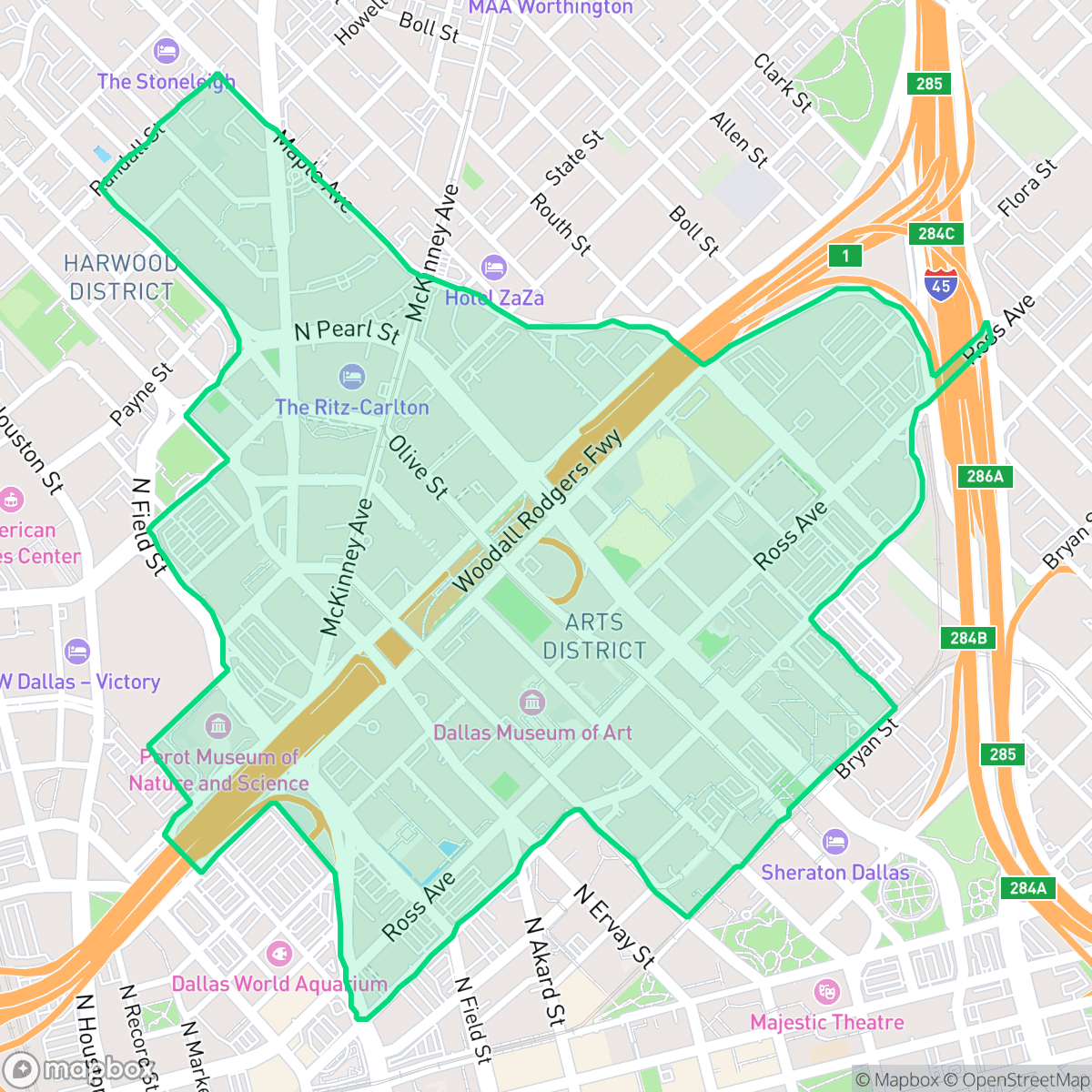
About Klyde Warren Park-Arts District PID
Established in 2014, the Klyde Warren Park-Arts District Public Improvement District (PID) unites two of Dallas's most transformative urban projects. The Dallas Arts District, conceived in the late 1970s and formally established in 1983, is the nation's largest contiguous urban arts district. It is celebrated for its world-class architecture, boasting works by five Pritzker Prize laureates, including I.M. Pei's Meyerson Symphony Center and Renzo Piano's Nasher Sculpture Center. Bridging this cultural hub with Uptown is Klyde Warren Park, a 5.4-acre deck park opened in 2012. Constructed over the recessed Woodall Rodgers Freeway, this innovative green space healed a major physical divide in the city's urban grid, transforming a former highway chasm into a lively, sustainable public commons.
This neighborhood functions as the cultural and social heart of Dallas, defined by its high-rise residential towers and seamless integration with the city's premier cultural institutions. Residents benefit from a highly walkable environment that features numerous pedestrian-oriented plazas and proximity to major attractions like the Perot Museum and the Meyerson Symphony Center. According to iHuus data, the area maintains a high level of activity, supported by a variety of dining options ranging from casual eateries to established local restaurants.
Living in this central district requires accepting the trade-offs of an intense urban setting. The neighborhood experiences elevated noise levels primarily from nearby road traffic, and the lack of green verges makes it less convenient for pet owners. Privacy is limited due to the prevalence of multi-family high-rise structures. It is best suited for professionals and individuals who prioritize immediate access to city amenities and cultural venues over suburban quiet or expansive private space.
Neighborhood Scores Across 15 Qualities
High-density multi-family buildings and shared walls create very little separation between residents. This level of privacy is significantly lower than the Dallas average due to the concentration of closely spaced residential and commercial structures.
Extensive sidewalk networks and pedestrian-priority plazas make most errands easily accessible on foot. This area offers a much more connected pedestrian environment than the Dallas average, according to iHuus data.
High-end architectural geometries and luxury amenities define the visual landscape, offering a more polished environment than the Dallas average. According to iHuus data, the area is characterized by modern multi-family complexes and premium commercial infrastructure.
Large nearby green spaces and walking trails provide excellent opportunities for pet owners, though the dense urban grid offers limited grassy areas elsewhere. This level of accessibility is roughly in line with the Dallas average according to iHuus data.
High-rise towers and expansive pavement characterize this area, which is significantly more built-up than the Dallas average. According to iHuus data, the landscape features minimal greenery and a high concentration of multi-story structures.
Dense high-rise development and a concentrated variety of dining and cultural attractions create an intense level of activity that is significantly higher than the Dallas average. According to iHuus data, this area serves as one of the city's primary epicenters for social density and urban energy.
Frequent auditory disturbances from nearby railroad tracks and heavy freeway traffic characterize this area. According to iHuus data, noise levels are notably higher than the Dallas average.
Air quality in this area typically fluctuates between acceptable and unhealthy levels, mirroring the general conditions found across Dallas. Sensitive groups may experience occasional concern during certain periods, according to iHuus data.
Industrial activity and heavy warehouses are entirely absent from this area, providing a cleaner environment than the Dallas average. According to iHuus data, the district is comprised solely of residential, commercial, and recreational spaces with no detected hazardous facilities.
Health insurance access among residents is below the Dallas average, according to iHuus data.
Political leanings in this area are largely liberal, though the community is less progressive than the Dallas average according to iHuus data.
Residents live alongside a balanced mix of young professionals, families, and older adults. This demographic spread is roughly in line with the broader Dallas area, according to iHuus data.
Flood risk in this area is higher than the Dallas average, though a detailed FEMA study is currently unavailable to determine the exact level of danger. Residents should remain aware of potential drainage concerns during heavy rain events according to iHuus data.
Address-Level Insights for Klyde Warren Park-Arts District PID


iHuus Neighborhood Intelligence Insights
Get address-level neighborhood insights for Klyde Warren Park-Arts District PID
- Street-level scores — see how individual blocks compare, not just neighborhood averages
- Micro-zone boundaries — identify quiet pockets, flood boundaries, and walkable clusters before you visit
- 15 dimensions in full — walkability, noise, air quality, school quality, insurance coverage, population age profile, urban/rural index, and more
- Boundary risk alerts — know if your address sits near a block boundary where scores drop, the kind of detail no listing will ever mention
- School insights — individual school ratings and insights, not just district-level data
- Compare before you commit — side-by-side data across neighborhoods, down to block precision
No credit card required
Compare with Any Neighborhood
| Dimension | Klyde Warren Park-Arts District PID | Arts District |
|---|---|---|
| 🚶 Walkabilityavg 7.43 | ||
| 🔊 Acoustic Comfortavg 3.98 | ||
| 🤫 Privacy Indexavg 5.4 | ||
| 🎨 Visual Appealavg 6.6 | ||
| 🐕 Dog Friendlinessavg 6.65 | ||
| 🗺️ Urban-Rural Indexavg 6.6 | ||
| ✨ Neighborhood Vibeavg 4.96 | ||
| 🏥 Health Insurance Coverageavg 5.31 | ||
| 🌿 Air Qualityavg 4.05 | ||
| 🏭 Industrial Proximityavg 8.56 | ||
| 🌊 Flood Safetyavg 3.3 | ||
| 🗳️ Ideological Leanavg 7.84 | ||
| 👥 Population Age Profileavg 4.6 | ||
| 🔥 Fire Safety | ||
| 🏫 School Quality |
Klyde Warren Park-Arts District PID Rankings
School Districts Serving Klyde Warren Park-Arts District PID
School Insights for Klyde Warren Park-Arts District PID
Below average outcomes; significant attendance and academic challenges.
School Insights
See what's really behind every school rating near Klyde Warren Park-Arts District PID
- Individual school ratings — each school's own score with outcome context, not just a district average
- Enrollment & class size data — student-to-teacher ratio and how it compares to the state average
- Full demographics breakdown — ethnicity and gender composition for every school in the enrollment zone
- Every school in the district — all schools within the enrollment boundary ranked by rating, not just the closest one
- Grade levels & benchmarks — elementary through high school, with below/above state-average flags
No credit card required