Government District, Dallas
Updated · 449 residents
The Government District serves as the civic core of downtown Dallas, characterized by its high-rise density and a vibrant, high-energy atmosphere. Residents benefit from excellent walkability and striking visual appeal, though the area experiences significant noise from nearby road traffic and offers limited residential privacy.
Key Highlights
About Government District
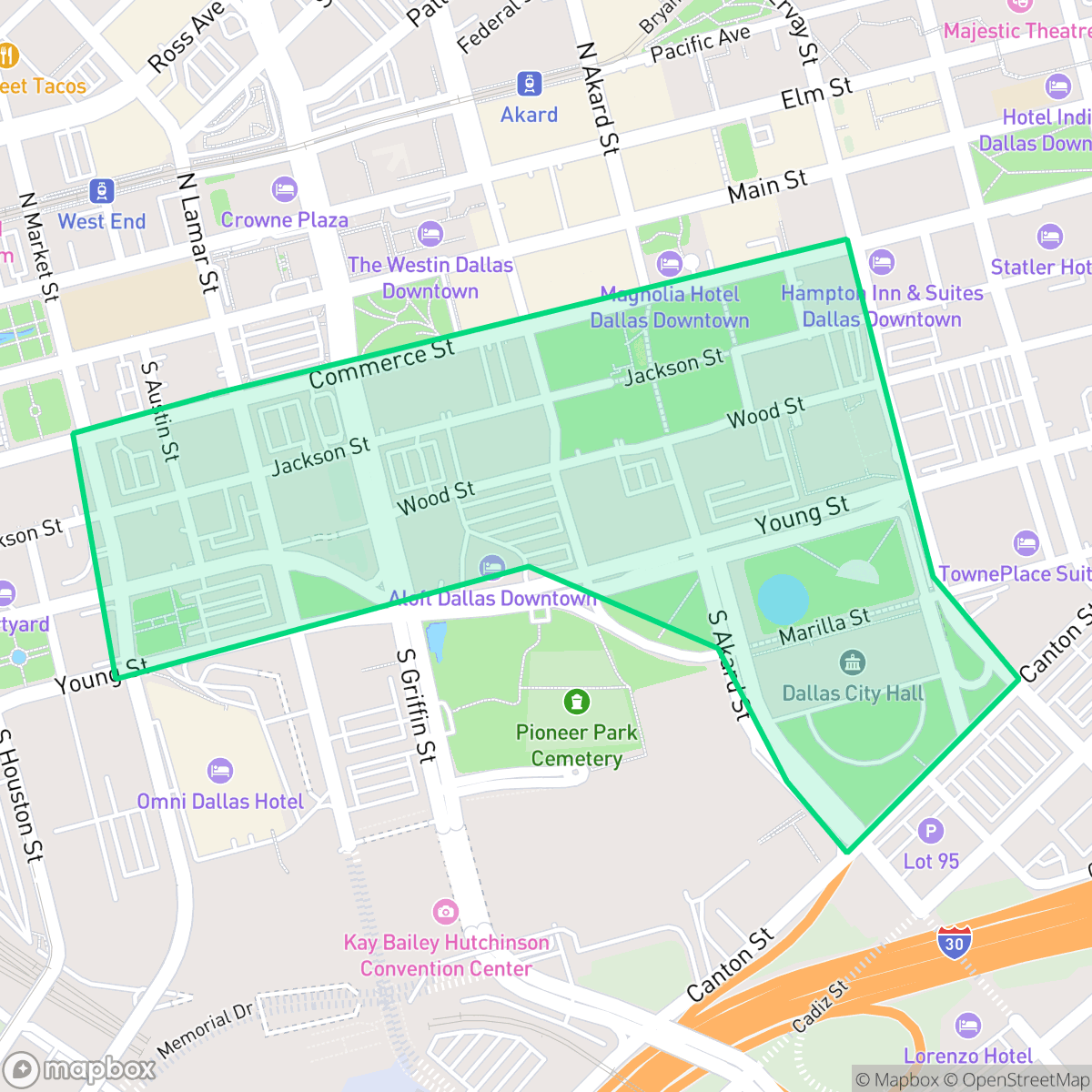
The Government District, located in south-central downtown Dallas, serves as the civic heart of the city. The neighborhood underwent significant revitalization in the 1970s and is anchored by Dallas City Hall, a modernist landmark completed in 1978. Designed by architect I.M. Pei, the building features a striking, cantilevered inverted-pyramid facade sloping at a 34-degree angle. The district also houses the George Dahl-designed Earle Cabell Federal Building and Courthouse, completed in 1971. Historically, the area was a vital commercial hub, defined by the 18-acre Santa Fe Terminal Complex. Constructed in 1924, this massive complex of Mission and Classical Revival-style buildings was connected by an underground rail tunnel network and served as the Southwest’s largest merchandising center. Today, the district also features the J. Erik Jonsson Central Library and the iconic bronze cattle drive sculptures of Pioneer Plaza.
This neighborhood functions as a dense, high-rise hub for city operations and public services. It features a lively environment with diverse dining options, including local pizzerias and cafes. The area maintains a high level of visual appeal and is exceptionally walkable, making it a convenient location for those who prioritize proximity to major civic institutions and central city amenities. Residents can easily navigate the district on foot to reach essential services and cultural landmarks.
Living in this district involves specific trade-offs, particularly regarding noise levels and personal privacy. According to iHuus data, the area experiences elevated road traffic noise and lower privacy scores compared to the city average. It is best suited for individuals who thrive in a bustling, urban environment and value central access over quiet, secluded living. The neighborhood also demonstrates strong flood safety protections and a complete absence of industrial hazards.
Neighborhood Scores Across 15 Qualities
Buildings are positioned in close proximity to one another with minimal separation between structures. According to iHuus data, this lack of spacing makes the area significantly less private than the Dallas average.
Pedestrian infrastructure is excellent here, featuring wide sidewalks and frequent crossings that make navigating the area on foot much easier than in most parts of Dallas. According to iHuus data, the district prioritizes foot traffic with many pedestrian-only zones.
Spacious driveways and frequent upscale amenities contribute to a visual environment that is slightly more polished than the Dallas average. According to iHuus data, the presence of large homes helps maintain a well-maintained aesthetic throughout the district.
Sparse greenery and narrow sidewalks make this area less ideal for pet owners. According to iHuus data, the lack of open, unpaved spaces is significantly lower than the Dallas average.
High-density towers and extensive pavement characterize this area, which contains significantly less greenery than the Dallas average. According to iHuus data, the landscape is primarily comprised of built structures with minimal natural vegetation.
Dense high-rises and a concentrated variety of dining options create an urban atmosphere significantly more active than the city average. According to iHuus data, this area functions as a major regional epicenter of density and energy.
Frequent auditory disturbances from nearby railroad tracks and major freeways characterize this area. According to iHuus data, acoustic comfort is notably lower than the Dallas average.
Air quality in this area fluctuates between acceptable and unhealthy levels, which may cause occasional concern for sensitive groups. According to iHuus data, these conditions are consistent with the city average.
Industrial facilities, warehouses, and hazard sites are entirely absent from this area. According to iHuus data, this neighborhood is notably cleaner of industrial proximity than the Dallas average.
Voting patterns and census indicators reflect a significantly more liberal leaning than the Dallas average, according to iHuus data.
Residents encounter a balanced demographic of young professionals, families, and seniors. This age distribution is largely consistent with the broader Dallas area according to iHuus data.
Flood risk in this area is considerably lower than the Dallas average, though some residual risk remains within the floodplain according to iHuus data.
Address-Level Insights for Government District


iHuus Neighborhood Intelligence Insights
Get address-level neighborhood insights for Government District
- Street-level scores — see how individual blocks compare, not just neighborhood averages
- Micro-zone boundaries — identify quiet pockets, flood boundaries, and walkable clusters before you visit
- 15 dimensions in full — walkability, noise, air quality, school quality, insurance coverage, population age profile, urban/rural index, and more
- Boundary risk alerts — know if your address sits near a block boundary where scores drop, the kind of detail no listing will ever mention
- School insights — individual school ratings and insights, not just district-level data
- Compare before you commit — side-by-side data across neighborhoods, down to block precision
No credit card required
Compare with Any Neighborhood
| Dimension | Government District | Arts District |
|---|---|---|
| 🚶 Walkabilityavg 7.43 | ||
| 🔊 Acoustic Comfortavg 3.98 | ||
| 🤫 Privacy Indexavg 5.4 | ||
| 🎨 Visual Appealavg 6.6 | ||
| 🐕 Dog Friendlinessavg 6.65 | ||
| 🗺️ Urban-Rural Indexavg 6.6 | ||
| ✨ Neighborhood Vibeavg 4.96 | ||
| 🏥 Health Insurance Coverageavg 5.31 | ||
| 🌿 Air Qualityavg 4.05 | ||
| 🏭 Industrial Proximityavg 8.56 | ||
| 🌊 Flood Safetyavg 3.3 | ||
| 🗳️ Ideological Leanavg 7.84 | ||
| 👥 Population Age Profileavg 4.6 | ||
| 🔥 Fire Safety | ||
| 🏫 School Quality |
Government District Rankings
School Districts Serving Government District
School Insights for Government District
Below average outcomes; significant attendance and academic challenges.
School Insights
See what's really behind every school rating near Government District
- Individual school ratings — each school's own score with outcome context, not just a district average
- Enrollment & class size data — student-to-teacher ratio and how it compares to the state average
- Full demographics breakdown — ethnicity and gender composition for every school in the enrollment zone
- Every school in the district — all schools within the enrollment boundary ranked by rating, not just the closest one
- Grade levels & benchmarks — elementary through high school, with below/above state-average flags
No credit card required