Five Mile Creek, Dallas
Updated · 6,726 residents
Five Mile Creek is a suburban Dallas neighborhood defined by its proximity to the Dallas VA Medical Center and expansive green spaces along its namesake waterway. While the area offers a quiet residential environment, residents experience significant noise from nearby highway traffic and a reliance on personal vehicles for daily errands.
Key Highlights
About Five Mile Creek
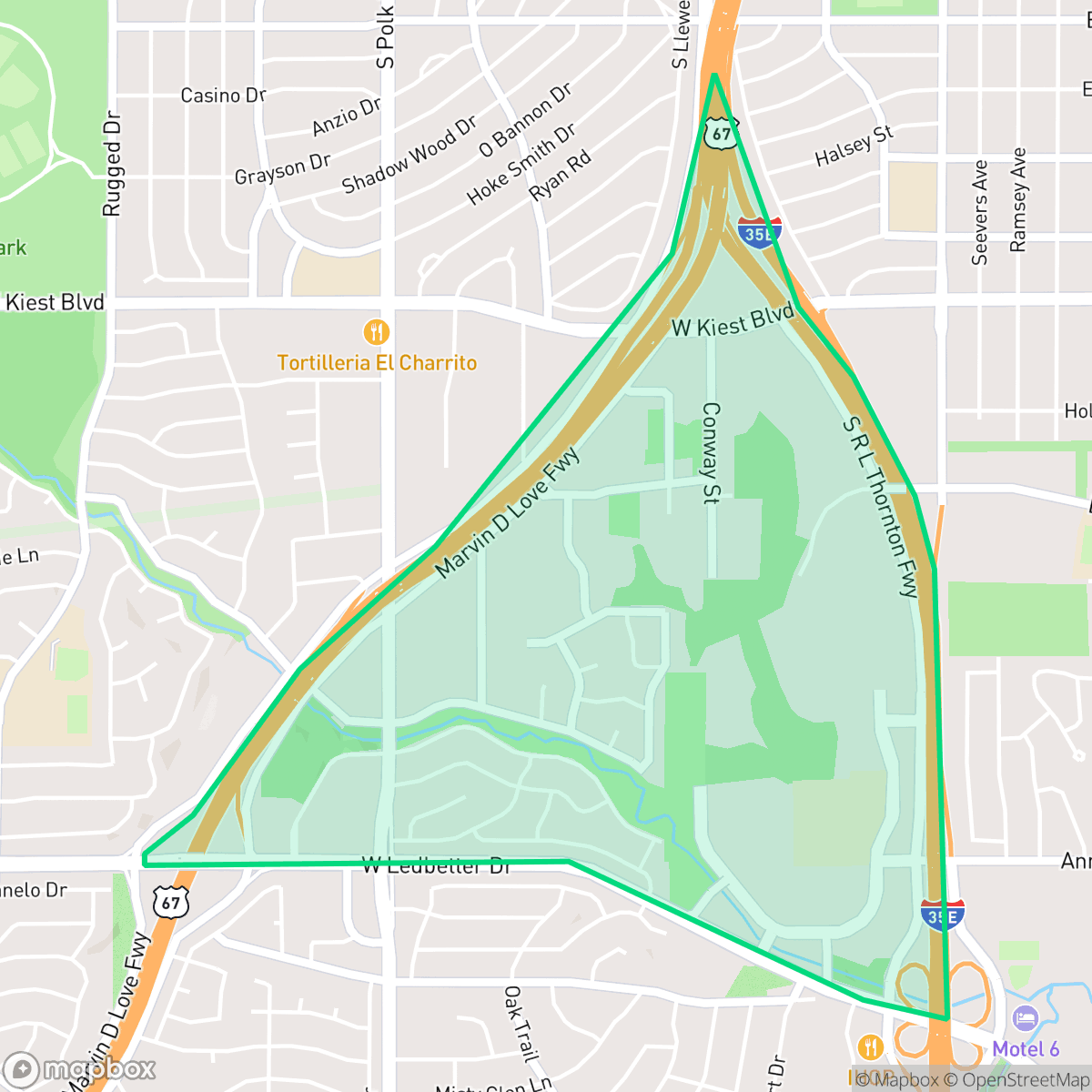
Located in Southern Dallas’s Oak Cliff region, the Five Mile Creek neighborhood traces its origins to the 1836 settlement of Lisbon, founded by Samuel Sloan and his brothers on land awarded for their service in the Texas War of Independence. Sloan’s log cabin served as a community hub, with early property records historically referenced in relation to the "Sloan House on Five Mile Creek". The settlement officially became Lisbon, Texas, in 1870 with the arrival of mail service, before transitioning from farmland to a residential district at the turn of the 20th century. Today, the neighborhood's footprint includes the Dallas VA Medical Center—built on former Sloan property—and residential housing largely developed between 1940 and 1999. The area is also defined by its namesake creek, which flows through local parks but historically prompted major flood management initiatives following a significant flood in 1969.
The area functions as a dense suburban enclave in Southern Dallas, characterized by a mix of mid-century residential housing and light commercial zoning. The presence of the Dallas VA Medical Center serves as a primary anchor, while the surrounding landscape provides ample room for outdoor activity, particularly for pet owners who benefit from the local parks and walking trails. The neighborhood maintains a distinct suburban atmosphere that balances residential blocks with accessible light industrial and service-oriented hubs.
Prospective residents should consider the trade-offs inherent to this location, including a high level of ambient noise from regional road traffic and limited walkability due to highway infrastructure. The area also faces challenges regarding flood safety and air quality, which are important factors for long-term planning. Families may navigate the Dallas Independent School District, which offers a wide range of academic outcomes depending on individual school choices and magnet program access.
Neighborhood Scores Across 15 Qualities
Residential spacing is slightly higher than the Dallas average, though privacy varies depending on whether you reside in a single-family home or a high-density apartment block. While some areas feature standard suburban separation, closely packed structures and shared fence lines are common in denser pockets of the neighborhood.
Residential streets offer safe walking paths through tree-lined areas, but major highway infrastructure acts as a significant barrier to movement. Overall walkability in this area is lower than the Dallas average due to these fragmented connections.
Standard tract housing and multi-family apartment blocks define the landscape, characterized by uniform roof geometries and modest yard spaces. This level of visual variety is slightly below the Dallas average.
Private backyards and nearby sports complexes offer some space for pets, but the area lacks the abundant public park access found elsewhere in Dallas. Sidewalk verges are generally narrow, meaning most greenery is confined to residential lots according to iHuus data.
Residential areas feature a blend of single-family homes, apartment complexes, and commercial strips that closely align with the typical suburban density found across Dallas. This landscape provides a mix of housing types and light commercial access near major highways.
Mixed-use pockets offer various dining and social hubs, but the neighborhood's layout requires a vehicle for most errands. According to iHuus data, the area provides slightly more activity and amenity variety than the Dallas average.
Frequent noise from nearby railroad tracks and major freeways characterizes the area. According to iHuus data, acoustic comfort in this neighborhood is significantly lower than the Dallas average.
Air quality levels in this area are consistent with the Dallas average, presenting a mix of acceptable and unhealthy days for sensitive groups. According to iHuus data, residents may encounter occasional periods of concern regarding pollutant levels.
Residential life remains largely undisturbed by heavy industry, though proximity to a major multi-lane freeway introduces notable traffic noise and air pollution. According to iHuus data, the area is nearly identical to the city average in terms of its lack of significant industrial presence.
Health insurance access among residents is below the Dallas average, according to iHuus data. This indicates a higher proportion of uninsured individuals compared to most other parts of the city.
Voting patterns and census indicators in Five Mile Creek reflect a much more liberal political leaning than the Dallas average, according to iHuus data.
Residents live alongside a balanced mix of young adults, families, and seniors. This age distribution is slightly lower than the Dallas average, according to iHuus data.
Significant flood hazards exist in this area, which is notably more prone to flooding than the Dallas average. According to iHuus data, residents should anticipate elevated or potentially prohibitive insurance costs due to the high-risk designation.
Address-Level Insights for Five Mile Creek


iHuus Neighborhood Intelligence Insights
Get address-level neighborhood insights for Five Mile Creek
- Street-level scores — see how individual blocks compare, not just neighborhood averages
- Micro-zone boundaries — identify quiet pockets, flood boundaries, and walkable clusters before you visit
- 15 dimensions in full — walkability, noise, air quality, school quality, insurance coverage, population age profile, urban/rural index, and more
- Boundary risk alerts — know if your address sits near a block boundary where scores drop, the kind of detail no listing will ever mention
- School insights — individual school ratings and insights, not just district-level data
- Compare before you commit — side-by-side data across neighborhoods, down to block precision
No credit card required
Compare with Any Neighborhood
| Dimension | Five Mile Creek | Arts District |
|---|---|---|
| 🚶 Walkabilityavg 7.43 | ||
| 🔊 Acoustic Comfortavg 3.98 | ||
| 🤫 Privacy Indexavg 5.4 | ||
| 🎨 Visual Appealavg 6.6 | ||
| 🐕 Dog Friendlinessavg 6.65 | ||
| 🗺️ Urban-Rural Indexavg 6.6 | ||
| ✨ Neighborhood Vibeavg 4.96 | ||
| 🏥 Health Insurance Coverageavg 5.31 | ||
| 🌿 Air Qualityavg 4.05 | ||
| 🏭 Industrial Proximityavg 8.56 | ||
| 🌊 Flood Safetyavg 3.3 | ||
| 🗳️ Ideological Leanavg 7.84 | ||
| 👥 Population Age Profileavg 4.6 | ||
| 🔥 Fire Safety | ||
| 🏫 School Quality |
Five Mile Creek Rankings
School Districts Serving Five Mile Creek
School Insights for Five Mile Creek
Below average outcomes; significant attendance and academic challenges.
School Insights
See what's really behind every school rating near Five Mile Creek
- Individual school ratings — each school's own score with outcome context, not just a district average
- Enrollment & class size data — student-to-teacher ratio and how it compares to the state average
- Full demographics breakdown — ethnicity and gender composition for every school in the enrollment zone
- Every school in the district — all schools within the enrollment boundary ranked by rating, not just the closest one
- Grade levels & benchmarks — elementary through high school, with below/above state-average flags
No credit card required