Farmers Market District, Dallas
Updated · 1,533 residents
The Farmers Market District is a high-energy urban neighborhood in southeastern Downtown Dallas known for its vibrant food scene and converted industrial architecture. While it offers a lively atmosphere with diverse dining options, residents should expect notable noise levels from nearby highway traffic and limited residential privacy.
Key Highlights
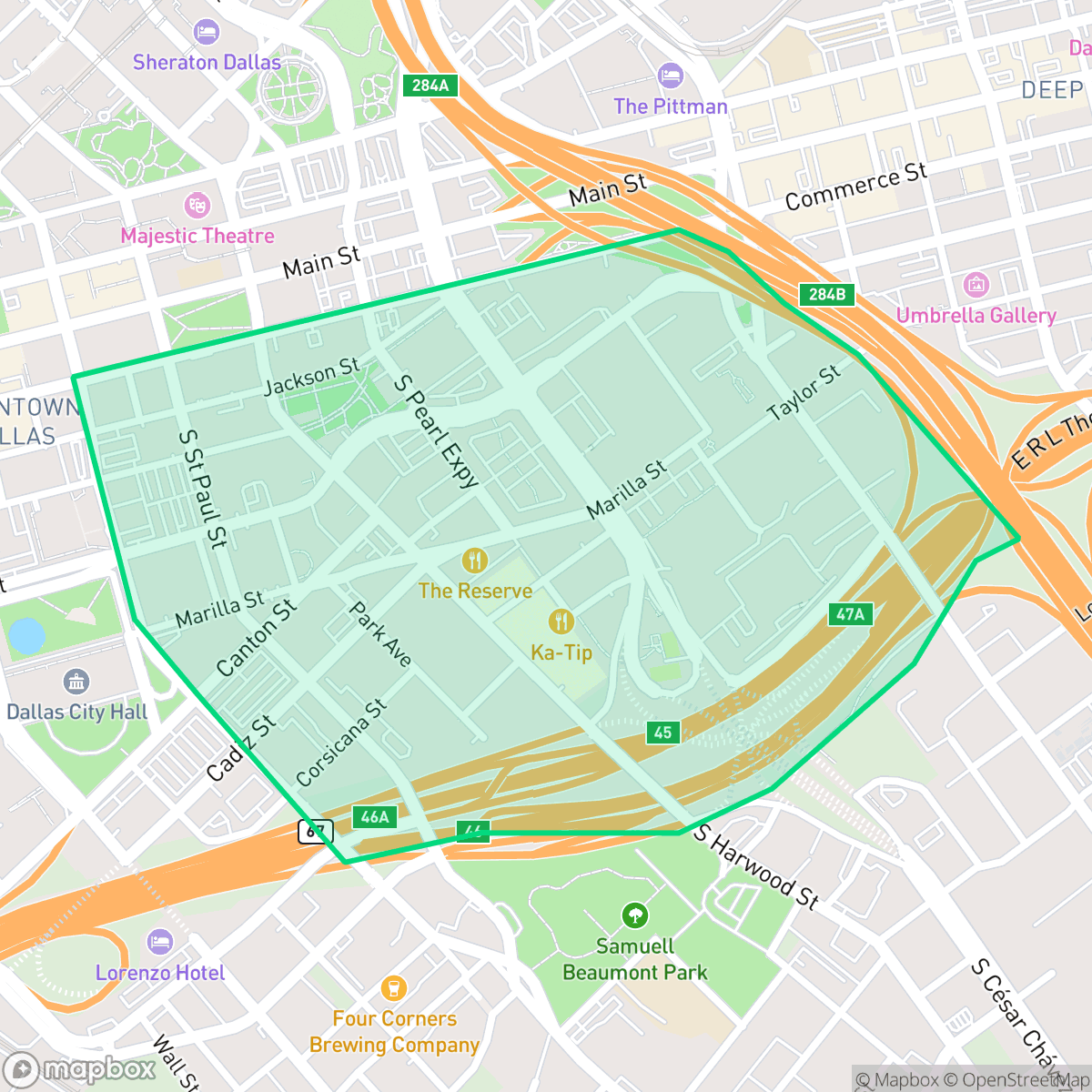
About Farmers Market District
The Farmers Market District in southeastern Downtown Dallas originated in the late 19th century when local farmers began selling livestock, eggs, and produce from horse-drawn wagons at the intersection of South Pearl Expressway and Cadiz Street. To meet growing demand, the city erected the market's first open-air shed in 1939 and officially sanctioned the site as a municipally owned market in 1941. Over the decades, the surrounding area evolved into a commercial hub of produce warehouses and wholesale distributors. Following periods of decline, the district underwent a major revitalization in the 2010s. Led by privatization and developers like Tanya Ragan, the historic market sheds were reimagined—converting Shed 1 into a pedestrian-only open-air pavilion and Shed 2 into a climate-controlled food hall—transforming the old industrial warehouse zone into a highly walkable, mixed-use residential neighborhood.
This area serves as a dense, high-rise hub that blends active commercial traffic with modern residential life. The streetscape is characterized by a mix of light industrial units and popular dining destinations, including local favorites like Bellatrino Pizzeria and Ka-Tip. With a strong visual appeal and a distinct, energetic vibe, the neighborhood attracts those who prioritize proximity to the city center and a fast-paced environment over quiet, suburban surroundings. Residents benefit from high flood safety ratings and access to specialized educational opportunities like Citylab High School, which maintains a strong academic reputation within the Dallas Independent School District.
Living in this district involves specific trade-offs, particularly regarding acoustic comfort and privacy. The neighborhood experiences significant road traffic noise, and the dense layout results in a lower privacy index compared to the city average. While the area is walkable in certain pockets, many residents remain car-dependent for daily needs. It is best suited for individuals who thrive in a bustling, urban setting and are comfortable with the inherent noise and activity levels associated with a central, high-density location.
Neighborhood Scores Across 15 Qualities
Residential lots feature close quarters with minimal separation between structures. This level of density is significantly lower than the Dallas average, according to iHuus data.
Sidewalks and safe crossings are available on portions of the area, though walking accessibility is below the Dallas average. Most local movement requires navigating streets where pedestrian infrastructure is only partially developed.
Large homes and frequent upscale amenities contribute to a visual environment that is slightly more polished than the Dallas average. According to iHuus data, the area features spacious driveways and well-maintained surroundings.
Limited access to public parks and a lack of wide green verges make this area less ideal for dog owners. According to iHuus data, the availability of pet-friendly spaces is below the Dallas average.
Multi-storey buildings define this landscape, which features significantly more concentrated urban development than the Dallas average. According to iHuus data, the area lacks substantial green space and is characterized by a high density of structures.
Constant movement and a high concentration of diverse dining options create a much more active environment than the Dallas average. This dense, high-rise sector functions as a significant commercial center with a highly energetic atmosphere according to iHuus data.
Persistent noise from nearby railroad tracks and major freeway traffic is significantly higher than the Dallas average. According to iHuus data, this area experiences frequent acoustic disturbances that may impact residents seeking quiet environments.
Air quality levels here are consistent with the Dallas average, presenting a mix of acceptable and unhealthy days. Sensitive groups may experience occasional concern during certain periods, according to iHuus data.
Industrial activity is virtually non-existent in this area, consisting instead of residential zones and light commercial uses. This lack of heavy industry aligns with the city average for Dallas.
Health insurance accessibility is notably lower than the Dallas average. According to iHuus data, a small minority of residents in this area maintain active health coverage.
Voting patterns and census indicators in this area reflect a much more liberal leaning than the Dallas average, according to iHuus data.
Residents live alongside a balanced mix of young professionals, families, and seniors. According to iHuus data, this demographic spread is slightly more varied than the typical Dallas profile.
Flood risk in this area is higher than the Dallas average, though a detailed FEMA study has not yet been completed for this specific location. Residents should remain aware of potential vulnerabilities during heavy rain events according to iHuus data.
Address-Level Insights for Farmers Market District


iHuus Neighborhood Intelligence Insights
Get address-level neighborhood insights for Farmers Market District
- Street-level scores — see how individual blocks compare, not just neighborhood averages
- Micro-zone boundaries — identify quiet pockets, flood boundaries, and walkable clusters before you visit
- 15 dimensions in full — walkability, noise, air quality, school quality, insurance coverage, population age profile, urban/rural index, and more
- Boundary risk alerts — know if your address sits near a block boundary where scores drop, the kind of detail no listing will ever mention
- School insights — individual school ratings and insights, not just district-level data
- Compare before you commit — side-by-side data across neighborhoods, down to block precision
No credit card required
Compare with Any Neighborhood
| Dimension | Farmers Market District | Arts District |
|---|---|---|
| 🚶 Walkabilityavg 7.43 | ||
| 🔊 Acoustic Comfortavg 3.98 | ||
| 🤫 Privacy Indexavg 5.4 | ||
| 🎨 Visual Appealavg 6.6 | ||
| 🐕 Dog Friendlinessavg 6.65 | ||
| 🗺️ Urban-Rural Indexavg 6.6 | ||
| ✨ Neighborhood Vibeavg 4.96 | ||
| 🏥 Health Insurance Coverageavg 5.31 | ||
| 🌿 Air Qualityavg 4.05 | ||
| 🏭 Industrial Proximityavg 8.56 | ||
| 🌊 Flood Safetyavg 3.3 | ||
| 🗳️ Ideological Leanavg 7.84 | ||
| 👥 Population Age Profileavg 4.6 | ||
| 🔥 Fire Safety | ||
| 🏫 School Quality |
Farmers Market District Rankings
School Districts Serving Farmers Market District
School Insights for Farmers Market District
Below average outcomes; significant attendance and academic challenges.
School Insights
See what's really behind every school rating near Farmers Market District
- Individual school ratings — each school's own score with outcome context, not just a district average
- Enrollment & class size data — student-to-teacher ratio and how it compares to the state average
- Full demographics breakdown — ethnicity and gender composition for every school in the enrollment zone
- Every school in the district — all schools within the enrollment boundary ranked by rating, not just the closest one
- Grade levels & benchmarks — elementary through high school, with below/above state-average flags
No credit card required