Far North, Dallas
Updated · 167,303 residents
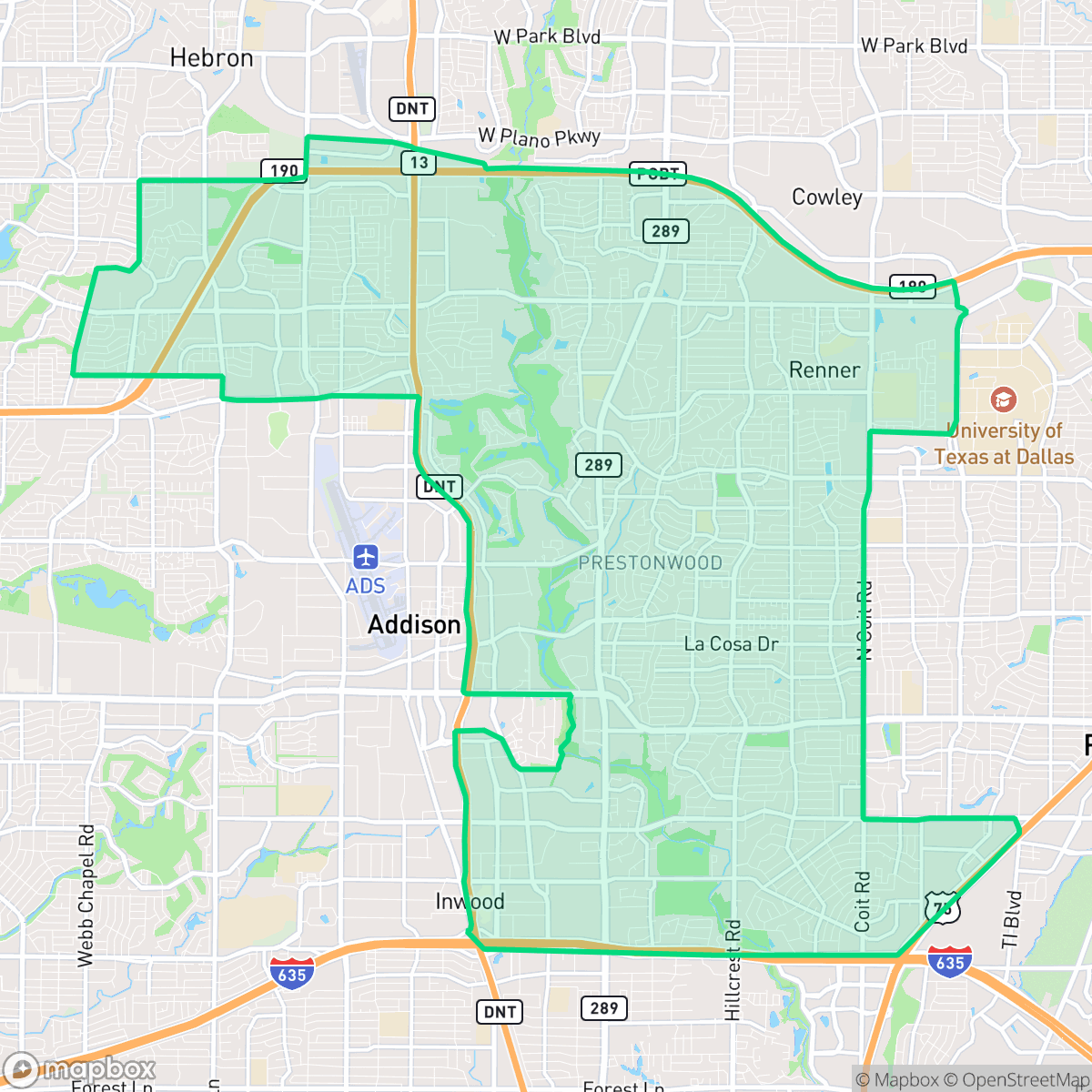
Far North Dallas is a well-established suburban community defined by its master-planned neighborhoods, affluent properties, and extensive greenbelt networks. While the area is highly walkable in residential pockets, residents often rely on cars to navigate the commercial corridors surrounding the major highway interchanges.
Key Highlights
About Far North
Originally a vast expanse of 19th-century farmland and prairie, Far North Dallas—the distinct section of the city extending north of the Lyndon B. Johnson Freeway—was transformed by the post-World War II housing boom. The construction of the Dallas North Tollway in the late 1960s accelerated this shift, turning the region into a "golden corridor" of suburban and commercial development. Far North Dallas is defined by master-planned, mid-to-late 20th-century neighborhoods such as Bent Tree, built around prestigious country clubs, and Prestonwood, known for its spacious lots. Culturally, the area is home to a vibrant, established Jewish community, with the city's largest concentration of Orthodox residents living within a designated local eruv.
The area functions as a premier suburban hub, characterized by large, well-manicured properties and a high concentration of private backyard pools. It balances quiet, low-density residential streets with active commercial zones, providing residents with access to diverse dining and essential services. The presence of significant green space, including neighborhood parks and riparian buffers, contributes to a high level of dog friendliness and outdoor accessibility throughout the community.
Prospective residents should note that while the neighborhood offers a high quality of life, the proximity to major highway interchanges results in noticeable road noise in certain sections. The area is served by multiple school districts, creating a varied educational landscape for families. According to iHuus data, the housing density ranges from spacious single-family lots to more compact multi-family developments, making it suitable for a wide range of household sizes and lifestyle preferences.
Neighborhood Scores Across 15 Qualities
Residential spacing varies between dense apartment clusters with shared walls and detached single-family homes with moderate yard buffers. This level of privacy is roughly comparable to the city average.
Extensive sidewalk networks and dedicated pedestrian paths through greenbelts make much of the area accessible on foot, performing above the Dallas average. However, a major highway interchange acts as a significant barrier for crossing between certain residential and commercial zones.
Large custom homes, manicured landscapes, and a high density of private backyard pools characterize this area, which offers more visual appeal than the Dallas average. Many properties feature complex rooflines and expansive grounds that contribute to a premium aesthetic throughout the neighborhood.
Extensive greenbelts, wooded trails, and wide grassy verges provide ample space for pet exercise. According to iHuus data, these connected parklands and buffered sidewalks offer better walking options than the Dallas average.
Developed suburban landscapes feature a blend of single-family homes, multi-family apartment complexes, and commercial retail zones. This level of density is roughly aligned with the city average for Dallas.
A mix of quiet residential pockets and lively commercial corridors provides a diverse range of dining and social options. This variety of activity and amenities is slightly higher than the city average.
Frequent noise from nearby railroad tracks and major freeways characterizes the area. According to iHuus data, acoustic comfort in this neighborhood is lower than the Dallas average.
Air quality levels fluctuate between acceptable and unhealthy conditions. According to iHuus data, the air quality in this area is slightly better than the Dallas city average.
Residential and commercial uses dominate this area, with very few warehouses or heavy industrial hazards detected. This landscape is notably cleaner than the Dallas average regarding proximity to industrial facilities.
Health insurance access is notably higher than the Dallas average, indicating a well-covered resident population according to iHuus data.
Political leanings in this area are more balanced than the Dallas average, featuring a liberal majority alongside a notable conservative presence. According to iHuus data, the community exhibits a more moderate ideological profile compared to the rest of the city.
Residents encounter a balanced blend of young adults, families, and older individuals. This demographic spread is largely consistent with the broader Dallas area according to iHuus data.
Flood risk levels are difficult to determine here because official federal studies for this area are currently incomplete. According to iHuus data, the potential for flooding is notably higher than the average found across Dallas.
Address-Level Insights for Far North


iHuus Neighborhood Intelligence Insights
Get address-level neighborhood insights for Far North
- Street-level scores — see how individual blocks compare, not just neighborhood averages
- Micro-zone boundaries — identify quiet pockets, flood boundaries, and walkable clusters before you visit
- 15 dimensions in full — walkability, noise, air quality, school quality, insurance coverage, population age profile, urban/rural index, and more
- Boundary risk alerts — know if your address sits near a block boundary where scores drop, the kind of detail no listing will ever mention
- School insights — individual school ratings and insights, not just district-level data
- Compare before you commit — side-by-side data across neighborhoods, down to block precision
No credit card required
Compare with Any Neighborhood
| Dimension | Far North | Arts District |
|---|---|---|
| 🚶 Walkabilityavg 7.43 | ||
| 🔊 Acoustic Comfortavg 3.98 | ||
| 🤫 Privacy Indexavg 5.4 | ||
| 🎨 Visual Appealavg 6.6 | ||
| 🐕 Dog Friendlinessavg 6.65 | ||
| 🗺️ Urban-Rural Indexavg 6.6 | ||
| ✨ Neighborhood Vibeavg 4.96 | ||
| 🏥 Health Insurance Coverageavg 5.31 | ||
| 🌿 Air Qualityavg 4.05 | ||
| 🏭 Industrial Proximityavg 8.56 | ||
| 🌊 Flood Safetyavg 3.3 | ||
| 🗳️ Ideological Leanavg 7.84 | ||
| 👥 Population Age Profileavg 4.6 | ||
| 🔥 Fire Safety | ||
| 🏫 School Quality |
Far North Rankings
School Districts Serving Far North
School Insights for Far North
Below average outcomes; significant attendance and academic challenges.
School Insights
See what's really behind every school rating near Far North
- Individual school ratings — each school's own score with outcome context, not just a district average
- Enrollment & class size data — student-to-teacher ratio and how it compares to the state average
- Full demographics breakdown — ethnicity and gender composition for every school in the enrollment zone
- Every school in the district — all schools within the enrollment boundary ranked by rating, not just the closest one
- Grade levels & benchmarks — elementary through high school, with below/above state-average flags
No credit card required