Eagle Ford, Dallas
Updated · 27,019 residents
Eagle Ford is a quiet, industrial-suburban neighborhood characterized by a mix of modest residential blocks and large-scale logistics warehouses. While residents enjoy access to local parks and diverse dining options, the area is primarily car-dependent and features significant freight traffic. According to iHuus data, the neighborhood provides a balanced, though modest, living environment for those seeking proximity to major transit corridors.
Key Highlights
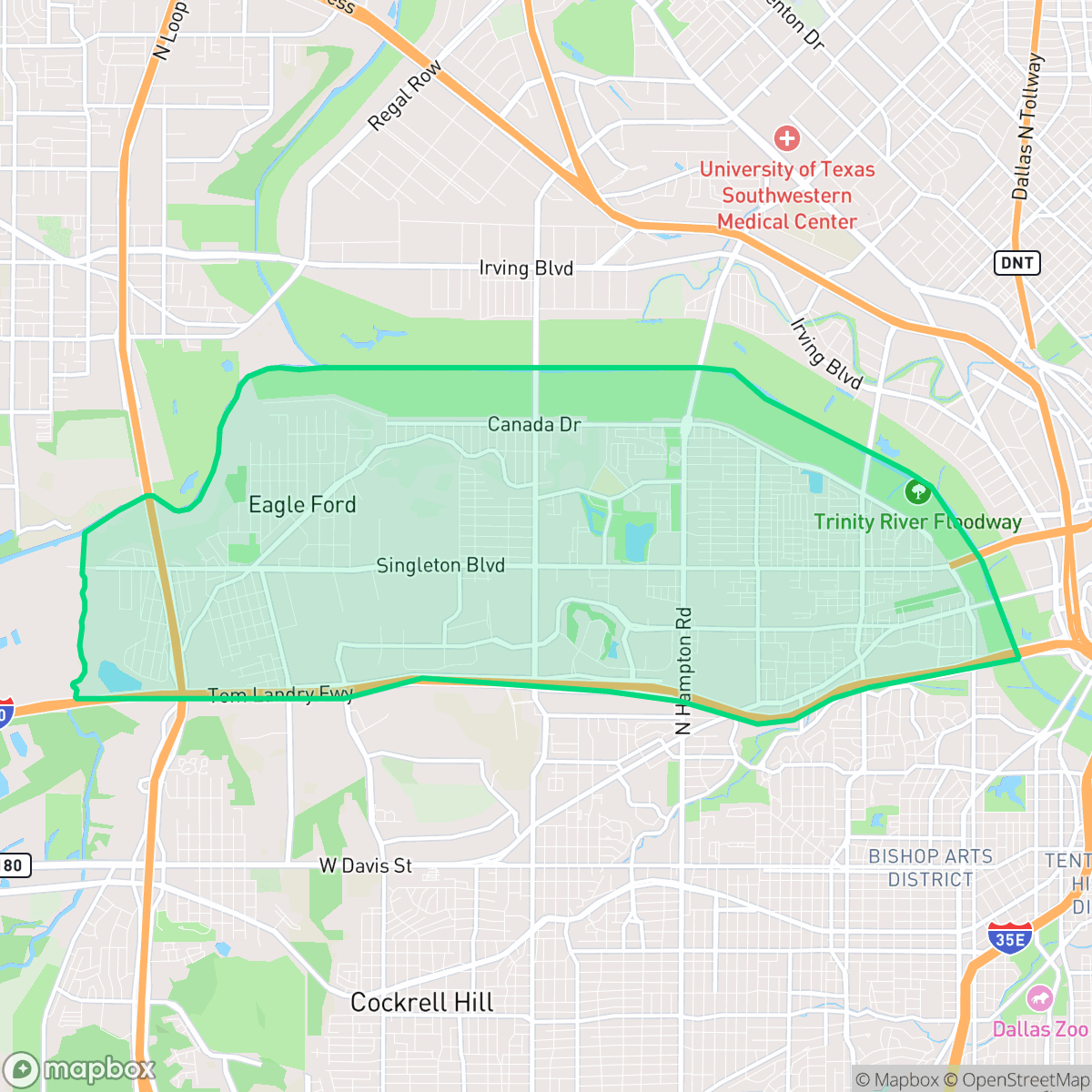
About Eagle Ford
First settled in 1844 by Enoch Horton, Eagle Ford developed near a West Fork Trinity River crossing named for a local eagle's nest. It grew rapidly in the 1870s as a temporary western terminus for the Texas and Pacific Railway, serving as a major cattle-shipping hub. In 1907, the Southwestern States Portland Cement Company (later Trinity Portland Cement) established operations here, constructing company housing that attracted a large wave of Mexican immigrants. This industrial boom defined the community, which was also the namesake for the massive Eagle Ford Shale geological formation. The neighborhood's last standing historic structure is the Gothic Revival-style Eagle Ford School, built in 1924 using local cement. Eagle Ford was officially annexed into Dallas in 1956.
The neighborhood functions as a dense industrial-suburban landscape where residential clusters sit alongside massive logistics hubs and freight corridors. The street grid is largely consistent, though the presence of heavy trucking and light manufacturing creates a distinct urban fringe character that differs from typical residential suburbs. Residents benefit from accessible green spaces, including two large public parks and a retention pond, which offer necessary relief from the surrounding industrial activity. Living here requires navigating a car-dependent environment, as the area features inconsistent sidewalk infrastructure and significant noise from road traffic. Prospective residents should be aware of the proximity to heavy industrial facilities and an EPA Superfund site, which impacts the local environmental profile. While the area offers a quiet, modest housing stock and access to diverse local dining, iHuus data suggests that the lifestyle is best suited for those prioritizing functional proximity to transit infrastructure over traditional suburban aesthetics. Educational options are varied, with families often looking toward specialized magnet programs within the broader district to supplement neighborhood school offerings.
Neighborhood Scores Across 15 Qualities
Residential spacing provides a moderate level of separation between homes, sitting slightly above the Dallas average. According to iHuus data, the area features a mix of closely spaced detached houses and some more isolated open spaces.
Low traffic volumes on residential streets allow for quiet walking, but the lack of consistent sidewalks makes pedestrian travel less convenient than in most other parts of Dallas. High speed highway interchanges in certain sections further restrict easy movement on foot.
Modest tract housing and uniform rooflines define the area, which offers less visual variety than the Dallas average. According to iHuus data, the landscape consists primarily of small yards and functional buildings without significant luxury amenities.
Abundant riverfront green space and large public parks provide ample walking paths and trails. According to iHuus data, the availability of accessible, fenceless green space is significantly higher than the Dallas average.
Large-scale industrial warehouses and logistics infrastructure are interspersed with open river basins and pockets of greenery. This landscape provides a slightly more open feel than the typical Dallas urban environment, according to iHuus data.
Low commercial density and heavy industrial presence make much of this area feel quiet and remote. Most daily errands and dining destinations require a vehicle, as the neighborhood lacks the frequent social hubs found elsewhere in Dallas.
Frequent noise from nearby highways and railroad tracks defines the acoustic environment. This level of disturbance is higher than the average for Dallas, according to iHuus data.
Air quality in Eagle Ford is consistent with the Dallas average, presenting a mix of acceptable and unhealthy days. Residents and sensitive groups should monitor local conditions for occasional periods of concern.
Active logistics hubs, scrapyards, and a nearby Superfund site contribute to a higher level of industrial activity and heavy truck traffic than the Dallas average. Residents may encounter notable noise and environmental considerations from large-scale commercial operations and wastewater treatment facilities near residential pockets.
Health insurance access among residents is notably lower than the Dallas average. According to iHuus data, a small portion of the population maintains medical coverage.
Voting patterns and census indicators show a predominantly liberal political leaning, which is notably more pronounced than the Dallas average according to iHuus data.
Residents live among a diverse mix of young adults, families, and seniors. This age distribution is largely comparable to the broader Dallas area according to iHuus data.
Flood risk in this area is slightly higher than the Dallas average, though a definitive assessment is currently unavailable due to incomplete federal flood studies. According to iHuus data, the area remains under a moderate level of uncertainty regarding potential inundation.
Address-Level Insights for Eagle Ford


iHuus Neighborhood Intelligence Insights
Get address-level neighborhood insights for Eagle Ford
- Street-level scores — see how individual blocks compare, not just neighborhood averages
- Micro-zone boundaries — identify quiet pockets, flood boundaries, and walkable clusters before you visit
- 15 dimensions in full — walkability, noise, air quality, school quality, insurance coverage, population age profile, urban/rural index, and more
- Boundary risk alerts — know if your address sits near a block boundary where scores drop, the kind of detail no listing will ever mention
- School insights — individual school ratings and insights, not just district-level data
- Compare before you commit — side-by-side data across neighborhoods, down to block precision
No credit card required
Compare with Any Neighborhood
| Dimension | Eagle Ford | Arts District |
|---|---|---|
| 🚶 Walkabilityavg 7.43 | ||
| 🔊 Acoustic Comfortavg 3.98 | ||
| 🤫 Privacy Indexavg 5.4 | ||
| 🎨 Visual Appealavg 6.6 | ||
| 🐕 Dog Friendlinessavg 6.65 | ||
| 🗺️ Urban-Rural Indexavg 6.6 | ||
| ✨ Neighborhood Vibeavg 4.96 | ||
| 🏥 Health Insurance Coverageavg 5.31 | ||
| 🌿 Air Qualityavg 4.05 | ||
| 🏭 Industrial Proximityavg 8.56 | ||
| 🌊 Flood Safetyavg 3.3 | ||
| 🗳️ Ideological Leanavg 7.84 | ||
| 👥 Population Age Profileavg 4.6 | ||
| 🔥 Fire Safety | ||
| 🏫 School Quality |
Eagle Ford Rankings
School Districts Serving Eagle Ford
School Insights for Eagle Ford
Below average outcomes; significant attendance and academic challenges.
School Insights
See what's really behind every school rating near Eagle Ford
- Individual school ratings — each school's own score with outcome context, not just a district average
- Enrollment & class size data — student-to-teacher ratio and how it compares to the state average
- Full demographics breakdown — ethnicity and gender composition for every school in the enrollment zone
- Every school in the district — all schools within the enrollment boundary ranked by rating, not just the closest one
- Grade levels & benchmarks — elementary through high school, with below/above state-average flags
No credit card required