Coppell, Dallas
Updated · 2,128 residents
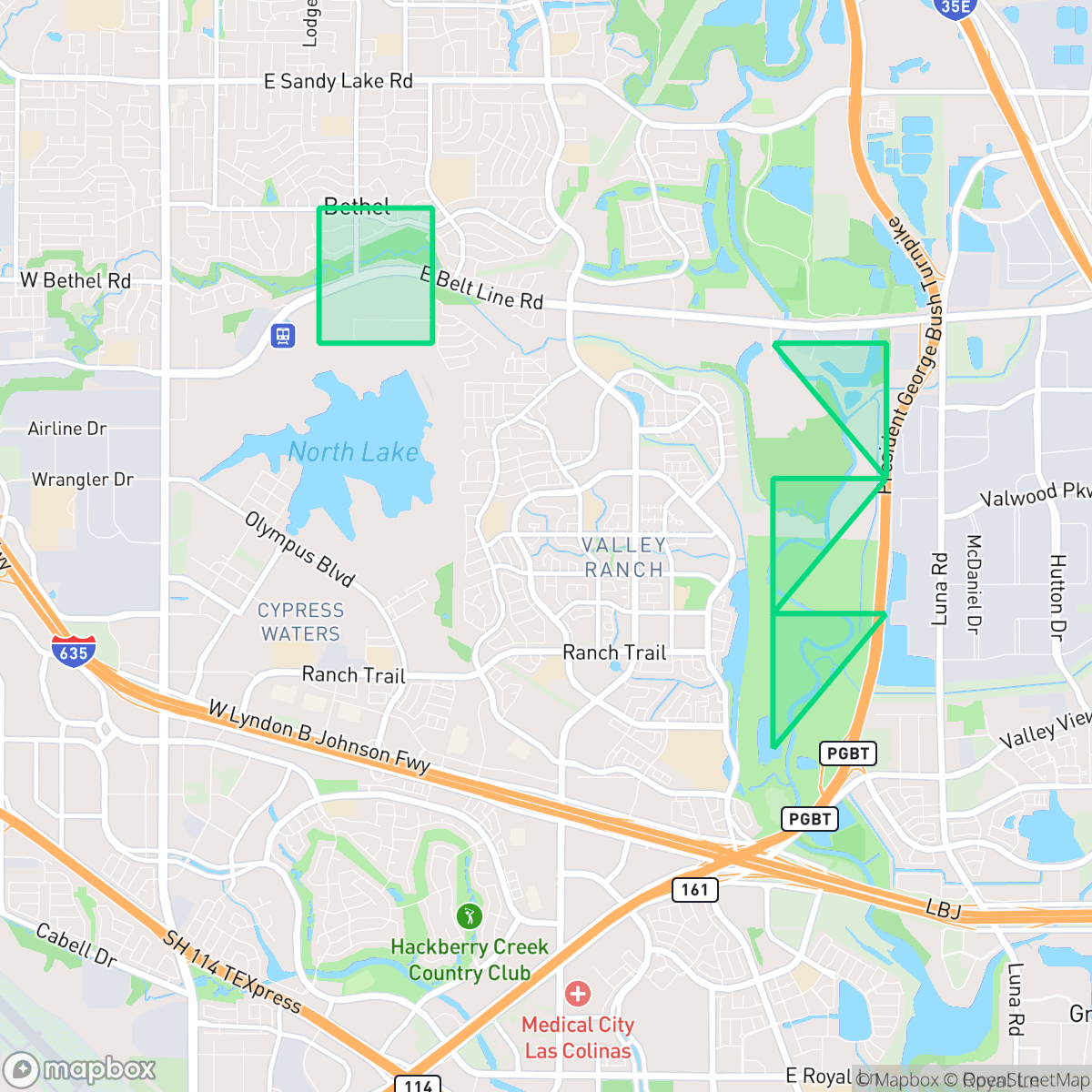
Coppell is a highly walkable and dog-friendly suburb characterized by a mix of dense residential tracts and large-scale commercial logistics hubs. While the area offers access to top-rated schools, residents navigate a landscape defined by quiet suburban streets situated near active industrial sites and surface mining operations.
Key Highlights
About Coppell
Originally settled in the 1840s by German and French immigrants, the Coppell area was first organized as "Grapevine Springs," where Republic of Texas President Sam Houston camped in 1843 during historic peace negotiations. Later named "Gibbs Station" for Texas Lieutenant Governor Barnett Gibbs, the community was renamed Coppell in 1892 to honor wealthy railroad financier George Coppell. For decades, it remained a small, agricultural hub centered around a cotton gin and a Cotton Belt Railroad depot. Coppell's modern transformation began with its incorporation in 1955 and accelerated dramatically after the 1974 opening of the nearby Dallas/Fort Worth International Airport, which spurred its evolution into a thriving suburban community. Local historic landmarks include Grapevine Springs Park and the 1853 Bethel Cemetery, which holds the graves of early Texas pioneers.
The neighborhood serves as a distinct suburban enclave that balances residential comfort with significant industrial infrastructure. It is highly regarded for its pedestrian-friendly layout and commitment to pet owners, providing ample green space alongside its dense housing developments. Families are drawn to the area by the presence of highly rated schools, including Coppell Middle West and Richard J Lee Elementary, which contribute to a stable educational environment and high community trust.
Living here involves specific trade-offs, particularly regarding the proximity to large-scale logistics warehouses and active mining sites. The area experiences moderate noise levels primarily from road traffic, and residents should be aware of the localized flood safety risks. While the overall vibe is serene and quiet, the presence of industrial zones creates a unique contrast to the suburban lifestyle, making it a practical choice for those prioritizing school quality and walkability over a traditional, purely residential atmosphere.
Neighborhood Scores Across 15 Qualities
Living arrangements vary between apartment blocks with shared walls and closely spaced houses. This level of density is slightly higher than the Dallas average, according to iHuus data.
Extensive sidewalk networks and dedicated off-street trail systems make navigating the area on foot easy. This level of pedestrian infrastructure is significantly higher than the Dallas average, according to iHuus data.
Manicured landscaping, private pools, and large homes with complex rooflines create a visual environment that is more polished than the Dallas average. According to iHuus data, the area also features well-maintained multi-family developments and shared amenities.
Large regional parks, winding trails, and green belts along canals provide ample space for pet owners. This access to open greenery and walking paths is significantly higher than the Dallas average, according to iHuus data.
Open landscapes and scattered woodland areas provide a more rural feel than most of Dallas. Residents will find a mix of dense suburban housing and significant patches of undeveloped green space according to iHuus data.
Low density and significant open space create a serene atmosphere, but the area lacks a vibrant commercial core. Most social activities and dining options are scattered and require a vehicle for easy access, making the neighborhood feel much more subdued than the Dallas average.
Steady noise from nearby busy streets creates a consistent hum throughout the area. This level of acoustic activity is slightly higher than the Dallas average, according to iHuus data.
Air quality levels fluctuate between acceptable and unhealthy, presenting occasional concerns for sensitive groups. According to iHuus data, the local air quality is slightly higher than the Dallas average.
Industrial activity and heavy warehouse presence are virtually nonexistent here, making the area notably cleaner of industrial hazards than the Dallas average. Residents will find a landscape dominated by residential and light commercial uses rather than large-scale logistics hubs.
Health insurance access is significantly higher than the Dallas average, providing residents with greater access to medical services. According to iHuus data, most households in this area are covered by a health plan.
Political leanings in this area are largely liberal, though the community presents a more moderate ideological profile than the Dallas average according to iHuus data.
A balanced mix of young adults, families, and older residents characterizes the community. According to iHuus data, this age distribution is slightly lower than the Dallas average, indicating a demographic profile that is nearly comparable to the rest of the city.
Flood risk in this area is notably higher than the Dallas average; however, FEMA has not yet completed a detailed flood study for this specific location according to iHuus data.
Address-Level Insights for Coppell


iHuus Neighborhood Intelligence Insights
Get address-level neighborhood insights for Coppell
- Street-level scores — see how individual blocks compare, not just neighborhood averages
- Micro-zone boundaries — identify quiet pockets, flood boundaries, and walkable clusters before you visit
- 15 dimensions in full — walkability, noise, air quality, school quality, insurance coverage, population age profile, urban/rural index, and more
- Boundary risk alerts — know if your address sits near a block boundary where scores drop, the kind of detail no listing will ever mention
- School insights — individual school ratings and insights, not just district-level data
- Compare before you commit — side-by-side data across neighborhoods, down to block precision
No credit card required
Compare with Any Neighborhood
| Dimension | Coppell | Arts District |
|---|---|---|
| 🚶 Walkabilityavg 7.43 | ||
| 🔊 Acoustic Comfortavg 3.98 | ||
| 🤫 Privacy Indexavg 5.4 | ||
| 🎨 Visual Appealavg 6.6 | ||
| 🐕 Dog Friendlinessavg 6.65 | ||
| 🗺️ Urban-Rural Indexavg 6.6 | ||
| ✨ Neighborhood Vibeavg 4.96 | ||
| 🏥 Health Insurance Coverageavg 5.31 | ||
| 🌿 Air Qualityavg 4.05 | ||
| 🏭 Industrial Proximityavg 8.56 | ||
| 🌊 Flood Safetyavg 3.3 | ||
| 🗳️ Ideological Leanavg 7.84 | ||
| 👥 Population Age Profileavg 4.6 | ||
| 🔥 Fire Safety | ||
| 🏫 School Quality |
Coppell Rankings
School Districts Serving Coppell
School Insights for Coppell
Below average outcomes; significant attendance and academic challenges.
School Insights
See what's really behind every school rating near Coppell
- Individual school ratings — each school's own score with outcome context, not just a district average
- Enrollment & class size data — student-to-teacher ratio and how it compares to the state average
- Full demographics breakdown — ethnicity and gender composition for every school in the enrollment zone
- Every school in the district — all schools within the enrollment boundary ranked by rating, not just the closest one
- Grade levels & benchmarks — elementary through high school, with below/above state-average flags
No credit card required