Convention Center District, Dallas
Updated · 589 residents
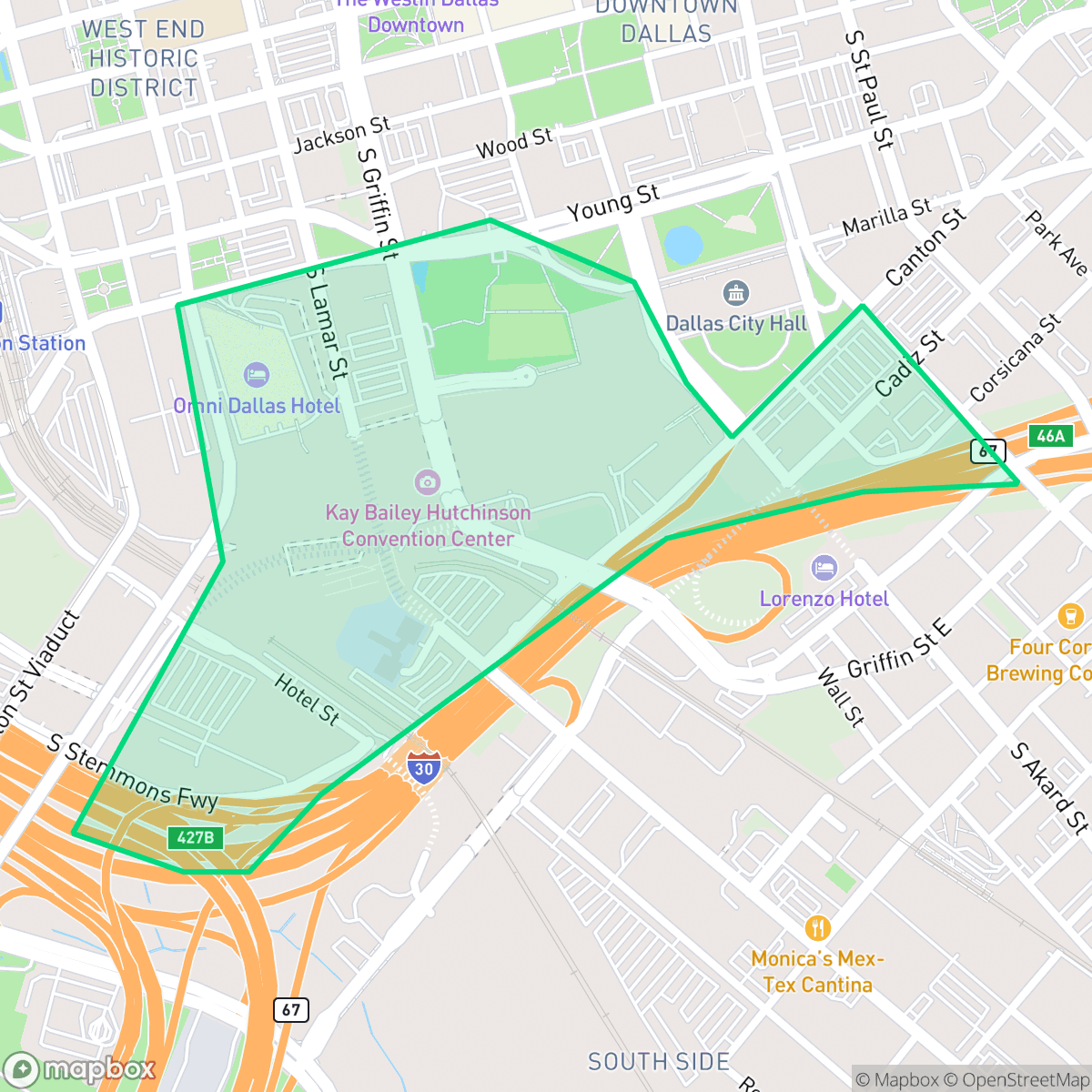
The Convention Center District is a high-energy, pedestrian-focused urban core in southern downtown Dallas. Residents enjoy exceptional walkability and immediate access to city landmarks, though the area is characterized by heavy road traffic noise and limited residential privacy.
Key Highlights
About Convention Center District
Located in southern downtown Dallas, the Convention Center District is anchored by the Kay Bailey Hutchison Convention Center, which originated as the Dallas Memorial Auditorium designed by architect George Dahl in 1957. The district is rich in early Texas history, home to Pioneer Park Cemetery. Established in 1849 on a high ridge to avoid Trinity River floods, this historic site comprises four 19th-century graveyards and serves as the final resting place for several of Dallas’s founding mayors and early settlers. Adjacent to the cemetery is Pioneer Plaza, dedicated in 1994. The plaza features the world’s largest bronze monument—a dramatic installation of 49 larger-than-life longhorn steers and three trail riders sculpted by Robert Summers, commemorating the historic cattle drives along the 19th-century Shawnee Trail.
This neighborhood serves as a dense, concrete-heavy hub defined by its proximity to major transit lines and the city's primary convention infrastructure. With perfect walkability, the area is designed for those who prefer to navigate the city on foot. The vibe is consistently lively, supported by a variety of high-rise developments and established local dining options that cater to both visitors and long-term residents. The district maintains a distinct urban identity that stands apart from the surrounding residential sectors of Dallas.
Living here requires adjusting to a fast-paced environment where the privacy index is low and ambient noise levels average 62 decibels due to consistent road and rail traffic. While the district offers superior flood safety compared to the broader city, prospective residents should note the limited local health insurance coverage and the mixed performance of the Dallas Independent School District. This area is best suited for young professionals or those prioritizing immediate access to downtown amenities over quiet, suburban-style seclusion.
Neighborhood Scores Across 15 Qualities
Buildings and structures are positioned in close proximity with minimal separation between lots. This lack of distance results in a lower level of privacy than is typical for the Dallas average, according to iHuus data.
Pedestrian access is functional due to safe crossings and sidewalks on certain streets, though ease of walking is lower than the Dallas average.
The surrounding area features a mix of upscale amenities and functional urban infrastructure that is roughly in line with the Dallas average. According to iHuus data, the visual landscape consists of varied architectural styles and developed streetscapes.
Limited access to large green spaces or public parks makes daily walks difficult for pet owners. According to iHuus data, this area offers significantly less dog-friendly infrastructure than the rest of Dallas.
Massive transit infrastructure and multi-level highway interchanges characterize this area. According to iHuus data, the landscape is significantly more built-up and industrial than the typical Dallas neighborhood, featuring high-rise structures and limited greenery.
Constant movement and a dense concentration of commercial activity define this area, making it significantly more vibrant than the Dallas average. According to iHuus data, the landscape is characterized by high-rise hubs, diverse dining options, and a high-energy atmosphere driven by heavy foot traffic and proximity to major transit corridors.
Frequent sounds from nearby railroad tracks and heavy freeway traffic contribute to a much louder environment than the Dallas average, according to iHuus data.
Air quality levels in this area fluctuate between acceptable and unhealthy periods. According to iHuus data, the air quality here is consistent with the city average.
The area is characterized by a blend of residential and light commercial use with no significant industrial activity or hazards. This level of industrial proximity is consistent with the average found across Dallas.
Health insurance accessibility is significantly below the Dallas average, which may impact long-term healthcare planning for residents. According to iHuus data, a small portion of the local population is covered by health insurance plans.
Voting patterns and census indicators show a much more liberal leaning than the Dallas average. This political profile is clearly reflected in the local demographic data according to iHuus.
A balanced variety of young adults, families, and older residents live in this area. This demographic spread is roughly in line with the average seen across Dallas.
Flood safety levels are notably higher than the Dallas average, though some residual risk remains due to proximity to the floodplain. According to iHuus data, the area is subject to infrequent, low-level flooding events.
Address-Level Insights for Convention Center District


iHuus Neighborhood Intelligence Insights
Get address-level neighborhood insights for Convention Center District
- Street-level scores — see how individual blocks compare, not just neighborhood averages
- Micro-zone boundaries — identify quiet pockets, flood boundaries, and walkable clusters before you visit
- 15 dimensions in full — walkability, noise, air quality, school quality, insurance coverage, population age profile, urban/rural index, and more
- Boundary risk alerts — know if your address sits near a block boundary where scores drop, the kind of detail no listing will ever mention
- School insights — individual school ratings and insights, not just district-level data
- Compare before you commit — side-by-side data across neighborhoods, down to block precision
No credit card required
Compare with Any Neighborhood
| Dimension | Convention Center District | Arts District |
|---|---|---|
| 🚶 Walkabilityavg 7.43 | ||
| 🔊 Acoustic Comfortavg 3.98 | ||
| 🤫 Privacy Indexavg 5.4 | ||
| 🎨 Visual Appealavg 6.6 | ||
| 🐕 Dog Friendlinessavg 6.65 | ||
| 🗺️ Urban-Rural Indexavg 6.6 | ||
| ✨ Neighborhood Vibeavg 4.96 | ||
| 🏥 Health Insurance Coverageavg 5.31 | ||
| 🌿 Air Qualityavg 4.05 | ||
| 🏭 Industrial Proximityavg 8.56 | ||
| 🌊 Flood Safetyavg 3.3 | ||
| 🗳️ Ideological Leanavg 7.84 | ||
| 👥 Population Age Profileavg 4.6 | ||
| 🔥 Fire Safety | ||
| 🏫 School Quality |
Convention Center District Rankings
School Districts Serving Convention Center District
School Insights for Convention Center District
Below average outcomes; significant attendance and academic challenges.
School Insights
See what's really behind every school rating near Convention Center District
- Individual school ratings — each school's own score with outcome context, not just a district average
- Enrollment & class size data — student-to-teacher ratio and how it compares to the state average
- Full demographics breakdown — ethnicity and gender composition for every school in the enrollment zone
- Every school in the district — all schools within the enrollment boundary ranked by rating, not just the closest one
- Grade levels & benchmarks — elementary through high school, with below/above state-average flags
No credit card required