City Center District, Dallas
Updated · 1,530 residents
The City Center District serves as the high-energy, commercial heart of downtown Dallas, defined by its dense high-rise architecture and constant urban activity. Residents enjoy exceptional walkability to diverse dining and cultural institutions, though the area is notably loud due to heavy road traffic and offers limited residential privacy.
Key Highlights
About City Center District
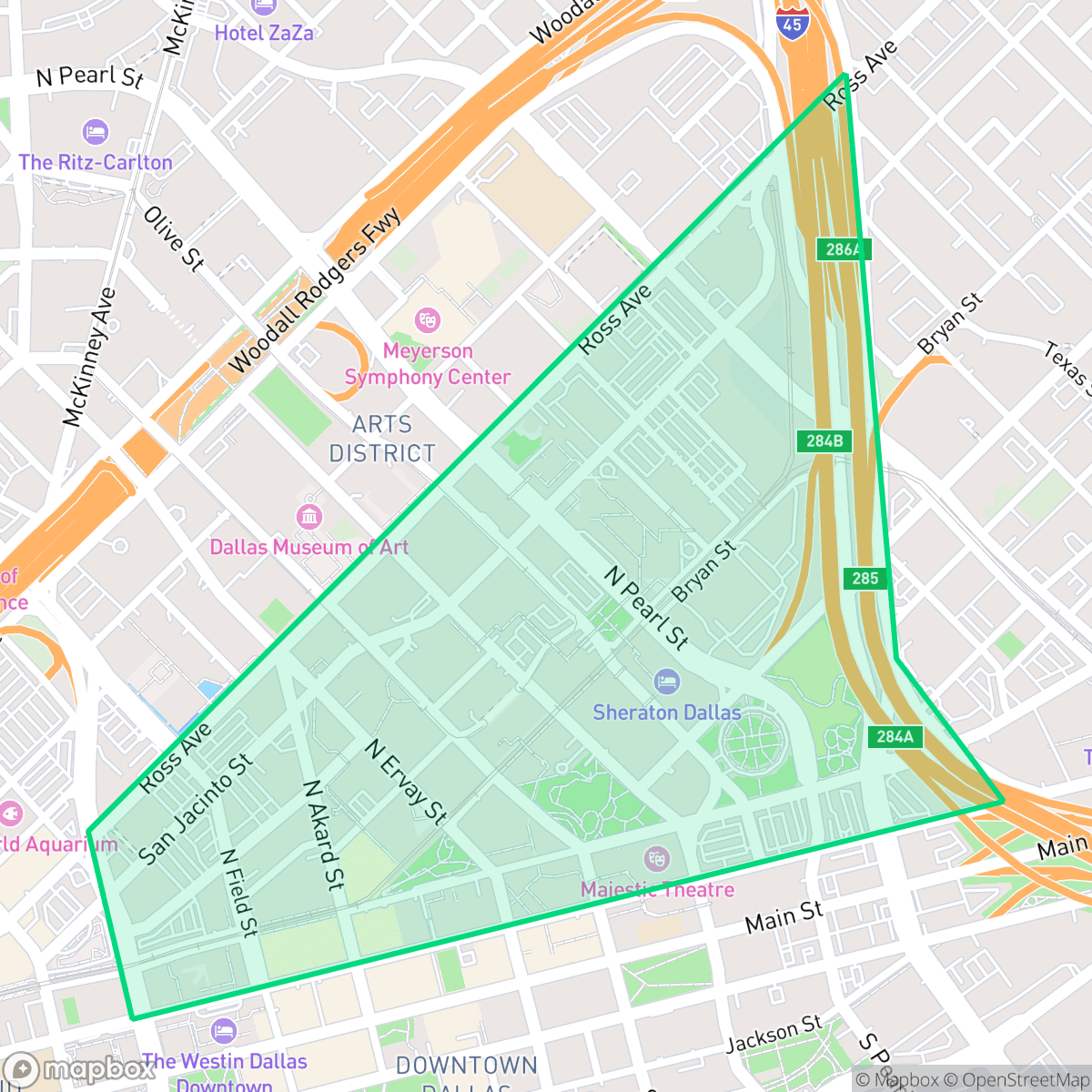
The City Center District in north-central downtown Dallas emerged as the city's commercial and financial powerhouse during the early-to-mid 20th century. Historically centered along Elm Street, the neighborhood was home to "Theatre Row," a vibrant entertainment hub that flourished from the 1920s to the 1970s. Today, the Renaissance Revival-style Majestic Theatre (built in 1921) stands as the district's last remaining historic theater. The neighborhood is also defined by Thanks-Giving Square, a unique triangular park and non-denominational chapel designed by world-renowned architect Philip Johnson. Dedicated on Thanksgiving Day in 1976, the square features the iconic 90-foot-tall spiraling Chapel of Thanksgiving and the stunning "Glory Window" stained-glass installation. This urban oasis sits atop the underground Bullington Truck Terminal, reflecting innovative mid-century city planning.
This neighborhood functions as a dense, vertical urban core characterized by a high-energy atmosphere and consistent street-level activity. It provides immediate access to a wide array of dining options, including local favorites like Bread Zeppelin and Partenope Ristorante, and sits in close proximity to major cultural landmarks such as the Crow Museum of Asian Art. The environment is dominated by concrete landscapes and high-rise residential towers, creating an intense, fast-paced urban experience that caters to those who prioritize a central location over suburban tranquility.
Living here involves significant trade-offs, particularly regarding acoustic comfort and personal space. The area experiences elevated noise levels from constant road traffic, and the high-density layout results in minimal privacy compared to other parts of the city. While the neighborhood is highly walkable, it is less suitable for pet owners due to limited dog-friendly infrastructure. It is best suited for young professionals or commuters who thrive in a bustling, central environment and value proximity to the city's commercial and transit hubs.
Neighborhood Scores Across 15 Qualities
Buildings and structures are positioned in close quarters with very little separation between them. According to iHuus data, this level of density is significantly higher than the average across Dallas.
Pedestrian accessibility is exceptionally high due to wide sidewalks and numerous crossings. According to iHuus data, the area offers significantly better walkability than the Dallas average.
Standard residential structures and small yards characterize the area, providing a visual experience that is slightly below the Dallas average. Most scenery consists of simple, utilitarian architecture and manicured but compact green spaces.
Limited access to open green space and narrow sidewalks make it difficult for pet owners to find comfortable walking routes. This area offers significantly fewer pet-friendly features compared to the Dallas average, according to iHuus data.
High-density skyscrapers and extensive pavement characterize this area, which lacks significant greenery and sits much lower in urban-rural density than the Dallas average.
Dense high-rise developments and a concentrated variety of dining options create a level of activity and density much higher than the Dallas average. This area functions as a major regional epicenter for social energy and urban interest according to iHuus data.
Continuous noise from nearby major freeways and rail lines makes this area significantly louder than the Dallas average. According to iHuus data, residents should expect frequent disturbances from heavy transit traffic.
Air quality levels in this area fluctuate between acceptable and unhealthy, which may pose occasional concerns for sensitive groups. This pattern of atmospheric quality is consistent with the city average, according to iHuus data.
Zero warehouses, factories, or hazardous industrial sites are present within this district. This area lacks the industrial activity found in many other parts of Dallas, according to iHuus data.
Voting patterns and census indicators reflect a leaning that is more liberal than the Dallas average. According to iHuus data, this area exhibits stronger liberal political trends than most other parts of the city.
Residents will find a balanced demographic spread of young professionals, families, and older adults. According to iHuus data, this age distribution is consistent with the broader Dallas area.
Flood risk in this area is notably higher than the Dallas average, though a precise assessment is unavailable because FEMA has not finalized a detailed study for this specific district. Residents should remain aware of potential vulnerabilities during extreme weather events.
Address-Level Insights for City Center District


iHuus Neighborhood Intelligence Insights
Get address-level neighborhood insights for City Center District
- Street-level scores — see how individual blocks compare, not just neighborhood averages
- Micro-zone boundaries — identify quiet pockets, flood boundaries, and walkable clusters before you visit
- 15 dimensions in full — walkability, noise, air quality, school quality, insurance coverage, population age profile, urban/rural index, and more
- Boundary risk alerts — know if your address sits near a block boundary where scores drop, the kind of detail no listing will ever mention
- School insights — individual school ratings and insights, not just district-level data
- Compare before you commit — side-by-side data across neighborhoods, down to block precision
No credit card required
Compare with Any Neighborhood
| Dimension | City Center District | Arts District |
|---|---|---|
| 🚶 Walkabilityavg 7.43 | ||
| 🔊 Acoustic Comfortavg 3.98 | ||
| 🤫 Privacy Indexavg 5.4 | ||
| 🎨 Visual Appealavg 6.6 | ||
| 🐕 Dog Friendlinessavg 6.65 | ||
| 🗺️ Urban-Rural Indexavg 6.6 | ||
| ✨ Neighborhood Vibeavg 4.96 | ||
| 🏥 Health Insurance Coverageavg 5.31 | ||
| 🌿 Air Qualityavg 4.05 | ||
| 🏭 Industrial Proximityavg 8.56 | ||
| 🌊 Flood Safetyavg 3.3 | ||
| 🗳️ Ideological Leanavg 7.84 | ||
| 👥 Population Age Profileavg 4.6 | ||
| 🔥 Fire Safety | ||
| 🏫 School Quality |
City Center District Rankings
School Districts Serving City Center District
School Insights for City Center District
Below average outcomes; significant attendance and academic challenges.
School Insights
See what's really behind every school rating near City Center District
- Individual school ratings — each school's own score with outcome context, not just a district average
- Enrollment & class size data — student-to-teacher ratio and how it compares to the state average
- Full demographics breakdown — ethnicity and gender composition for every school in the enrollment zone
- Every school in the district — all schools within the enrollment boundary ranked by rating, not just the closest one
- Grade levels & benchmarks — elementary through high school, with below/above state-average flags
No credit card required