Cedar Crest, Dallas
Updated · 62,462 residents
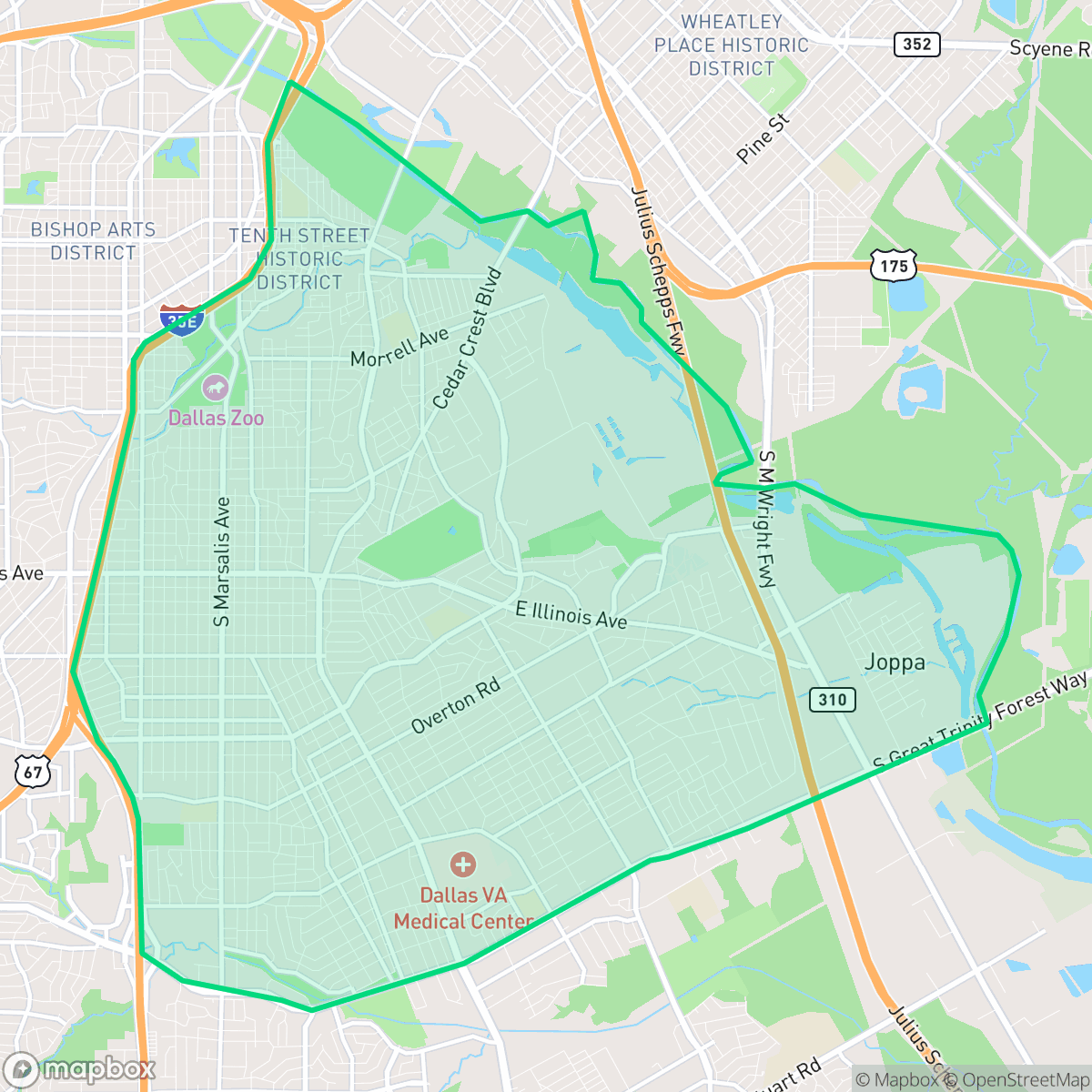
Cedar Crest is a historically significant neighborhood five miles south of Downtown Dallas, characterized by its grid layout, mature tree canopy, and modest residential architecture. While the area offers a quiet, suburban atmosphere with some walkable streets, residents should be aware of its proximity to industrial logistics hubs and elevated flood risks.
Key Highlights
About Cedar Crest
Located five miles south of Downtown Dallas, Cedar Crest developed in the early 1900s as a streetcar suburb. The neighborhood is anchored by the historic Cedar Crest Golf Course, which opened in 1919 and was designed by famed architect A. W. Tillinghast. The course put the area on the national map by hosting the 1927 PGA Championship, won by Walter Hagen. In 1946, the city purchased the course, and in 1954, it hosted the United Golf Association's Negro National Open, won by pioneering golfer Dr. Charlie Sifford. Architecturally, Cedar Crest features a mix of mid-century modern homes, classic early-20th-century residential structures, and mature, tree-lined streets. Today, the neighborhood maintains a strong cultural identity, supported by local institutions like the Pan-African Connection Bookstore and its close proximity to the Dallas Zoo.
The neighborhood features a blend of mid-century and early 20th-century housing set within a traditional grid, offering a calm environment removed from the immediate intensity of the city center. While the area benefits from a tree-lined aesthetic and accessible street layouts, the overall landscape is influenced by its proximity to major transit corridors and industrial zones. Residents have access to local social hubs and community-focused institutions, though the commercial density remains sparse, often requiring travel for daily errands. Livability in the area involves navigating specific trade-offs, particularly regarding environmental and infrastructure factors. The proximity to heavy logistics and industrial sites contributes to moderate noise levels, and the neighborhood faces significant flood risks that potential residents should consider. While public school options within the broader Dallas Independent School District range from neighborhood campuses to highly rated magnet programs, access to comprehensive health insurance coverage remains a challenge for many in the area. This neighborhood is best suited for those seeking a quiet, historically grounded residential pocket who are prepared for the realities of living in a dense, industrial-adjacent suburban environment.
Neighborhood Scores Across 15 Qualities
Residential spacing offers a moderate level of separation between homes, which is slightly higher than the Dallas average. Most lots feature consistent gaps between structures, though some areas contain denser layouts with more closely positioned houses.
Residential streets feature a grid layout with sidewalks and safe crossings, though the nearby major highway acts as a significant barrier to movement. While many low-traffic areas allow for easy walking, the overall walkability is lower than the Dallas average.
Uniform tract housing and small yards characterize the area, which offers less visual variety than the Dallas average. Residential lots are typically small with standard roof geometries and few luxury amenities visible.
Walking opportunities for pets vary by block, as some areas feature continuous grassy verges and a linear park trail while others rely on private backyards. Access to public green space is below the Dallas average, though a central park with sports fields provides a notable resource for the community.
Open landscapes and natural river corridors provide a semi-rural feel that is slightly more expansive than the typical Dallas urban environment. Residents will find a mix of wooded areas, low-density residential pockets, and significant industrial or utility infrastructure.
A tranquil atmosphere prevails across much of the area, characterized by low-density residential blocks and significant green space. While some pockets offer accessible local services, the overall level of activity and commercial density is lower than the Dallas average.
Audible traffic sounds from nearby busy streets are a consistent presence here. According to iHuus data, this level of acoustic activity is roughly in line with the average seen across Dallas.
Air quality levels are consistent with the Dallas average, featuring a mix of acceptable and unhealthy days that may occasionally impact sensitive groups. According to iHuus data, residents should expect periodic periods of concern regarding pollutants.
Industrial activity varies across the area, with some pockets containing heavy logistics hubs, scrapyards, and rail yards that contrast with quieter residential streets. While many sections are purely residential, certain areas near major highways and infrastructure feature significant warehouse traffic and large-scale utility facilities, making the industrial density lower than the Dallas average.
Health insurance access is significantly lower in this area than the Dallas average. According to iHuus data, a small minority of residents possess employer-sponsored or private medical coverage.
Voting patterns and census indicators show a significantly more liberal leaning than the Dallas average, according to iHuus data.
Residents live alongside a balanced mix of young adults, families, and older populations. This demographic spread is consistent with the broader Dallas area according to iHuus data.
Significant flood risk exists here because parts of the area fall within a designated floodplain. According to iHuus data, this level of risk is much higher than the average for Dallas.
Address-Level Insights for Cedar Crest


iHuus Neighborhood Intelligence Insights
Get address-level neighborhood insights for Cedar Crest
- Street-level scores — see how individual blocks compare, not just neighborhood averages
- Micro-zone boundaries — identify quiet pockets, flood boundaries, and walkable clusters before you visit
- 15 dimensions in full — walkability, noise, air quality, school quality, insurance coverage, population age profile, urban/rural index, and more
- Boundary risk alerts — know if your address sits near a block boundary where scores drop, the kind of detail no listing will ever mention
- School insights — individual school ratings and insights, not just district-level data
- Compare before you commit — side-by-side data across neighborhoods, down to block precision
No credit card required
Compare with Any Neighborhood
| Dimension | Cedar Crest | Arts District |
|---|---|---|
| 🚶 Walkabilityavg 7.43 | ||
| 🔊 Acoustic Comfortavg 3.98 | ||
| 🤫 Privacy Indexavg 5.4 | ||
| 🎨 Visual Appealavg 6.6 | ||
| 🐕 Dog Friendlinessavg 6.65 | ||
| 🗺️ Urban-Rural Indexavg 6.6 | ||
| ✨ Neighborhood Vibeavg 4.96 | ||
| 🏥 Health Insurance Coverageavg 5.31 | ||
| 🌿 Air Qualityavg 4.05 | ||
| 🏭 Industrial Proximityavg 8.56 | ||
| 🌊 Flood Safetyavg 3.3 | ||
| 🗳️ Ideological Leanavg 7.84 | ||
| 👥 Population Age Profileavg 4.6 | ||
| 🔥 Fire Safety | ||
| 🏫 School Quality |
Cedar Crest Rankings
School Districts Serving Cedar Crest
School Insights for Cedar Crest
Below average outcomes; significant attendance and academic challenges.
School Insights
See what's really behind every school rating near Cedar Crest
- Individual school ratings — each school's own score with outcome context, not just a district average
- Enrollment & class size data — student-to-teacher ratio and how it compares to the state average
- Full demographics breakdown — ethnicity and gender composition for every school in the enrollment zone
- Every school in the district — all schools within the enrollment boundary ranked by rating, not just the closest one
- Grade levels & benchmarks — elementary through high school, with below/above state-average flags
No credit card required