Bonton, Dallas
Updated · 2,065 residents
Bonton is a historic South Dallas community defined by its commitment to urban agriculture and grassroots revitalization. While it offers a quiet, rural-like atmosphere with significant green space, residents experience limited local services and moderate noise levels from nearby industrial and transportation corridors.
Key Highlights
About Bonton
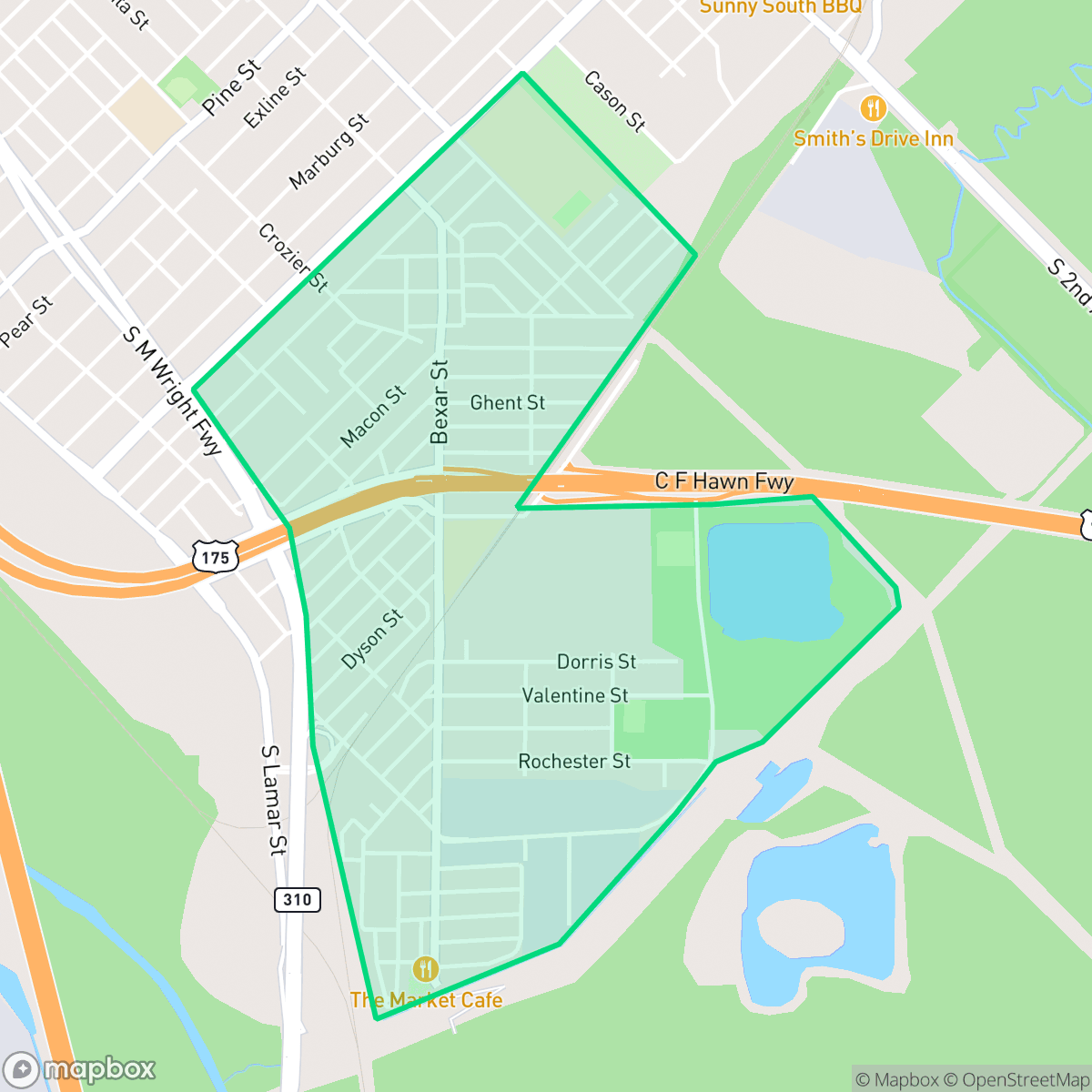
Developed between 1919 and the 1940s in South Dallas, Bonton is a historic African-American neighborhood whose name derives from early 20th-century Black slang for "high society" or "style" (from the French bon ton). Advertised in The Dallas Express as a premier residential area, Bonton later suffered from systemic segregation and severe environmental injustice; for decades, city-controlled watershed gates were closed during storms to intentionally flood Bonton and protect surrounding districts, a practice halted only by the mid-1990s Rochester Levee. The neighborhood was home to Turner Courts, a 1952 public housing complex named for J.L. Turner Sr., one of Texas's first Black attorneys. Today, Bonton is defined by community-led revitalization, highlighted by Bonton Farms—an urban agriculture initiative combating local food insecurity—and the transformation of its historic floodgates into public art installations.
The neighborhood maintains a distinct character that blends residential life with expansive open areas and light industrial units. It is characterized by a quiet, suburban setting situated near major highways, providing a landscape that feels more rural than the typical urban core of Dallas. According to iHuus data, the area features a mix of established housing and green space, fostering a unique environment where community-led initiatives like urban farming serve as a focal point for local identity. The presence of specific local institutions, such as religious centers, provides a sense of community stability within a largely residential layout.
Living in this area involves navigating specific trade-offs, particularly regarding accessibility and infrastructure. While the neighborhood offers a quieter pace of life, residents face limited immediate access to commercial services and must often travel to neighboring districts for daily needs. The acoustic environment is influenced by a combination of road traffic and railroad activity, resulting in moderate noise levels. Families in the area are served by the Dallas Independent School District, which provides access to specialized magnet programs alongside neighborhood campuses. Prospective residents should note that while the area has seen significant improvements in flood safety, it remains an industrial-adjacent community that is best suited for those seeking a slower, community-focused lifestyle with strong ties to local agricultural efforts.
Neighborhood Scores Across 15 Qualities
Residential spacing provides a reasonable buffer between neighbors, offering a level of seclusion that is slightly higher than the Dallas average according to iHuus data.
Low traffic volume makes for a peaceful walking environment; however, the lack of sidewalks makes navigation less convenient than the Dallas average, according to iHuus data.
Standard tract housing with simple rooflines and small yards defines the local landscape. According to iHuus data, the area offers less visual variety than the Dallas average.
Access to public parks and large green verges is somewhat limited compared to the Dallas average. Residents may find fewer immediate opportunities for off-leash walking within the immediate vicinity of the neighborhood.
Open land and industrial lots create a semi-rural feel that is slightly more expansive than the Dallas average. Residents will encounter a combination of wooded areas, large-scale commercial storage, and dense residential pockets.
Limited local businesses and a prevalence of warehouses and green space create a subdued atmosphere that is below the Dallas average. Most daily needs require a car due to the sparse distribution of retail and services throughout the area.
Steady hum from nearby busy streets defines the acoustic environment, though levels are slightly more tranquil than the Dallas average.
Air quality in Bonton fluctuates between acceptable and unhealthy levels, matching the typical conditions found across Dallas. Residents sensitive to pollutants may experience occasional concern during certain periods.
Occasional light commercial activity and logistics hubs are interspersed with residential areas, though the presence of heavy industry is lower than the Dallas average. Residents may encounter localized traffic from nearby truck storage and recycling facilities near certain corridors.
Health insurance coverage levels in Bonton are consistent with the Dallas average. According to iHuus data, a significant portion of the local population remains uninsured.
Voting patterns and census indicators reflect a deeply liberal political leaning that is notably higher than the Dallas average, according to iHuus data.
Residents live alongside a balanced mix of young adults, families, and seniors. This age distribution is largely consistent with the broader Dallas area, according to iHuus data.
Flood risk levels remain undetermined due to a lack of detailed federal studies, though the area shows a higher potential for flooding than much of Dallas. According to iHuus data, residents should exercise caution as official assessments for this specific area are currently incomplete.
Address-Level Insights for Bonton


iHuus Neighborhood Intelligence Insights
Get address-level neighborhood insights for Bonton
- Street-level scores — see how individual blocks compare, not just neighborhood averages
- Micro-zone boundaries — identify quiet pockets, flood boundaries, and walkable clusters before you visit
- 15 dimensions in full — walkability, noise, air quality, school quality, insurance coverage, population age profile, urban/rural index, and more
- Boundary risk alerts — know if your address sits near a block boundary where scores drop, the kind of detail no listing will ever mention
- School insights — individual school ratings and insights, not just district-level data
- Compare before you commit — side-by-side data across neighborhoods, down to block precision
No credit card required
Compare with Any Neighborhood
| Dimension | Bonton | Arts District |
|---|---|---|
| 🚶 Walkabilityavg 7.43 | ||
| 🔊 Acoustic Comfortavg 3.98 | ||
| 🤫 Privacy Indexavg 5.4 | ||
| 🎨 Visual Appealavg 6.6 | ||
| 🐕 Dog Friendlinessavg 6.65 | ||
| 🗺️ Urban-Rural Indexavg 6.6 | ||
| ✨ Neighborhood Vibeavg 4.96 | ||
| 🏥 Health Insurance Coverageavg 5.31 | ||
| 🌿 Air Qualityavg 4.05 | ||
| 🏭 Industrial Proximityavg 8.56 | ||
| 🌊 Flood Safetyavg 3.3 | ||
| 🗳️ Ideological Leanavg 7.84 | ||
| 👥 Population Age Profileavg 4.6 | ||
| 🔥 Fire Safety | ||
| 🏫 School Quality |
Bonton Rankings
School Districts Serving Bonton
School Insights for Bonton
Below average outcomes; significant attendance and academic challenges.
School Insights
See what's really behind every school rating near Bonton
- Individual school ratings — each school's own score with outcome context, not just a district average
- Enrollment & class size data — student-to-teacher ratio and how it compares to the state average
- Full demographics breakdown — ethnicity and gender composition for every school in the enrollment zone
- Every school in the district — all schools within the enrollment boundary ranked by rating, not just the closest one
- Grade levels & benchmarks — elementary through high school, with below/above state-average flags
No credit card required