Bluffview, Dallas
Updated · 14,705 residents
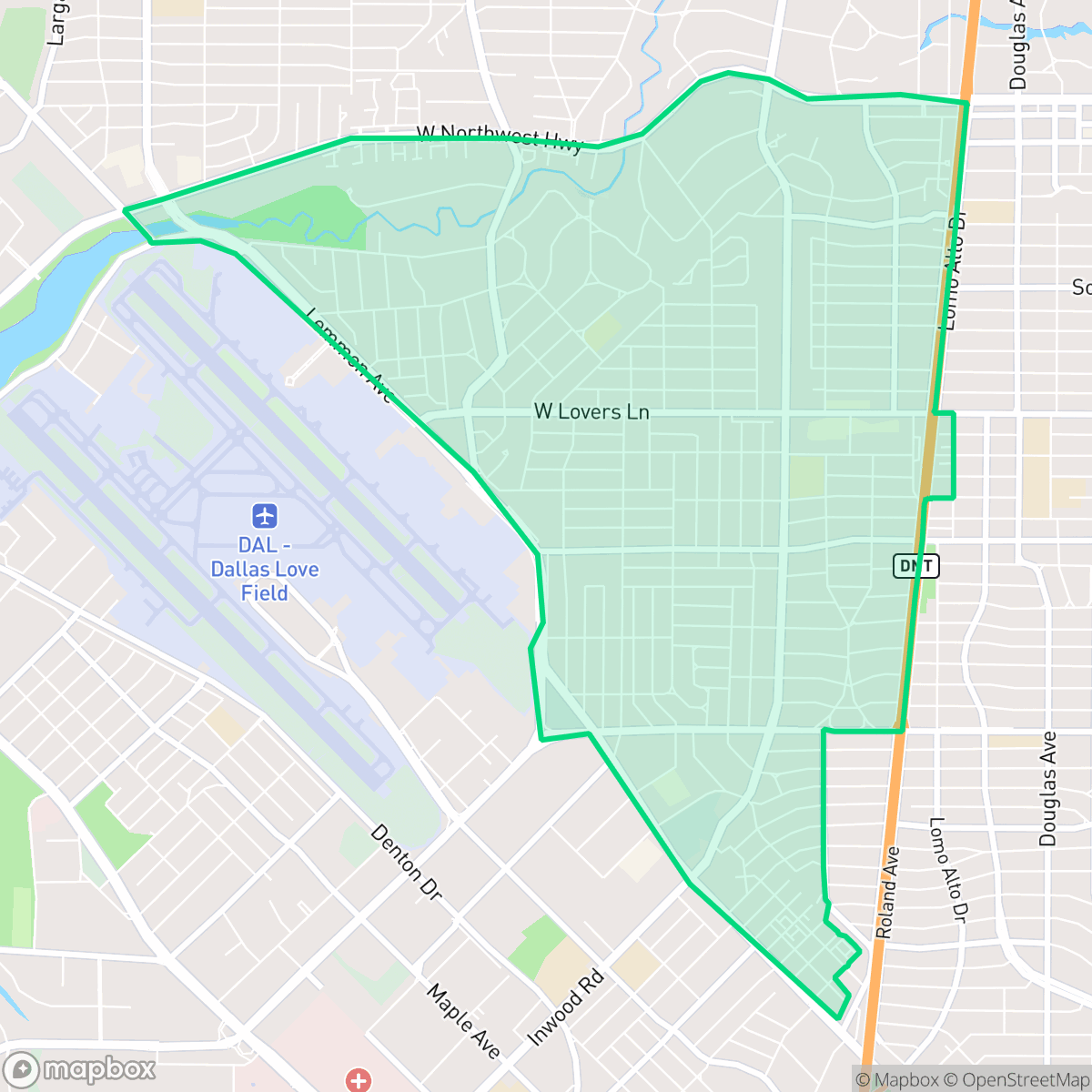
Bluffview is a scenic, affluent neighborhood in North Dallas defined by its hilly terrain and mature tree canopy. While the area offers high visual appeal and a consistent sidewalk network, it remains largely car-dependent with notable noise levels from surrounding road traffic.
Key Highlights
About Bluffview
Established in 1924 as "Bluff View Estates," the Bluffview neighborhood in North Dallas was developed by J.P. Stephenson and F.M. Drane, who transformed a 215-acre dairy farm along Bachman Creek into one-acre residential lots. The neighborhood is named for its distinctive, hilly topography, featuring 60-foot cliffs of Austin Chalk overlooking the creek. To preserve this unique terrain, winding roads, and mature trees, early architects like Harre Bernet and Ralph Bryan designed homes on irregular lots. This scenic landscape later attracted renowned architects Charles Dilbeck and modernist O’Neill Ford, who built one of his first homes here for local artist Jerry Bywaters. Following a brief legal dispute over municipal taxation, the area was officially annexed by the city of Dallas in March 1943.
The neighborhood maintains a distinct character through its mix of large residential lots and proximity to major commercial corridors. Residents benefit from a high level of health insurance coverage and access to both Highland Park Independent School District and Dallas Independent School District. According to iHuus data, the area features a dense suburban fabric that blends quiet residential streets with nearby logistics and airport infrastructure. This proximity to Dallas Love Field contributes to the local industrial presence, creating a unique environment where historic homes sit near active commercial zones.
Neighborhood Scores Across 15 Qualities
Residential spacing offers a moderate level of separation between neighbors, which is slightly higher than the Dallas average. While some single-family homes feature modest yards, certain areas contain closely spaced structures and higher density apartment blocks.
Pedestrian infrastructure is robust throughout the area, featuring a consistent sidewalk network and clear crosswalks that exceed the Dallas average. Many residential and commercial zones are connected by a well-integrated grid system and accessible park trails, according to iHuus data.
Large estates with complex rooflines, private pools, and mature tree canopies define the landscape. This area features significantly higher levels of greenery and well-maintained properties than the Dallas average.
Green verges and proximity to local school fields provide decent walking options, though the area sits slightly below the Dallas average for dedicated pet amenities. According to iHuus data, sidewalk connectivity varies between wide grass borders and narrower paths near private residences.
Residential blocks, commercial centers, and nearby airfield infrastructure create a landscape that is comparable to the broader Dallas area in terms of density. This environment features a blend of single-family homes and larger institutional or industrial structures.
Suburban streets and green spaces provide a steady but low-key atmosphere, slightly below the city average for activity. While some pockets offer accessible dining and social spots, much of the neighborhood relies on driving to reach nearby services and businesses.
Persistent noise from nearby major freeways and rail lines characterizes this area. According to iHuus data, acoustic comfort in Bluffview is lower than the Dallas average.
Air quality in this area fluctuates between acceptable and unhealthy levels on certain days. According to iHuus data, these conditions are consistent with the average experienced across Dallas.
Industrial activity is virtually non-existent here, as the area consists entirely of residential, commercial, and recreational zones. This lack of warehouses or heavy industry makes the neighborhood even more free of industrial hazards than the Dallas average.
Health insurance accessibility is significantly higher than the Dallas average, according to iHuus data. Most residents in this area are covered by health insurance plans.
Political leanings in this area are split relatively evenly between conservative and liberal perspectives. This represents a more moderate ideological landscape compared to the more pronounced liberal lean of the city average, according to iHuus data.
Residents will find a balanced demographic of young professionals, families, and seniors. According to iHuus data, this age distribution is slightly more varied than the average found across Dallas.
Flood risk in this area is notably higher than the Dallas average, though precise risk levels remain undetermined due to incomplete federal studies. Residents should remain aware of potential drainage concerns during heavy rain events.
Address-Level Insights for Bluffview


iHuus Neighborhood Intelligence Insights
Get address-level neighborhood insights for Bluffview
- Street-level scores — see how individual blocks compare, not just neighborhood averages
- Micro-zone boundaries — identify quiet pockets, flood boundaries, and walkable clusters before you visit
- 15 dimensions in full — walkability, noise, air quality, school quality, insurance coverage, population age profile, urban/rural index, and more
- Boundary risk alerts — know if your address sits near a block boundary where scores drop, the kind of detail no listing will ever mention
- School insights — individual school ratings and insights, not just district-level data
- Compare before you commit — side-by-side data across neighborhoods, down to block precision
No credit card required
Compare with Any Neighborhood
| Dimension | Bluffview | Arts District |
|---|---|---|
| 🚶 Walkabilityavg 7.43 | ||
| 🔊 Acoustic Comfortavg 3.98 | ||
| 🤫 Privacy Indexavg 5.4 | ||
| 🎨 Visual Appealavg 6.6 | ||
| 🐕 Dog Friendlinessavg 6.65 | ||
| 🗺️ Urban-Rural Indexavg 6.6 | ||
| ✨ Neighborhood Vibeavg 4.96 | ||
| 🏥 Health Insurance Coverageavg 5.31 | ||
| 🌿 Air Qualityavg 4.05 | ||
| 🏭 Industrial Proximityavg 8.56 | ||
| 🌊 Flood Safetyavg 3.3 | ||
| 🗳️ Ideological Leanavg 7.84 | ||
| 👥 Population Age Profileavg 4.6 | ||
| 🔥 Fire Safety | ||
| 🏫 School Quality |
Bluffview Rankings
School Districts Serving Bluffview
School Insights for Bluffview
Below average outcomes; significant attendance and academic challenges.
School Insights
See what's really behind every school rating near Bluffview
- Individual school ratings — each school's own score with outcome context, not just a district average
- Enrollment & class size data — student-to-teacher ratio and how it compares to the state average
- Full demographics breakdown — ethnicity and gender composition for every school in the enrollment zone
- Every school in the district — all schools within the enrollment boundary ranked by rating, not just the closest one
- Grade levels & benchmarks — elementary through high school, with below/above state-average flags
No credit card required