Southside, College Station
Updated · 8,250 residents
Southside is a well-established residential community defined by its diverse architectural styles and high walkability. Residents enjoy consistent access to local green spaces and a network of sidewalks that connect the area to nearby amenities and recreational facilities.
Key Highlights
About Southside
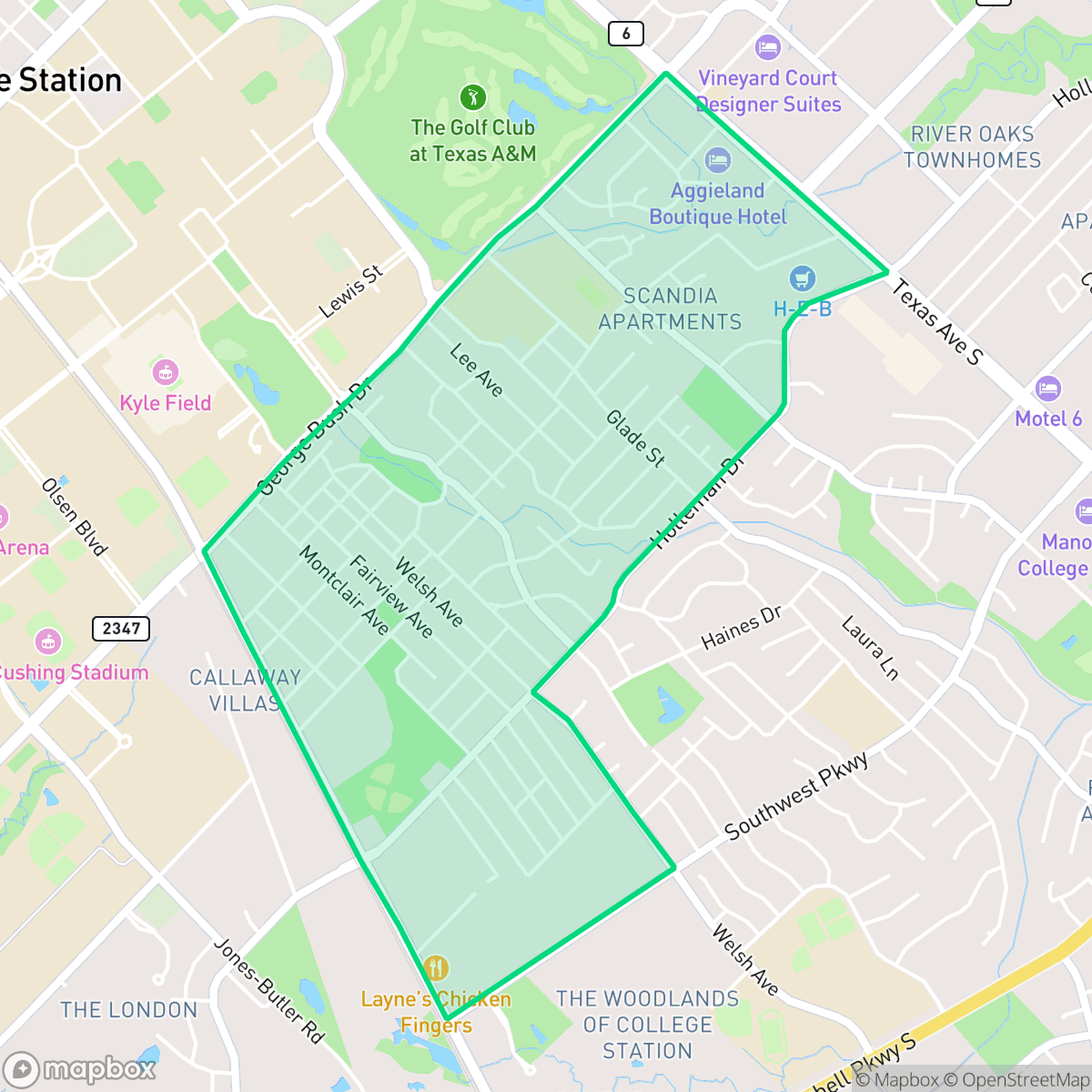
Established in 1921, the Southside neighborhood in College Station, Texas, was the first residential development created separate from the Texas A&M campus. Seeking an alternative to college-owned rentals, five university associates incorporated the Southside Development Company and purchased 83 acres of land. Reflecting the university's strong agricultural foundation, many of the neighborhood's original streets were named after cattle breeds, including Jersey, Guernsey, Hereford, and Angus. Today, the Southside Historic District encompasses sub-neighborhoods like West Park, College Park, Oakwood, and Leacrest. Its architectural landscape is defined by a diverse mix of early-to-mid 20th-century styles, ranging from Craftsman bungalows and quaint cottages to Colonial Revival homes.
The neighborhood maintains a distinct suburban character, blending early-to-mid 20th-century homes with modern apartment complexes. Residents benefit from a highly walkable environment, supported by a consistent sidewalk grid that connects residential blocks to local green spaces and neighborhood parks. The area is particularly well-suited for pet owners, as the abundance of open grass areas and recreational fields provides ample space for outdoor activity. While the area offers significant convenience, it maintains a quiet, residential atmosphere despite being located near light commercial hubs.
Prospective residents should note that the neighborhood experiences moderate noise levels primarily attributed to road traffic. The community is served by the highly-rated College Station Independent School District, making it a strong candidate for families seeking academic excellence. However, those considering the area should be aware of the local flood safety profile, as the neighborhood records lower ratings in this category compared to other parts of the city. Overall, the area is best suited for those who prioritize community connectivity and proximity to local schools over absolute silence or flood-resistant terrain.
Neighborhood Scores Across 15 Qualities
Closely packed apartment buildings and shared walls result in less personal space than the College Station average. According to iHuus data, the proximity of campus dormitories and dense housing complexes means neighbors are often situated in very close quarters.
Extensive sidewalk networks and dedicated pedestrian paths connect residential blocks and apartment complexes to nearby parks and campus areas. This infrastructure provides better connectivity for pedestrians than is typically found across the rest of College Station.
Residential scenery consists of a mix of modern apartment complexes and standard tract housing with shared amenities. The visual landscape is largely comparable to the rest of College Station.
Abundant parks, campus lawns, and wide grassy verges provide ample space for pet owners to walk dogs safely. According to iHuus data, the availability of connected green spaces and large fields is higher than the College Station average.
Residential layouts feature a blend of single-family homes and multi-story apartment complexes. This area is less densely developed than the typical College Station landscape, offering a more even distribution of greenery and street infrastructure according to iHuus data.
Frequent social activity and a concentrated variety of dining and local landmarks make this area more vibrant than the College Station average. Residents can find a mix of high-energy urban pockets and quieter suburban streets with accessible amenities.
Local traffic from nearby busy streets creates a persistent hum throughout the area. This level of acoustic activity is roughly comparable to the average for College Station.
Air quality remains consistently high with very few instances of pollution. According to iHuus data, these conditions are slightly better than the average seen throughout College Station.
Residential and light commercial uses dominate the area with no detectable warehouses or heavy manufacturing. According to iHuus data, this neighborhood maintains a higher level of separation from industrial hazards than the College Station average.
Health insurance accessibility is consistent with the College Station average, reflecting a stable level of coverage among area residents according to iHuus data.
Political views in this area are split relatively evenly between conservative and liberal leanings; this represents a more moderate landscape than the more heavily conservative average of College Station.
Young adults make up the majority of the population here, creating a demographic profile that is notably younger than the College Station average. Residents will find a modest presence of families and older adults, but the area lacks a high concentration of seniors.
Flood risk is notably higher than the College Station average due to the area's location within a 100-year floodplain. According to iHuus data, residents should expect a higher likelihood of inundation and may find flood insurance requirements common for properties here.
Address-Level Insights for Southside


iHuus Neighborhood Intelligence Insights
Get address-level neighborhood insights for Southside
- Street-level scores — see how individual blocks compare, not just neighborhood averages
- Micro-zone boundaries — identify quiet pockets, flood boundaries, and walkable clusters before you visit
- 15 dimensions in full — walkability, noise, air quality, school quality, insurance coverage, population age profile, urban/rural index, and more
- Boundary risk alerts — know if your address sits near a block boundary where scores drop, the kind of detail no listing will ever mention
- School insights — individual school ratings and insights, not just district-level data
- Compare before you commit — side-by-side data across neighborhoods, down to block precision
No credit card required
Compare with Any Neighborhood
| Dimension | Southside | Camelot |
|---|---|---|
| 🚶 Walkabilityavg 7.59 | ||
| 🔊 Acoustic Comfortavg 4.05 | ||
| 🤫 Privacy Indexavg 5.71 | ||
| 🎨 Visual Appealavg 6.7 | ||
| 🐕 Dog Friendlinessavg 7.43 | ||
| 🗺️ Urban-Rural Indexavg 7.02 | ||
| ✨ Neighborhood Vibeavg 5.06 | ||
| 🏥 Health Insurance Coverageavg 8.23 | ||
| 🌿 Air Qualityavg 7.89 | ||
| 🏭 Industrial Proximityavg 9.23 | ||
| 🌊 Flood Safetyavg 5.39 | ||
| 🗳️ Ideological Leanavg 3.44 | ||
| 👥 Population Age Profileavg 3.75 | ||
| 🔥 Fire Safety | ||
| 🏫 School Quality |
Southside Rankings
School Districts Serving Southside
School Insights for Southside
Below average outcomes; significant attendance and academic challenges.
School Insights
See what's really behind every school rating near Southside
- Individual school ratings — each school's own score with outcome context, not just a district average
- Enrollment & class size data — student-to-teacher ratio and how it compares to the state average
- Full demographics breakdown — ethnicity and gender composition for every school in the enrollment zone
- Every school in the district — all schools within the enrollment boundary ranked by rating, not just the closest one
- Grade levels & benchmarks — elementary through high school, with below/above state-average flags
No credit card required