South Knoll, College Station
Updated · 11,049 residents
South Knoll is a well-established College Station neighborhood characterized by its blend of mid-century residential charm and convenient access to local retail and dining. Residents enjoy high walkability and proximity to green spaces, though the area experiences moderate noise levels due to nearby road traffic.
Key Highlights
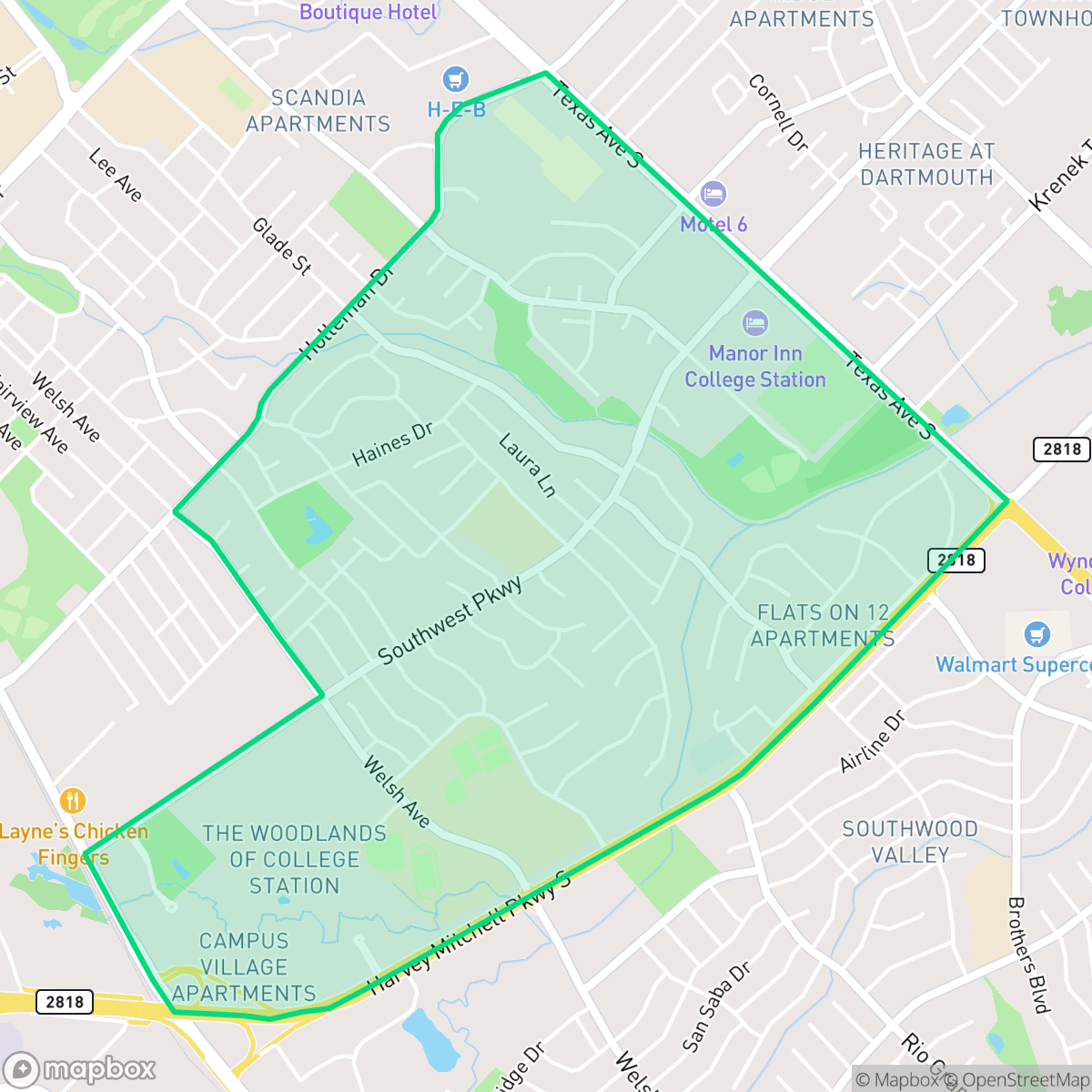
About South Knoll
The South Knoll neighborhood in College Station, Texas, traces its origins to the mid-20th century, with its earliest subdivisions, "The Knoll" and "South Knoll," established in 1947 and 1954, respectively. The area was systematically annexed into the city between 1953 and 1969. Reflecting its close connection to Texas A&M University, South Knoll features two historic "campus homes"—originally built on the university campus for faculty and administrators—that were sold and relocated to 1712 Glade Street and 1700 Laura Lane in 1965 to accommodate campus growth. Architecturally, the neighborhood features local landmarks like the Fitch House on Glade Street, built by prominent local developer William D. Fitch, and the mid-century modern South Knoll Elementary School, designed in 1967 by architect E. Earl Merrill.
The neighborhood offers a balanced urban-suburban environment, characterized by a mix of single-family homes and apartment complexes. It maintains a lively atmosphere supported by local dining establishments and convenient retail clusters. Residents benefit from high walkability, with extensive sidewalk networks and green corridors that provide easy access to community spaces like Bee Creek Park and Gabbard Park. The area is entirely residential and commercial in nature, with no heavy industrial hazards or warehouses present.
While the area is highly accessible, prospective residents should note the moderate noise levels resulting from road traffic. Additionally, the neighborhood has a lower flood safety rating compared to the city average, which is an important consideration for home buyers. Overall, it remains a popular choice for those seeking a central location within the highly regarded College Station Independent School District.
Neighborhood Scores Across 15 Qualities
Residential density is moderate and slightly lower than the College Station average. Housing arrangements vary from closely packed apartment buildings to single-family homes with small yards and modest separation between neighbors.
Pedestrians benefit from a continuous sidewalk network that connects residential blocks to commercial areas and greenways. This level of accessibility is slightly above the College Station average, according to iHuus data.
Residential views consist primarily of uniform tract housing and organized apartment complexes with shared amenities. This level of visual variety is slightly below the College Station average.
Abundant green spaces, including baseball fields and wide grassy verges between sidewalks and roads, provide ample space for pets. This area offers more accessible walking environments for dogs than the College Station average, according to iHuus data.
A mix of single-family homes and multi-family apartment complexes defines the area. This density is slightly lower than the College Station average, offering a more spread-out suburban feel compared to more urbanized parts of the city.
Diverse dining options and local parks create a lively atmosphere that is more active than the average College Station neighborhood. While some blocks are quiet and residential, many areas offer accessible amenities and social hubs near green spaces.
Steady noise from nearby busy streets is present, though acoustic levels are slightly more tranquil than the College Station average according to iHuus data.
Air remains mostly clean with rare instances of elevated readings. According to iHuus data, the air quality in this area is slightly better than the College Station average.
Industrial hazards and heavy manufacturing are absent from the area, which remains exclusively residential and commercial. According to iHuus data, this neighborhood offers a cleaner environment than the College Station average due to the lack of large warehouses or industrial facilities.
Health insurance coverage among residents is high, though slightly below the College Station average according to iHuus data.
Political views in this area are evenly distributed between conservative and liberal leanings, representing a more balanced ideological split than the College Station average according to iHuus data.
A majority of residents are young adults, though the area maintains a slightly lower concentration of this demographic compared to the College Station average. This age profile reflects a modest presence of families and older residents alongside the young adult population.
Flood risk levels in this area are currently uncertain because a detailed FEMA study has not been completed. According to iHuus data, this lack of clarity represents a higher level of uncertainty than is typically found in other parts of College Station.
Address-Level Insights for South Knoll


iHuus Neighborhood Intelligence Insights
Get address-level neighborhood insights for South Knoll
- Street-level scores — see how individual blocks compare, not just neighborhood averages
- Micro-zone boundaries — identify quiet pockets, flood boundaries, and walkable clusters before you visit
- 15 dimensions in full — walkability, noise, air quality, school quality, insurance coverage, population age profile, urban/rural index, and more
- Boundary risk alerts — know if your address sits near a block boundary where scores drop, the kind of detail no listing will ever mention
- School insights — individual school ratings and insights, not just district-level data
- Compare before you commit — side-by-side data across neighborhoods, down to block precision
No credit card required
Compare with Any Neighborhood
| Dimension | South Knoll | Camelot |
|---|---|---|
| 🚶 Walkabilityavg 7.59 | ||
| 🔊 Acoustic Comfortavg 4.05 | ||
| 🤫 Privacy Indexavg 5.71 | ||
| 🎨 Visual Appealavg 6.7 | ||
| 🐕 Dog Friendlinessavg 7.43 | ||
| 🗺️ Urban-Rural Indexavg 7.02 | ||
| ✨ Neighborhood Vibeavg 5.06 | ||
| 🏥 Health Insurance Coverageavg 8.23 | ||
| 🌿 Air Qualityavg 7.89 | ||
| 🏭 Industrial Proximityavg 9.23 | ||
| 🌊 Flood Safetyavg 5.39 | ||
| 🗳️ Ideological Leanavg 3.44 | ||
| 👥 Population Age Profileavg 3.75 | ||
| 🔥 Fire Safety | ||
| 🏫 School Quality |
South Knoll Rankings
School Districts Serving South Knoll
School Insights for South Knoll
Below average outcomes; significant attendance and academic challenges.
School Insights
See what's really behind every school rating near South Knoll
- Individual school ratings — each school's own score with outcome context, not just a district average
- Enrollment & class size data — student-to-teacher ratio and how it compares to the state average
- Full demographics breakdown — ethnicity and gender composition for every school in the enrollment zone
- Every school in the district — all schools within the enrollment boundary ranked by rating, not just the closest one
- Grade levels & benchmarks — elementary through high school, with below/above state-average flags
No credit card required