Trinity Mills, Carrollton
Updated · 198 residents
Trinity Mills is a highly walkable, transit-oriented neighborhood centered around the Trinity Mills DART station. While residents enjoy excellent access to public transportation and high visual appeal, the area experiences notable noise levels due to nearby road traffic.
Key Highlights
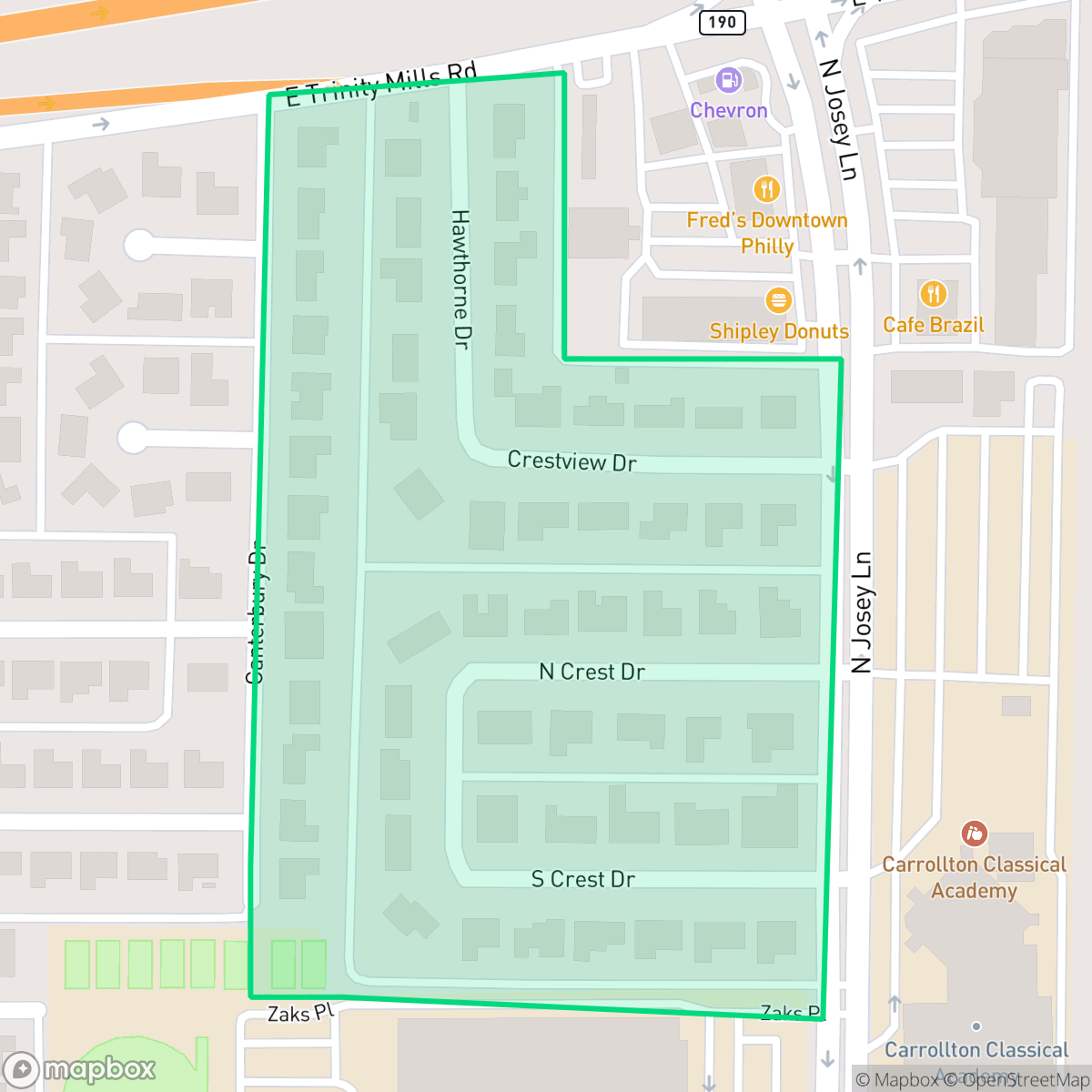
About Trinity Mills
Originally settled in 1853 on A.W. Perry’s land grant, Trinity Mills began as a small community centered around a gristmill established by Perry and Wade H. Witt. The mill, initially powered by oxen on a treadwheel and later upgraded to steam, became a vital flour supplier in North Texas. With the arrival of the Dallas-Wichita Railroad in 1878, Trinity Mills flourished as a cattle-shipping and agricultural hub, complete with a school, churches, and a post office. However, as rail lines shifted and residents relocated to nearby Carrollton, the population dwindled, leading to its eventual annexation. Today, the historic site is commemorated near the Duck Duck Goose Pond and Park, while the neighborhood has evolved into a major transit-oriented development hub centered around the Trinity Mills DART Station.
The neighborhood serves as a primary transit hub in Carrollton, characterized by its high walkability and immediate proximity to the DART light rail system. It maintains a distinct urban character that balances residential spaces with active transit corridors, offering residents convenient access to regional commuting options. The area is well-served by the Carrollton-Farmers Branch Independent School District, which is recognized for its stable academic performance and commitment to facility modernization.
Prospective residents should note that the neighborhood is subject to elevated noise levels from surrounding road traffic, which may impact acoustic comfort. Despite these auditory trade-offs, the area offers high levels of health insurance coverage and reliable flood safety, making it a practical choice for those prioritizing connectivity and infrastructure. The environment is best suited for commuters and individuals who value pedestrian-friendly access to public transit and regional amenities.
Neighborhood Scores Across 15 Qualities
Homes are situated with moderate spacing and small yards that provide some buffer between neighbors. This level of density is slightly higher than the Carrollton average according to iHuus data.
Extensive sidewalk networks and dedicated greenbelt trails provide superior pedestrian connectivity compared to the Carrollton average. Residents can easily navigate residential streets and nature paths via well-maintained crossings and pedestrian-priority zones.
Large homes with complex rooflines and private pools create an aesthetically pleasing environment that is more visually polished than the Carrollton average. According to iHuus data, the presence of premium amenities and spacious driveways contributes to a highly manicured appearance throughout the area.
Large central parks with connected trails and green buffers provide safe walking areas for pets. This level of accessibility is slightly below the Carrollton average according to iHuus data.
Residential areas feature a blend of dense suburban developments and pockets of open land. This balance of housing and greenery is largely consistent with the typical landscape found across Carrollton.
Local amenities and dining options provide a level of activity that is higher than the Carrollton average. While some areas near Ward Steenson Park remain quiet and suburban, other pockets offer accessible-to-foot restaurants and entertainment venues.
Frequent sounds from nearby railroad tracks and major freeways characterize the area. According to iHuus data, acoustic comfort levels in Trinity Mills are lower than the Carrollton average.
Air quality levels fluctuate between acceptable and unhealthy, presenting occasional concerns for sensitive groups. This neighborhood experiences slightly lower air quality than the Carrollton average, according to iHuus data.
Residential and light commercial zones comprise the entire area, with no detectable warehouses or industrial hazards. This lack of heavy industry makes the neighborhood even more secluded from industrial activity than the Carrollton average, according to iHuus data.
Health insurance access is relatively high here, performing slightly above the Carrollton average according to iHuus data.
Political leanings in this area trend more liberal than the Carrollton average, according to iHuus data.
A balanced mix of young adults, families, and older residents characterizes the area, reflecting a demographic spread slightly more varied than the Carrollton average according to iHuus data.
Flood safety levels in this area are roughly comparable to the Carrollton average. According to iHuus data, a detailed FEMA study for this specific neighborhood has not yet been completed.
Address-Level Insights for Trinity Mills


iHuus Neighborhood Intelligence Insights
Get address-level neighborhood insights for Trinity Mills
- Street-level scores — see how individual blocks compare, not just neighborhood averages
- Micro-zone boundaries — identify quiet pockets, flood boundaries, and walkable clusters before you visit
- 15 dimensions in full — walkability, noise, air quality, school quality, insurance coverage, population age profile, urban/rural index, and more
- Boundary risk alerts — know if your address sits near a block boundary where scores drop, the kind of detail no listing will ever mention
- School insights — individual school ratings and insights, not just district-level data
- Compare before you commit — side-by-side data across neighborhoods, down to block precision
No credit card required
Compare with Any Neighborhood
| Dimension | Trinity Mills | Bel Air of Josey Ranch |
|---|---|---|
| 🚶 Walkabilityavg 9.01 | ||
| 🔊 Acoustic Comfortavg 4.24 | ||
| 🤫 Privacy Indexavg 5.73 | ||
| 🎨 Visual Appealavg 7.3 | ||
| 🐕 Dog Friendlinessavg 7.81 | ||
| 🗺️ Urban-Rural Indexavg 6.62 | ||
| ✨ Neighborhood Vibeavg 4.47 | ||
| 🏥 Health Insurance Coverageavg 6.84 | ||
| 🌿 Air Qualityavg 4.71 | ||
| 🏭 Industrial Proximityavg 8.68 | ||
| 🌊 Flood Safetyavg 4.8 | ||
| 🗳️ Ideological Leanavg 5.75 | ||
| 👥 Population Age Profileavg 4.79 | ||
| 🔥 Fire Safety | ||
| 🏫 School Quality |
Trinity Mills Rankings
School Districts Serving Trinity Mills
School Insights for Trinity Mills
Below average outcomes; significant attendance and academic challenges.
School Insights
See what's really behind every school rating near Trinity Mills
- Individual school ratings — each school's own score with outcome context, not just a district average
- Enrollment & class size data — student-to-teacher ratio and how it compares to the state average
- Full demographics breakdown — ethnicity and gender composition for every school in the enrollment zone
- Every school in the district — all schools within the enrollment boundary ranked by rating, not just the closest one
- Grade levels & benchmarks — elementary through high school, with below/above state-average flags
No credit card required